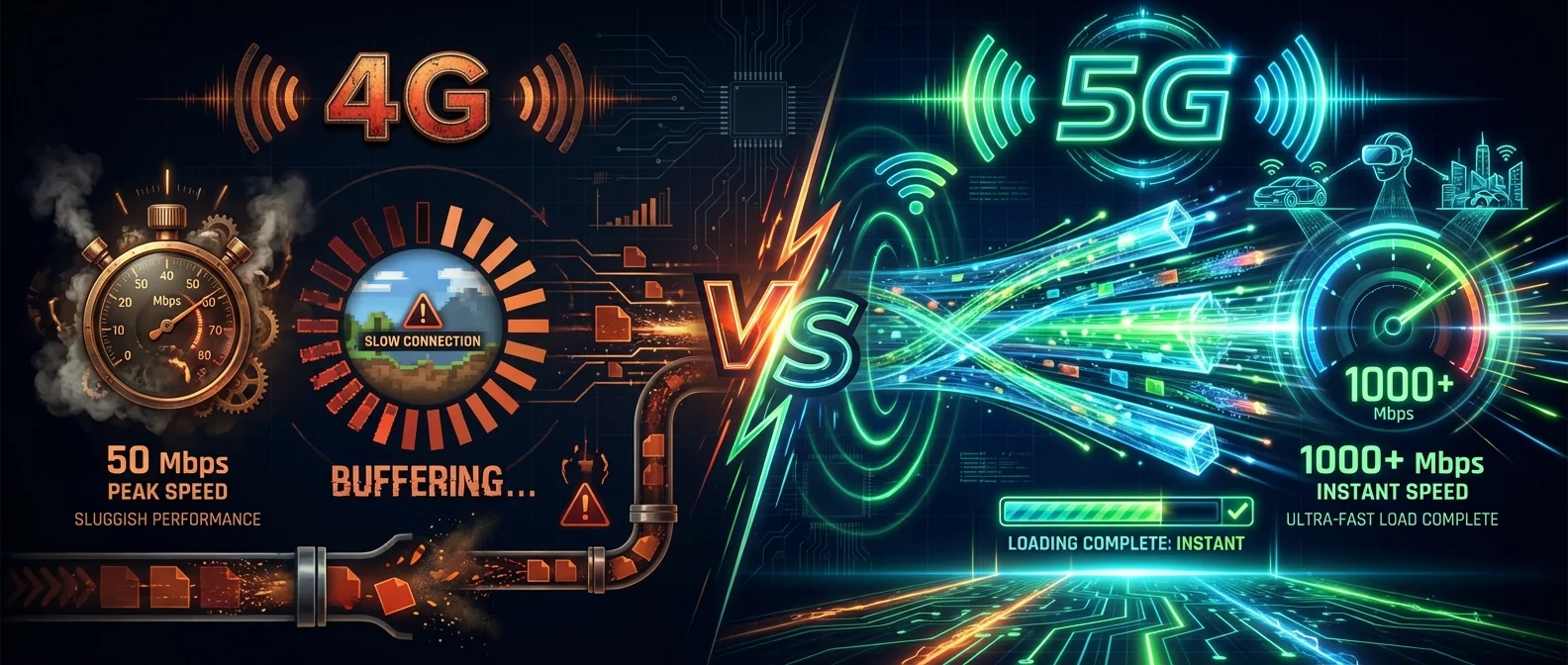
5G isn't just “faster 4G.” It's an entirely different network architecture that fundamentally changes how we use mobile devices. But how much real-world difference does it actually make? We measured, compared, and compiled the real numbers — no marketing hype, just facts.
📖 Read more: Nova Fiber: Prices, Plans & Availability
What Actually Changes with 5G?
The jump from 4G to 5G isn't just about download speeds. 5G introduces three fundamental improvements: massive bandwidth (eMBB), ultra-low latency (URLLC), and massive device connectivity (mMTC). This means 5G doesn't just improve speed — it transforms the entire mobile experience.
📖 Read more: iSIM: The Technology After eSIM
📊 The Numbers at a Glance
- 5G theoretical peak: 20 Gbps download / 10 Gbps upload (ITU IMT-2020 standard)
- Practical 5G average: 200–600 Mbps download (varies by country)
- Fastest 5G recorded: 5.9 Gbps — Faroese Telecom/Ericsson (2023)
- Practical 4G average: 5–100 Mbps download
- 5G latency: 8–12ms (air) vs 30–50ms on 4G
These aren't theoretical lab scenarios. They reflect real measurements from commercial networks, from South Korea to Greece. Let's break down the comparison.
Speed Comparison: 4G vs 5G
The table below shows a real-world comparison — not the theoretical maximums carriers love to advertise:
📶 Download Speeds — Real-World Measurements
| Metric | 4G LTE | 5G (Sub-6 GHz) | 5G (mmWave) |
|---|---|---|---|
| Theoretical Peak Download | 1 Gbps | 10 Gbps | 20 Gbps |
| Practical Avg Download | 15–50 Mbps | 200–600 Mbps | 1–4 Gbps |
| Upload (Practical) | 5–25 Mbps | 30–100 Mbps | 100–500 Mbps |
| Latency (End-to-End) | 30–50 ms | ~30 ms | 8–15 ms |
| Cell Tower Range | Up to 30 km | 1–5 km | 50–300 m |
| Building Penetration | Good | Moderate | Very poor |
| Users per Cell | ~2,000 | ~1,000,000 | ~1,000,000 |
FR1 vs FR2: The Two “Flavors” of 5G
Not all 5G is created equal. There are two main frequency ranges, and they behave very differently:
📡 5G Frequency Ranges
| Characteristic | FR1 (Sub-6 GHz) | FR2 (mmWave, 24–71 GHz) |
|---|---|---|
| Speed | 10–1,000 Mbps | Multi-Gbps |
| Coverage | Wide (kilometers) | Very short (meters) |
| Obstacles (walls, trees) | Handles well | Easily blocked |
| Deployment in Greece | Primary rollout | Pilot only |
| Improvement vs 4G (NSA) | 15–50% higher throughput | 10–100x higher |
In Greece, carriers almost exclusively use FR1 (Sub-6 GHz). This delivers 200–600 Mbps with solid coverage — quite impressive compared to 4G's typical 15–50 Mbps range.
📖 Read more: WiFi Calling Greece: Calls Over WiFi
Latency — The Change That Matters Most
If there's one metric where 5G truly shines, it's latency — the network's response time. The improvement is dramatic:
⏱️ Latency Comparison
| Latency Type | 4G LTE | 5G | Improvement |
|---|---|---|---|
| Air Latency | 15–30 ms | 8–12 ms | ~60% reduction |
| End-to-End | 30–50 ms | ~30 ms | ~40% reduction |
| With Edge Server | — | ~14 ms round-trip | New capability |
| Jitter (with Edge) | 5–15 ms | ~1.8 ms | ~85% reduction |
For everyday users, the biggest difference shows in gaming and video calls. On 4G, a 40–50ms ping can cause noticeable lag in competitive games. On 5G, sub-15ms ping delivers an experience nearly identical to wired fiber connections.
Real-World Applications: What Changes in Practice
The numbers are impressive, but how do they translate into daily use? Here's what the upgrade actually means:
Video Streaming
- 4G: Steady 1080p, 4K with buffering
- 5G: Buffer-free 4K, 8K possible
- 2-hour movie (5GB): 4G ~8 min, 5G ~40 seconds
Cloud Gaming
- 4G: Difficult, 50–80ms lag, stuttering
- 5G: Smooth gameplay, ~15ms latency
- Xbox Cloud, GeForce Now: AAA titles on your phone
Video Calls & Remote Work
- 4G: HD 720p, image breakup while moving
- 5G: Full HD 1080p, stable even on the go
- Zoom/Teams: no freezing, even in group calls
Downloads & Updates
- 4G: 1GB app update → 2–5 minutes
- 5G: 1GB app update → 10–20 seconds
- iOS/Android update (5GB): 5G → ~1 minute
Uploads & Content Creation
- 4G: 1-min 4K video upload → 2+ minutes
- 5G: Same upload → 15–30 seconds
- 4K live streaming: only practical on 5G
Specialized Applications
- Telemedicine: real-time high-resolution imaging
- AR/VR: smooth experience, no motion sickness
- IoT: thousands of sensors per square kilometer
📖 Read more: 5G Gaming: Can It Replace WiFi?
5G in Greece vs the World
How does Greece stack up against the rest of the world? Here's the real data:
🌍 Average 5G Speeds by Country/Carrier
| Country / Carrier | Avg 5G Speed | Peak Speed | Cities |
|---|---|---|---|
| 🇰🇷 South Korea | ~430 Mbps | 2+ Gbps | Nationwide |
| 🇺🇸 T-Mobile (USA) | ~186 Mbps | 1+ Gbps | 300+ |
| 🇬🇷 Cosmote (Greece) | 350–600 Mbps | >1 Gbps | 68+ cities |
| 🇬🇷 Vodafone Greece | 300–500 Mbps | ~900 Mbps | 45+ cities |
| 🇬🇷 Nova (Greece) | 250–450 Mbps | ~800 Mbps | 35+ cities |
| 🇫🇴 Faroese/Ericsson (Record) | — | 5.9 Gbps | Test |
🇬🇷 5G in Greece — What You Need to Know
- Cosmote: Coverage leader with 68+ cities, averaging 350–600 Mbps, peak over 1 Gbps
- Vodafone: Rapid expansion to 45+ cities with competitive speeds
- Nova: 35+ cities with affordable 5G plans
- Greece primarily uses FR1 (Sub-6 GHz) — a solid balance of speed and coverage
- Greece's average 5G speed is remarkably competitive globally — close to South Korea!
5G Small Cell Coverage Hierarchy
5G requires more base stations than 4G due to higher frequencies. Here's how the cell hierarchy works:
📡 5G Cell Types
| Type | Range | Use Case |
|---|---|---|
| Femto Cell | ~50 meters | Homes, offices |
| Pico Cell | ~100 meters | Shopping malls, airports |
| Micro Cell | 200–500 meters | Urban areas, streets |
| Macro Cell | 300–1,000 meters | Wide coverage, main towers |
Is Upgrading to 5G Worth It?
The answer depends entirely on your usage patterns. Here's a practical breakdown:
Worth It If...
- You cloud game or stream 4K content on the go
- You work remotely with frequent video calls while mobile
- You rely on mobile hotspot as your primary connection
- You regularly upload large files (creators, photographers)
- You live in a city with 5G coverage
Can Wait If...
- You primarily use Wi-Fi at home and work
- Your usage is mainly social media and email
- Your area doesn't have 5G coverage yet
- Your current 4G plan works perfectly fine
- You're not ready to upgrade your phone yet
💡 Pro Tip
Before signing up for a 5G plan, check your carrier's 5G coverage map for the areas where you live and work. Cosmote, Vodafone, and Nova all offer online coverage maps. If your area doesn't have 5G yet, there's no rush — 4G+ remains excellent for the vast majority of use cases.
📖 Read more: 5G Greece 2026: Coverage Map & Speed Tests
The Future: 5G-Advanced and Beyond
The evolution doesn't stop here. 5G-Advanced (5.5G), defined in 3GPP Release 18, promises significant leaps forward:
🔮 Mobile Network Evolution
| Technology | Download Speed | Latency | Timeline |
|---|---|---|---|
| 4G LTE | 15–50 Mbps | 30–50 ms | 2010–present |
| 4G LTE-A | 50–100 Mbps | 20–40 ms | 2014–present |
| 5G (current) | 200–600 Mbps | 8–30 ms | 2020–present |
| 5G-Advanced (5.5G) | 1–10 Gbps | 1–5 ms | 2025–2028 |
| 6G (estimated) | 100+ Gbps | \<1 ms | 2030+ |
5G-Advanced will bring AI-driven network management, even lower latency, and speeds approaching 10 Gbps in real-world conditions. In Greece, a gradual rollout is expected starting late 2026.
The Bottom Line
5G isn't just marketing — the differences are real and measurable. Download speeds 10–40x faster, latency reduced by over 60%, and the ability to connect hundreds of thousands of devices per square kilometer.
In Greece, with Cosmote delivering 350–600 Mbps averages, the country already enjoys globally competitive 5G performance. If you live in a covered area and your usage demands it, upgrading is worth it. Otherwise, don't worry — 4G will continue to serve most users exceptionally well for years to come.