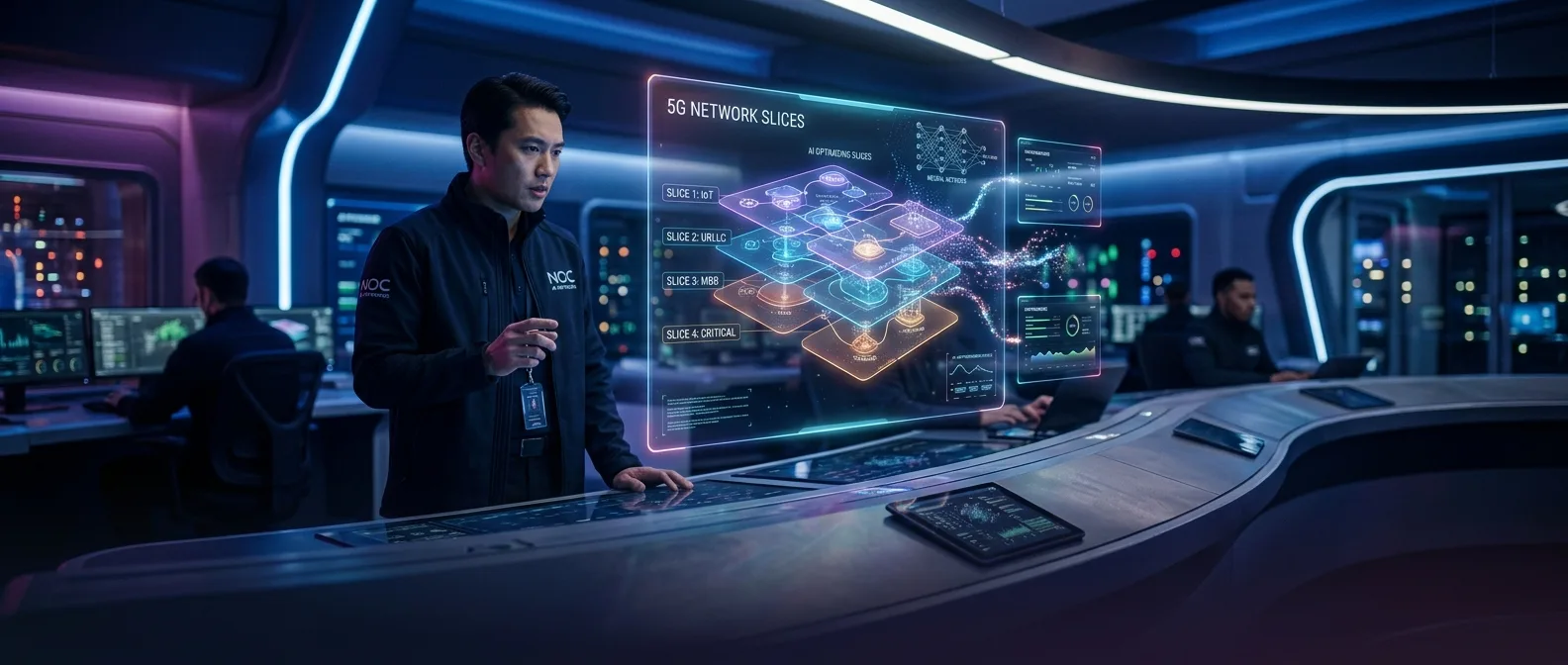
Six AI agents sit around a virtual table, haggling over bandwidth like traders on Wall Street. This scene from MWC 2026 shows how fast 5G networks are evolving. Instead of technicians spending hours tweaking parameters, machines negotiate among themselves which app gets more bandwidth right now.
Orange and du became the first carriers to adopt Nokia's AWS-powered solution for autonomous network slicing with artificial intelligence. The result? Networks that "understand" what's happening around them — from concerts to disasters — and adapt automatically. This technology is operational today.
Somewhere between static network configuration and futuristic autonomy, we've hit an inflection point. Network slicing — the ability to create virtual "sub-networks" within 5G infrastructure — meets generative AI and produces something entirely different.
🤖 Agentic AI: When Networks Think for Themselves
The word "agentic" sounds like science fiction, but it describes exactly what's happening. Instead of traditional AI models that give static answers, agentic AI involves software agents that make decisions, negotiate with each other, and adapt to conditions.
In Nokia's new solution with Amazon Web Services, these agents access data from everywhere. Not just network KPIs but open sources: weather, traffic, events, maps, even social media trends.
The difference from the past? Previously, a network slice had static parameters. Now it changes dynamically based on context. Raining downtown and people staying indoors? AI boosts indoor slices for streaming. Concert at the stadium? It automatically negotiates extra bandwidth for VIP areas.
Amazon Bedrock — AWS's foundation AI platform — orchestrates this entire process. The agents work in different modes: chatbot for ad-hoc queries, on-demand for emergencies, scheduled for planned events, and autonomous for continuous optimization.
📊 Three Scenarios That Change the Game
We're not talking theoretical applications. Nokia and AWS gave specific examples already working in their partners' networks.
Enterprise Slicing with Guaranteed SLAs
First, enterprise networks. In industrial spaces, hospitals, ports, AI monitors live KPIs like latency and bitrate. If a critical IoT application or robot arm needs guaranteed connectivity, the system automatically redistributes resources.
The difference? Instead of "best effort" connection, every slice becomes a guaranteed service. If the manufacturing control system requires zero packet loss, AI applies appropriate QoS policies without human intervention.
Emergency Response and Critical Services
Second scenario: emergencies. AI analyzes data from multiple sources and activates dedicated slices for first responders and security forces. Even if the network is overloaded, emergency services maintain quality of service.
Simultaneously, the system protects premium services for VIP customers — gaming, streaming, XR applications — by adjusting resource allocation automatically.
Mass Events and Predictive Scaling
Third, scheduled events. Concert at the arena, game at the stadium. AI analyzes historical data from similar events, "predicts" patterns and prepares slicing policies for specific zones.
VIP viewing, payment apps, fan engagement, video broadcasting — everything gets the resources it needs before the event even starts. What was manual configuration becomes predictive automation.
⚡ Intent-Based Networking: When You Talk to Networks in Plain English
Meanwhile, Ericsson works its own approach with the "Ericsson Operations Engine." Here the emphasis is on intent-based management — being able to tell the network what you want to achieve, not how to do it.
Instead of configuring thousands of parameters, you simply say "I want latency under 5ms for this application in the factory floor." AI translates this business requirement into technical settings across RAN, core and transport layers.
"This allows us to scale the network without additional cost, something essential to make 5G affordable and available for consumers and businesses."
Ken Tan, CTO of Digital Nasional Berhad (Malaysia)
Malaysia's DNB already uses this technology to manage the competing needs of six different operators sharing the same multi-operator core network. AI agents automatically balance each operator's requirements without degrading end-user experience.
💼 From Factory to Hotel: Real-World Deployments
Telefónica and Madrid's Hotel Meliá Serrano provide a concrete example. Here we've seen how network slicing works in practice — not in lab conditions but in a real hospitality environment.
Separate Networks for Guests and Operations
The logic is simple: visitors connect to a 5G slice separate from the hotel's internal systems. Guest streaming, video calls, social media don't affect critical services — home automation, energy management, security, POS systems.
The deployment started with 5G Non-Standalone (NSA) and evolved to Standalone (SA) to prove you can split the network into multiple segments that create and manage resources dynamically.
Imagine the same scenario in malls, airports, conference centers. Instead of one massive "shared" network that crashes during peak hours, each tenant — stores, restaurants, services — can have guaranteed connectivity quality.
Logistics and Smart Cities: The Next Application Zone
In ports and logistics hubs, AI-powered slicing separates traffic from autonomous vehicles, traffic management systems and passenger services. One high-reliability slice for V2X communications with ultra-low latency, another for signaling and monitoring, a third for onboard WiFi.
In smart cities, slices divide public safety, traffic lights, video surveillance, energy management. Emergency services enjoy top priority slice, while less critical applications coexist in separate segments.
Technical Architecture
5G Core Standalone with NSSF for slice selection, UPF instances per slice, Nokia AirScale with MantaRay SMO for RAN orchestration.
AI Orchestration
Amazon Bedrock foundation models, EKS hybrid nodes for cloud-edge deployment, APIs for real-time coordination.
🔮 2026: The Year Networks Become Products
What we're seeing in 2026 is more than technical improvement. Network slicing combined with AI transforms networks from infrastructure into programmable products.
Instead of "one network for everyone," providers can sell customized services with guaranteed SLAs. A logistics company can buy "zero-latency connectivity for warehouse automation." A hospital "guaranteed availability for telesurgery." A gaming studio "dedicated bandwidth for cloud gaming tournaments."
The business model changes radically. From flat-rate subscription in the traditional way, we move to value-based pricing with measurable outcomes. This becomes feasible through AI agents' ability to monitor and ensure specific performance levels automatically.
Challenges That Remain
Not everything is rosy. Complexity increases exponentially when you have dozens of interacting slices. AI models need continuous training with new data to avoid becoming disconnected from reality. And there's the issue of interoperability between vendor solutions.
Also, the regulatory landscape hasn't caught up with developments. How do you regulate autonomous networks that make decisions without immediate human oversight? What happens when an AI agent makes a mistake and disrupts critical services?
🎯 Frequently Asked Questions
What's the difference between agentic AI and traditional AI models in networks?
Traditional AI models give recommendations that the network administrator implements. Agentic AI agents make decisions and execute them automatically, negotiating among themselves for optimal resource allocation. It's the difference between an "advisor" and an "autonomous manager."
How secure is AI-managed network administration?
Isolation between slices ensures that a security incident in one slice doesn't affect others. However, AI agents represent a new attack surface that needs special protection. Providers implement multi-layer security with encrypted APIs, access control and continuous monitoring of agent actions.
Can small and medium businesses leverage this technology?
Yes, through managed services from providers. Instead of investing in their own infrastructure, they can buy customized slices with guaranteed SLAs for their applications — from POS systems to real-time inventory management. AI makes these services scalable and affordable.
AI-powered network slicing doesn't just change how networks work — it changes what "network" means. From passive infrastructure that moves bits, it becomes an active, adaptive system that "understands" needs and acts accordingly. The question isn't whether it will happen, but how quickly we'll see it everywhere around us.