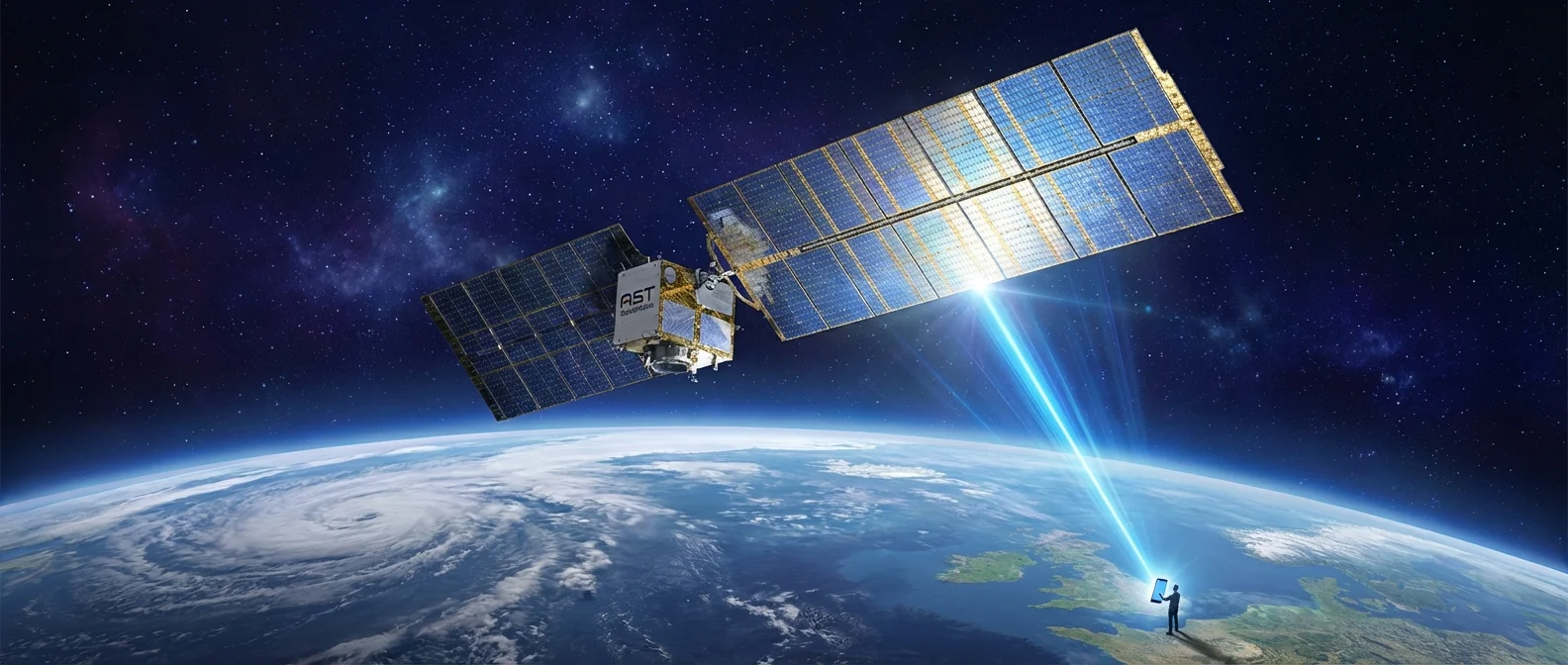
Picture yourself in the middle of the ocean, on a remote mountain peak, or on a tiny island with zero cell coverage — and your phone picks up a full 5G signal. No satellite dish, no special handset, no modifications whatsoever. That is exactly what AST SpaceMobile promises: satellite 5G broadband beamed directly to the smartphone already in your pocket. In this deep dive, we break down how the technology works, what has been achieved so far, and when you can expect to use it.
📖 Read more: Non-Terrestrial Networks: Connectivity Beyond Earth
What Is AST SpaceMobile?
AST SpaceMobile was founded in 2017 by Abel Avellan and is headquartered in Midland, Texas. The company's goal sounds almost impossibly ambitious: build a constellation of low-Earth orbit (LEO) satellites capable of delivering standard broadband — 4G and 5G — directly to ordinary, off-the-shelf smartphones without any hardware modifications.
Unlike Starlink, which requires a dedicated dish and router, or Apple's satellite SOS feature that only handles emergency text messages, AST SpaceMobile is designing a full-blown mobile network in orbit. Voice calls, video calls, streaming, data — everything through satellite, on a regular Samsung or iPhone.
The approach is called direct-to-cell, and it may be the biggest shift in telecommunications since networks jumped from 3G to 4G. Instead of building thousands of towers in every remote corner, a single satellite covers hundreds of square kilometres of terrain — ideal for the vast stretches of the planet that still have no mobile coverage at all.
Why Direct-to-Cell Matters
By some estimates, roughly 5 billion people live in or travel through areas with no mobile coverage. Oceans, mountains, deserts, rainforests — the gaps in cellular networks are enormous. AST SpaceMobile aims to fill those gaps with satellites instead of towers, without asking users to switch devices or carriers.
BlueWalker 3: Where It All Began
The first major milestone came in September 2022 with the launch of BlueWalker 3 — a full-scale test satellite. BlueWalker 3 was no ordinary small-sat: its antenna array unfolds to 64 square metres, making it the largest commercial communications array ever deployed in low-Earth orbit. That enormous surface area is critical — it has to pick up the weak signals from everyday phones that were never designed with satellite communication in mind.
The test results blew past expectations. On April 25, 2023, AST SpaceMobile placed the first-ever two-way phone call from space using unmodified smartphones — a Samsung Galaxy S22 and an iPhone. It was a world first that proved the concept was not theoretical but real.
More records followed in quick succession: the first 4G and 5G satellite connectivity with download speeds up to 21 Mbps. The first 5G voice call from space, with a staff member in Hawaii ringing a Vodafone employee in Madrid. And the first video call via space between ordinary smartphones. Every single one of these was a global first.
The BlueBird Satellites: Going Commercial
With BlueWalker 3 tests validated, AST SpaceMobile moved to the next phase: commercially operational BlueBird satellites. On September 12, 2024, the first five BlueBird satellites (1-5) launched, and by October 25, 2024 all five had fully deployed their antenna arrays in orbit — forming the core of the first commercial constellation.
The story continued with BlueBird 6, which launched on December 24, 2025 aboard India's ISRO LVM3 rocket. Weighing in at 6,100 kg, it was the heaviest payload the LVM3 had ever carried — a testament to just how massive and powerful these satellites are.
Block 2 BlueBird: The Next Generation
AST SpaceMobile is not stopping at the first-generation BlueBirds. The company is developing Block 2 BlueBird satellites — a new generation with dramatically enhanced capabilities:
- 223 m² antenna arrays: Nearly 3.5 times larger than BlueWalker 3, delivering a much stronger signal to handsets.
- Speeds up to 120 Mbps: Almost six times faster than BlueWalker 3's 21 Mbps — enough for HD streaming and video calls.
- Up to 60 satellites: The goal is to launch 60 Block 2 units for meaningful global coverage.
All told, AST SpaceMobile estimates that roughly 90 satellites are needed for continuous worldwide coverage — a far cry from Starlink's thousands of spacecraft, thanks to each satellite's vastly larger antenna footprint.
Strategic Partnerships
What makes AST SpaceMobile particularly credible is not just the technology — it is the partners backing it. The roster leaves little room for doubt:
- AT&T: America's largest mobile carrier — a strategic deal to plug dead zones across rural America.
- Verizon: A $100 million deal (roughly €93 million) signed in May 2024 — the second-largest US carrier trusting AST SpaceMobile with satellite coverage.
- Vodafone: A commercial contract running through 2034 — Vodafone will offer satellite coverage to its subscribers across Europe and Africa via AST SpaceMobile.
- Google: An Android integration agreement (January 2024) — satellite connectivity will work natively on Android smartphones.
- Nokia: A five-year contract for 4G/5G infrastructure — Nokia supplies the radio-access equipment running on the satellites.
The significance is enormous: you will not need to change your carrier or your phone. Satellite coverage will be embedded in existing networks and activate automatically when there is no terrestrial signal.
Funding & Recognition
- The company has raised over $2 billion (roughly €1.85 billion) as of Q2 2025.
- Saudi Arabia's stc group signed a $175 million prepayment (roughly €162 million) in October 2025.
- Named a Time Magazine Best Invention of 2025 — global recognition of the technology's significance.
How It Compares to Starlink & Competitors
AST SpaceMobile is not the only company working on satellite internet, but its approach is fundamentally different. Here is how the three main options stack up:
Satellite Service Comparison
| Feature | AST SpaceMobile | Starlink | Apple / Globalstar |
|---|---|---|---|
| Special equipment needed | No — regular phone | Yes — dish + router | Partially — iPhone only |
| Connection type | Full 4G/5G broadband | Broadband internet | SOS / messages only |
| Speeds | Up to 120 Mbps (Block 2) | 100-200 Mbps | Very low |
| Voice calls | Yes | Via VoIP | No |
| Mobility | Full — phone in your pocket | Fixed — home, boat | Mobile (iPhone) |
| Satellites needed | ~90 for global coverage | ~12,000+ already orbiting | ~24 Globalstar |
The advantage is crystal clear: you need nothing extra. No dish, no equipment, no special app. Your phone connects to the satellite exactly the way it would connect to a cell tower — automatically and invisibly. That changes the equation completely: instead of buying Starlink kit for over €500, you simply activate an add-on on your existing mobile plan.
Timeline: Key Milestones
AST SpaceMobile's journey reads like a rapid-fire series of breakthroughs:
- 2017: Founded by Abel Avellan in Midland, Texas — the idea of satellite broadband to regular phones sounds like science fiction.
- September 2022: BlueWalker 3 launches — its 64 m² antenna is the largest commercial comms array in LEO. The world starts paying attention.
- April 25, 2023: First-ever two-way phone call from space on unmodified smartphones (Galaxy S22, iPhone) — a world first.
- 2023: First 5G connectivity, first 5G voice call (Hawaii → Madrid), first video call via space — a triple record.
- January 2024: Google deal for native Android integration — satellite will be baked into the OS.
- May 2024: Verizon signs a $100 million deal (roughly €93 million) — a massive vote of confidence.
- September 2024: BlueBirds 1-5 launch — the first commercial satellites reach orbit.
- October 2024: All five BlueBirds fully deploy their arrays by month's end.
- October 2025: stc group (Saudi Arabia) signs a $175 million prepayment (roughly €162 million).
- 2025: Time Magazine Best Inventions award. Total funding surpasses $2 billion.
- December 24, 2025: BlueBird 6 launches on ISRO LVM3 — at 6,100 kg, the rocket's heaviest payload ever.
What It Means for Europe & Beyond
Countries with extensive coastlines, scattered islands, and mountainous terrain stand to benefit the most from direct-to-cell technology. Consider the advantages:
- Island coverage: Dozens of small islands with weak or non-existent mobile signal could gain full 5G coverage without installing a single new tower.
- Maritime: Shipping fleets — including some of the world's largest — would gain cellular coverage at sea without any specialist hardware.
- Mountain areas: Remote highland villages currently off the grid could connect instantly.
- Tourism: Millions of travellers on beaches and hiking trails would have a reliable signal even in the most remote spots.
- Emergencies: When earthquakes, wildfires, or floods knock out cell towers, satellite coverage stays up — critical for first responders.
The partnership with Vodafone — one of Europe's largest carriers — running through 2034 means satellite coverage could be integrated into standard Vodafone plans across Europe. If you are a Vodafone subscriber, you may soon see a satellite option appear in your phone's settings.
Under the Hood: How It Works
The technology behind AST SpaceMobile is highly complex, but the core idea is straightforward: each BlueBird satellite works like a cell tower in space. Its phased-array antenna generates narrow signal beams focused on specific ground areas, forming “cells” — exactly the way a roadside base station does.
Phones see the satellite as a standard base station, requiring no special firmware or hardware. The connection uses standard 3GPP protocols (4G LTE and 5G NR), meaning any smartphone supporting those standards can theoretically connect. The satellite then relays traffic to ground-based gateways, bridging the user to the terrestrial network.
The enormous antenna (64 m² on BlueWalker 3, 223 m² on Block 2) is essential because regular smartphones transmit at very low power — you need an extremely large and sensitive antenna to “hear” a phone from more than 700 km up in space.
Challenges & Open Questions
AST SpaceMobile faces significant hurdles that must be cleared before the service can reach millions of users:
- Launch costs: Each satellite costs tens of millions of euros to build and launch — at 90 satellites, we are talking an investment in the billions.
- Capacity: Even with 90 satellites, per-cell bandwidth is limited compared to thousands of terrestrial towers — the service is best suited for sparsely populated regions.
- Latency: LEO orbit slashes delay compared to geostationary satellites but still cannot match ground-based networks — expect around 25-35 ms.
- Regulatory hurdles: Using mobile spectrum from space requires agreements with regulators in every country — a lengthy process.
- Light pollution: The giant antenna arrays reflect sunlight, raising concerns among astronomers — AST SpaceMobile is working with NASA on mitigation.
Despite these challenges, progress to date suggests the company is tackling them methodically. Over $2 billion in funding and partnerships with the world's largest carriers signal that the market believes in the venture.
What to Expect in 2026-2028
The next two to three years will be pivotal for AST SpaceMobile. The roadmap includes:
- 2026: Commercial service launch in first markets — initially the US in partnership with AT&T and Verizon, focusing on rural and remote areas.
- 2026-2027: Further launches of Block 2 BlueBird satellites with the larger 223 m² arrays and 120 Mbps speeds.
- 2027: Commercial availability in Europe through Vodafone — potential coverage across southern and island regions.
- 2027-2028: Scaling toward 90 satellites for continuous global coverage.
- 2028+: Full integration into mobile plans — satellite roaming becomes a standard feature.
The Bigger Picture
AST SpaceMobile is not competing with existing networks — it complements them. Think of satellite coverage as a safety net that kicks in automatically whenever there is no ground signal. If every phone on the planet can always connect somewhere — even in the middle of the ocean — the very meaning of “network coverage” changes forever. The era of dead zones is coming to an end.
Conclusion
AST SpaceMobile is one of the most ambitious undertakings in the history of telecommunications. Since its founding in 2017, the company has racked up a string of world firsts — the first phone call, the first 5G link, the first video call, all from space to unmodified smartphones — proving that direct-to-cell technology is no longer science fiction.
Backed by over $2 billion in funding and partnerships with AT&T, Verizon, Vodafone, Google, and Nokia, the company is on a steady march toward commercial operations. For countries with vast maritime and mountainous expanses, the promise is invaluable: 5G everywhere, no dead zones, no special equipment.
The coming years will reveal whether AST SpaceMobile can turn stunning technical demonstrations into a mass-market service. But judging by the pace so far, the day when the words “no signal” disappear from our screens is approaching — and it may arrive sooner than you think.