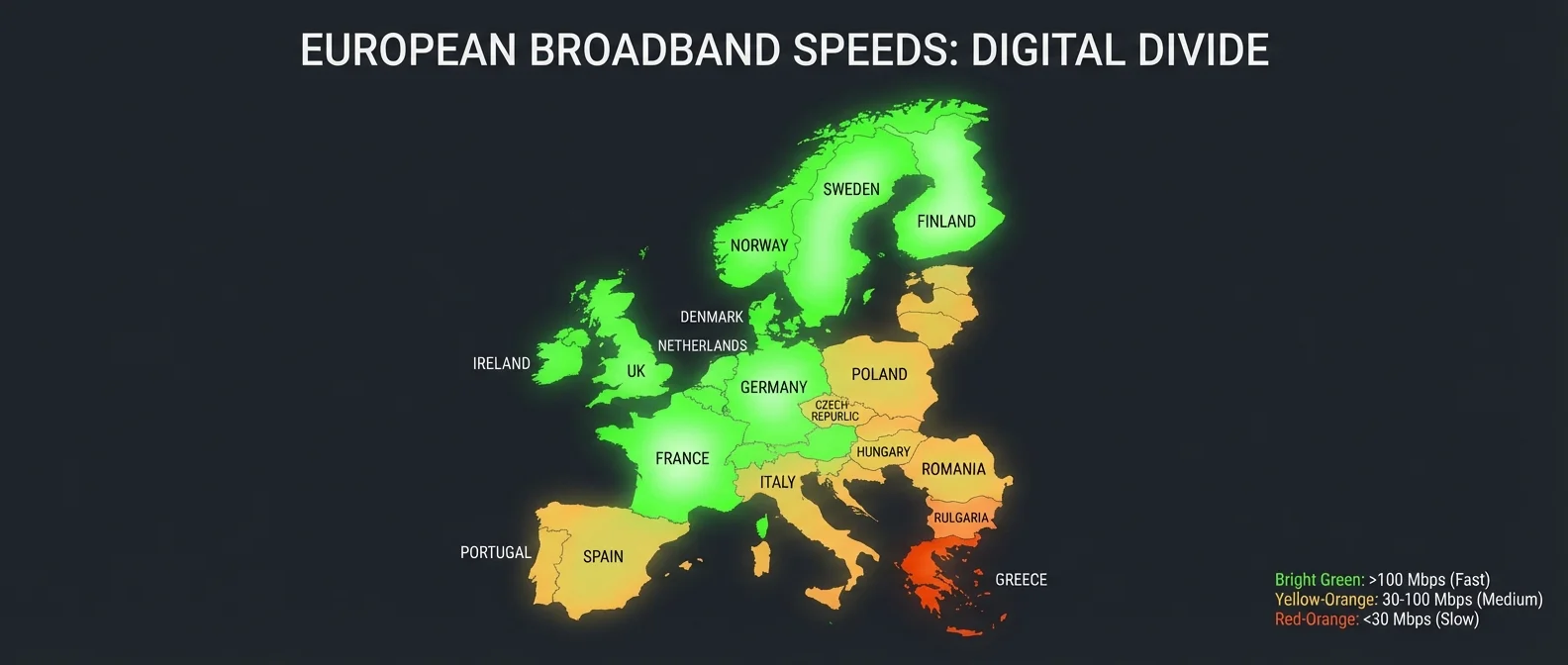
Across most of Europe in 2026, gigabit internet is the norm. In Greece, the average fixed-line speed still hovers below 50 Mbps, fiber-to-the-premises coverage sits at a mere 28%, and millions of households remain tethered to decades-old copper wiring. How did a country that leads the EU in e-government adoption end up so far behind in basic broadband infrastructure — and when will things finally change?
📊 The Numbers That Haunt Us
The data paints a stark picture. According to the DESI (Digital Economy and Society Index) and the Speedtest Global Index, Greece consistently ranks near the bottom of the European Union when it comes to fixed broadband infrastructure. FTTP coverage — meaning actual fiber reaching the home — stands at just 28% of the population, compared to an EU average of 56%. In practical terms, only one in four Greeks has access to a genuine fiber-optic connection.
The picture worsens further when looking at Fixed VHCN (Very High Capacity Network) coverage, where Greece registers 28% against an EU average of 73%. This metric measures the availability of networks capable of delivering at least 100 Mbps downstream with the potential to scale to gigabit speeds. The gap is staggering: nearly three out of four Europeans have access to such networks, while in Greece the figure is fewer than one in three.
When it comes to actual adoption, things are no better. Take-up of fixed broadband at speeds of 100 Mbps or above sits at 20% in Greece, compared to 55% across the rest of the EU. This means that even where fast connections are available, a significant portion of the population isn't using them — whether due to cost, lack of awareness, or simply not seeing the need to upgrade.
The Speedtest Global Index places Greece 92nd worldwide, with an average download speed of just 44.60 Mbps. For context, Romania — a country that was considered a telecom backwater fifteen years ago — now delivers average speeds above 200 Mbps. Spain exceeds 150 Mbps. France, Portugal, even the Baltic states all rank significantly higher. Greece isn't merely lagging behind — it's playing in an entirely different league.
🏗️ How We Got Here: The Story Behind the Numbers
Greece's digital deficit didn't happen overnight. It's the product of several structural problems that compounded over decades. The first and most significant is the country's dependence on its copper network. Rather than pursuing early and extensive fiber deployment, Greece invested heavily in upgrading existing copper lines through VDSL2 and Vectoring technologies. This strategy — which appeared more cost-effective on paper — created the illusion of progress while in reality leading to a technological dead end.
Geography presents a second enormous obstacle. Greece is a country of roughly 6,000 islands (227 of which are inhabited), mountainous terrain covering over 80% of its landmass, and dozens of sparsely populated rural areas on the mainland. Laying submarine cables and trenching through rocky ground costs several times more than rolling out fiber across the flat plains of northern Europe. This doesn't excuse the delays — but it does explain why deployment requires a substantially higher per-capita budget.
Red Tape: The Invisible Enemy
No technical or geographical barrier, however, compares to the bureaucratic burden. For a provider to deploy a fiber network in a single city block in Greece, it needs dozens of permits — from municipalities, ministries, archaeological services (if the area is near a protected zone), and sometimes even ecclesiastical authorities. In many Greek cities, the permitting process for a simple excavation can take twelve months or more. In countries like Romania, the same process is completed in weeks.
The Greek economic crisis of 2010-2018 made everything dramatically worse. During that period, telecom companies froze major investments, public bodies lacked the resources to fund infrastructure projects, and consumers — under severe financial pressure — weren't looking for more expensive connections. Those lost years carried a cumulative cost: while Ireland, Portugal, and Romania were building out their networks, Greece stood still.
A final — but equally critical — factor is market structure. Three providers (Cosmote, Vodafone Greece, and Nova Greece) control the vast majority of the market. Competition exists, but it isn't fierce enough to drive prices down or accelerate rollout timelines. In countries with dozens of local providers — like Romania with its small but remarkably efficient fiber ISPs — competition pushes speeds up and costs down. In Greece, the three-player oligopoly doesn't generate that kind of pressure.
📌 Key Broadband Indicators: Greece vs Europe
- FTTP coverage: Greece 28% — EU 56%
- Fixed VHCN coverage: Greece 28% — EU 73%
- 100 Mbps+ adoption: Greece 20% — EU 55%
- Avg download speed: 44.60 Mbps (92nd globally)
- 5G coverage: 86% (EU 81%) — a rare bright spot
- Mobile broadband: 76% (EU 87%)
- e-Government users: 81% (EU 74%)
🎯 What Greece Is Doing Now: Plans and Investments
Despite these structural weaknesses, the past few years have seen genuine mobilization. Here's a look at the main tools being deployed to close the gap.
SFBB — Super-Fast Broadband
The SFBB (Super-Fast Broadband) program was completed in September 2022 and represented the first major state-backed push. Through it, approximately 140,000 vouchers were distributed to households to subsidize faster internet connections. The goal was to lower the cost of switching for consumers and stimulate demand — because without demand, providers won't invest. The program succeeded insofar as it raised awareness and nudged thousands of households to migrate from ADSL to VDSL or fiber. But 140,000 vouchers in a country with more than 4.5 million households is a drop in the ocean.
UFBB — Ultra-Fast Broadband
More ambitious is the UFBB (Ultra-Fast Broadband) program, targeting 18% of the population — primarily rural and semi-urban areas that aren't commercially served by the three major providers. This involves public funding for FTTH construction in areas where the market wouldn't invest on its own. The logic is straightforward: if Nova won't bring fiber to a village of 500 residents because the economics don't work, the state funds the build and leases the network to providers. Implementation, however, continues to face the classic Greek hurdles: delays, objections, and permitting difficulties.
National Broadband Plan 2021-2027
At the strategic level, Greece's National Broadband Plan 2021-2027 sets the big target: gigabit connectivity for every home and every business. This goal aligns with the EU's Digital Decade framework, which mandates that by 2030, every European household should have access to gigabit internet. To make this a reality, combined public and private investment plans exceed €1.5 billion — an unprecedented figure by Greek standards.
The three major providers have announced their own rollout plans. Cosmote, as market leader, is steadily expanding its fiber footprint in urban centers. Vodafone Greece is investing in GPON infrastructure, while Nova Greece is pursuing an aggressive fiber build-out strategy, particularly in suburban areas. GPON (Gigabit Passive Optical Network) technology delivers 2.5 Gbps downstream, while the next generation — XGS-PON — reaches 10 Gbps symmetric speeds. These numbers may sound futuristic, but the infrastructure being laid today needs to serve the demands of the next decade.
🌍 How Europe Got It Right: Lessons Greece Can Learn
To understand where Greece went wrong, it's worth examining what other European countries did right. Romania is perhaps the most striking example. A country with considerably lower GDP per capita than Greece, Romania today ranks among the top 10 nations worldwide for internet speed. The secret? A highly decentralized model: dozens of small local ISPs built fiber networks neighborhood by neighborhood, competing fiercely on price and speed. Today, a Romanian can get a gigabit fiber connection for under €10 a month.
Spain took an entirely different approach but achieved equally impressive results. The government and regulator created incentives for major providers (Telefónica, Orange, Vodafone) to deploy FTTH on a massive scale across the entire country. Today, Spain boasts one of the world's largest FTTH networks, with coverage exceeding 80% of the population. The key ingredient was an exceptionally fast permitting process — where Greece needs months, Spain needed days.
France invested in a hybrid model, with state funding for rural areas (Plan France Très Haut Débit) and private deployment in urban centers. The result: over 35 million homes with access to FTTH. The common denominator across all successful countries? Political will, fast permitting, and a clear regulatory framework. Precisely the three things Greece has historically struggled with.
🔮 When Will the Gap Close?
If plans hold — and that's a significant “if” — Greece could approach the EU average for FTTH coverage by around 2028-2029. The National Broadband Plan 2021-2027 targets gigabit connectivity, but practical implementation depends on factors no plan fully controls: permitting speed, availability of skilled labor for excavation and installation, weather conditions, and local pushback.
One major development set to reshape Greece's position on the telecom map is the Quantum Cable. This is a 7,700 km submarine cable that will connect Greece, Cyprus, Israel, Italy, France, and Spain, with a capacity of 160 Tbit/s. This won't directly affect the average consumer's download speed — you won't be streaming at 160 Terabit — but it positions Greece as a strategic hub in Mediterranean digital infrastructure. Data centers, cloud providers, and tech companies all seek geographic points with high connectivity, and Greece sits precisely at the crossroads of three continents.
On the technology front, the transition from GPON to XGS-PON will dramatically expand the capabilities of existing fiber networks. While current GPON networks deliver 2.5 Gbps downstream, XGS-PON reaches 10 Gbps symmetric — meaning identical upload and download speeds. This matters enormously for remote work, cloud computing, live streaming, and any application requiring substantial upload bandwidth.
It's worth noting that Greece performs markedly better in mobile: 5G coverage stands at 86%, ahead of the EU average of 81%. This proves the country can compete in digital infrastructure when the right political will and incentives are in place. However, mobile connectivity cannot replace fixed-line service — the bandwidth, latency, and reliability needs of a household or business can only be met by fiber.
Meanwhile, Starlink — available in Greece since Q2 2022 — offers speeds of 150-300 Mbps via satellite. It's a valuable alternative, particularly for remote rural areas and islands, but it can't replace fiber infrastructure in densely populated urban centers. Starlink serves as an effective gap-filler, but the backbone of Greece's digital upgrade must remain FTTH.
💡 What Consumers Can Do Today
If you're a consumer wondering what steps you can take right now, the answer depends on your location. First step: check fiber availability at your address through the websites of the three providers (Cosmote, Vodafone, Nova). If fiber is available, switching is worth it — even if the price is slightly higher than your current VDSL plan.
If fiber isn't available, explore alternatives: VDSL Vectoring (if you're close to a DSLAM), 5G FWA (Fixed Wireless Access — if there's decent 5G coverage in your area), or even Starlink if you're in a remote rural area or on an island. Each solution has trade-offs: VDSL is affordable but speed-limited; 5G FWA is fast but location-dependent; Starlink is available everywhere but costs considerably more.
Regardless of your connection, make sure to measure the actual speeds you're getting. Speedtest.net or fast.com are the standard tools. If your measured speed is significantly below what you're paying for, contact your provider. EETT (the Hellenic Telecommunications and Post Commission) offers comparison tools and complaint mechanisms.
Finally, don't underestimate the importance of your router. Even with a 1 Gbps fiber connection, an outdated router or poor placement can bottleneck your Wi-Fi speeds to under 100 Mbps. Mesh Wi-Fi systems (especially Wi-Fi 6 or Wi-Fi 7) can transform your experience without changing providers.
Greece has a long road ahead in broadband. FTTP coverage at 28%, 92nd place globally in speed, ongoing copper dependence — these paint a picture of a country that missed the digital train when it mattered most. But the tools are there: a national broadband plan, billions in investment, strategic submarine cables, and international pressure through the Digital Decade initiative. What's missing is execution speed — the same speed that, ironically, is also the problem with Greece's internet. If Greek bureaucracy can manage to move at least as fast as a VDSL modem, there may yet be hope.