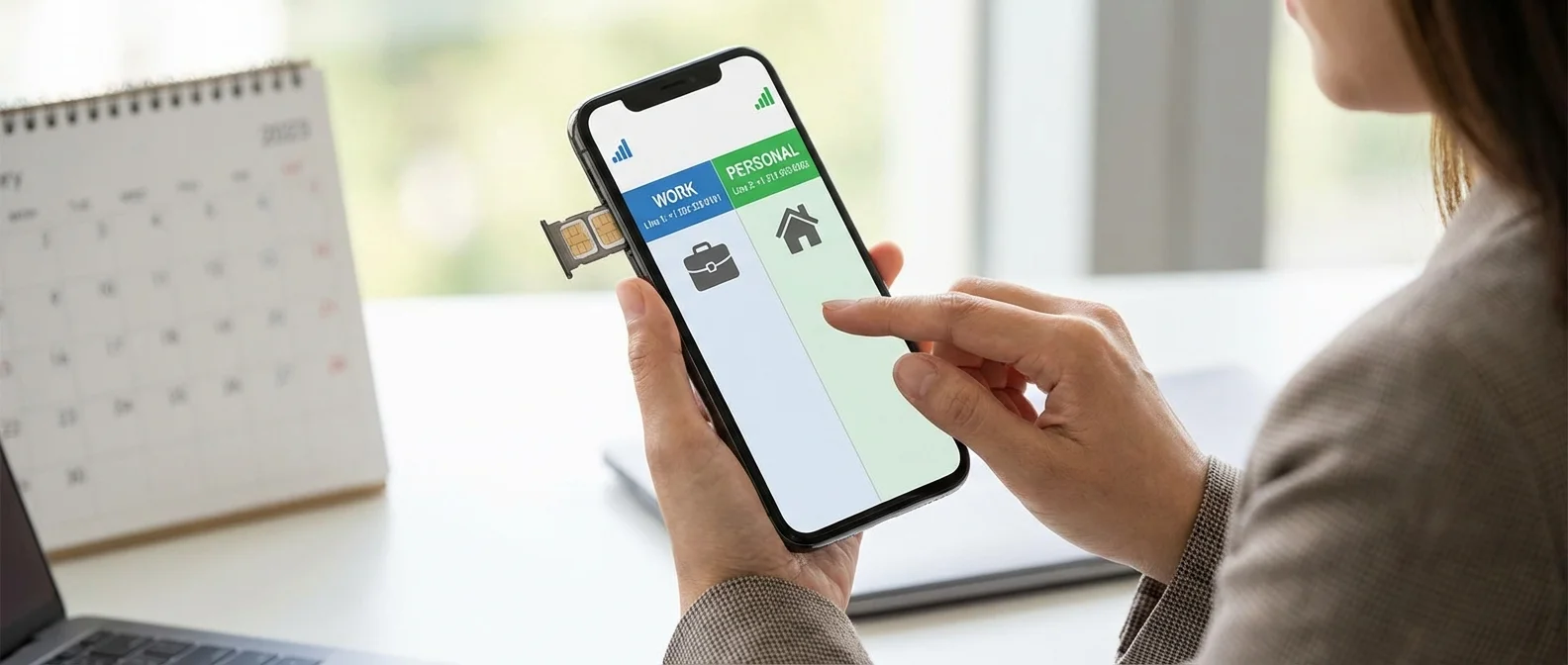
One phone, two numbers. Personal and work. Domestic and international. The concept of dual SIM has been around since 2000 (the Benefon Twin was first), but it's never been as seamless and widespread as it is today — thanks to the combination of physical SIM + eSIM, or even dual eSIM. Here's everything you need to know about how it works, how to set it up, and why it might change the way you use your phone.
📖 Read more: eSIM in Greece 2026: Complete Activation Guide
Dual SIM Types: Key Differences
Not all dual SIM implementations are equal. There are three main types, and the differences between them are significant:
Dual SIM Technology Types
| Type | How It Works | Simultaneous Calls | Pros | Cons |
|---|---|---|---|---|
| Passive Dual SIM | One SIM active at a time, manual switching | No | Very cheap to implement | Miss calls on the inactive SIM |
| DSDS (Dual Standby) | Both SIMs on standby, but only one active call | One at a time | Receive calls on both; most common type | Second SIM drops during a call |
| DSDA (Dual Active) | Two independent modems, fully simultaneous | Yes, simultaneously | No missed calls, full 5G+5G | More expensive, higher battery usage |
DSDS — What It Means in Practice
DSDS (Dual SIM Dual Standby) is the most common type today. Both SIM cards are registered on their respective networks and can receive calls and SMS. However, when you answer a call on one SIM, the other temporarily disconnects — you can't receive a call on the second line at the same time.
In practice, this is rarely a problem. Calls are short, and if someone calls the second line during an active call, they'll get a “no answer” — but it'll show up as a missed call once you hang up.
DSDA — The Premium Experience
DSDA (Dual SIM Dual Active) uses two separate modems, enabling fully simultaneous operation. You can be on a call on one line and receive calls on the other. You can have 5G data on one line and 5G voice on the other — simultaneously.
DSDA is available on premium chipsets: Qualcomm Snapdragon 8 Gen 2+ and MediaTek Dimensity 9000+. It draws more battery (roughly 5–10% extra) but is worth it for professionals who can't afford to miss a call.
Dual SIM Configurations in 2026
The ways you can use dual SIM today:
Physical SIM + eSIM
The most common combo. One nano SIM in the tray, one eSIM digitally. Supported by iPhone XS+, Samsung S21+, Pixel 3a+. Ideal for personal + work separation.
Dual eSIM
Two eSIM profiles active simultaneously. Supported by iPhone 13+ (iOS 16+), Pixel 7+, Samsung S23+. No physical SIM needed at all.
Dual Physical SIM
Two nano SIM slots. Mainly found in Chinese brands (Xiaomi, OnePlus, Realme). Some models use a hybrid tray: SIM or microSD card.
eSIM + Travel eSIM
Keep your home number on eSIM, add a travel eSIM for data abroad. The ideal travel scenario — no roaming, full connectivity.
Setting Up Dual SIM on Popular Devices
iPhone (iOS 16+)
iPhone Dual SIM Setup
- Settings → Cellular: You'll see both lines listed (e.g., “Personal” and “Work”)
- Default line: Choose which line handles calls, messages, and data
- Per-contact assignment: Assign a specific line to individual contacts — mom calls your personal, clients call your work line
- Data switching: Enable “Allow Cellular Data Switching” for automatic data failover between lines
- Dual eSIM: On iPhone 13+, you can run two eSIMs simultaneously with no physical SIM at all
Samsung Galaxy (One UI 4+)
Samsung Dual SIM Setup
- Settings → Connections → SIM Manager: View and manage both SIMs
- Preferred SIM: Set which SIM handles calls, messages, and data
- Wi-Fi Calling: Enable WiFi Calling on each line independently
- Auto data switching: Automatically switch data if one line loses signal
- Samsung Galaxy S21+: eSIM support was added via One UI 4 update (November 2021)
Google Pixel
Pixel Dual SIM Setup
- Settings → Network & Internet → SIMs: Both SIMs displayed
- Preferred SIM: Choose your preferred SIM for data, calls, and SMS
- Pixel 7+: Supports dual eSIM (two eSIMs active simultaneously)
- Pixel 10 (US): eSIM-only — dual eSIM or single eSIM
- Automatic rules: Set auto-switching based on location or schedule
Dual SIM Use Cases
Personal + Work
The classic reason. Keep two separate numbers without carrying a second phone. After 6 PM, disable the work line. Separate call logs, separate billing.
Travel
Keep your home number active (for calls/SMS via WiFi Calling), add a travel eSIM or local SIM for data. Zero roaming charges, full connectivity.
Network Coverage
In rural or remote areas, one carrier may have coverage where another doesn't. With dual SIM, you always connect to the best available network.
Cost Optimization
One SIM with cheap voice calls, another with a large data package. Combine the best of two carriers. Example: one for calls, another for data.
Small Business Owner
One number for customers, one personal. No second device needed. Clients don't need your personal number.
Privacy & Security
Use a secondary number for online sign-ups, marketplaces, and classifieds. Protect your primary number from spam.
Battery Impact
The question everyone asks: “Does dual SIM drain battery?” The short answer: yes, but barely.
Dual SIM Battery Consumption
| Mode | Impact vs Single SIM | Notes |
|---|---|---|
| DSDS (standby) | +3–5% | Two SIMs on network standby, minimal difference |
| DSDA (standby) | +5–10% | Two active modems, higher consumption |
| DSDS (call + data) | +5–8% | During a call, one SIM disconnects |
| DSDA (call + data) | +8–15% | Both lines fully active simultaneously |
| One SIM disabled | +0% | Same as single SIM — ideal if you don't need the second 24/7 |
In practice, the difference is negligible on modern flagship phones with 4,500–5,500mAh batteries. If you're concerned, you can disable the second line at night or when you don't need it.
Best Dual SIM Phones 2026
Top Dual SIM Smartphones 2026
| Device | Dual SIM Type | Technology | 5G+5G | Price (from) |
|---|---|---|---|---|
| iPhone 16 Pro Max | nano SIM + eSIM or dual eSIM | DSDS | Yes | ~€1,449 |
| iPhone 17 Pro | dual eSIM (eSIM-only) | DSDS | Yes | ~€1,299 |
| Samsung Galaxy S26 Ultra | nano SIM + eSIM | DSDA | Yes | ~€1,419 |
| Google Pixel 10 Pro | dual eSIM (US) or nano SIM + eSIM | DSDS | Yes | ~€999 |
| OnePlus 13 | dual nano SIM + eSIM | DSDA | Yes | ~€899 |
| Xiaomi 16 Pro | dual nano SIM + eSIM | DSDA | Yes | ~€799 |
| Samsung Galaxy A56 | nano SIM + eSIM | DSDS | Yes | ~€449 |
Frequently Asked Questions
Dual SIM FAQ
- Can I use two different carriers? Yes — that's one of the main reasons for dual SIM. For example, one carrier for calls and another for data.
- Will I miss calls on the second line? With DSDS, if you're on a call on one line, the other won't ring. With DSDA, you can receive calls on both simultaneously.
- Can I have two WhatsApp accounts? Yes! Samsung and Xiaomi offer Dual Messenger/Dual Apps. On iPhone, use WhatsApp Business as the second app.
- Is eSIM quality the same as physical SIM? Absolutely. An eSIM uses the exact same network — there's no difference in speed or coverage.
- Can I get 5G on both lines? On DSDA phones, yes (5G+5G). On DSDS, one line typically falls back to 4G during active data use.
- What about hybrid SIM trays? Some Android phones use a hybrid tray: you can insert a second SIM or a microSD card, but not both. eSIM eliminates this trade-off entirely.
The Future of Dual SIM
The direction is clear: dual eSIM will become the standard. As phones drop the physical SIM tray (iPhone 17, Pixel 10 US), the ability to run two eSIM profiles simultaneously becomes essential. Apple, Google, and Samsung already support dual eSIM on their latest models.
The next evolution, iSIM, will integrate SIM functionality directly into the processor — making it trivial to run multiple profiles with zero additional hardware.
For businesses, MDM (Mobile Device Management) integration with eSIM allows IT departments to remotely provision corporate lines on dozens or hundreds of devices — without shipping physical SIM cards.
Conclusion
Dual SIM on a single phone is no longer a luxury — it's a tool. Work/life separation, cost optimization, travel freedom, better coverage — the reasons are practical and plentiful.
In 2026, the combination of physical SIM + eSIM or dual eSIM is the way to go. iPhones, Samsung Galaxy, and Pixel phones all support it fully, setup takes just minutes, and the battery impact is negligible.
If you're not already using dual SIM, consider what you stand to gain: one phone instead of two, two numbers under complete control, and the freedom to mix carriers, countries, and use cases — without any compromise.