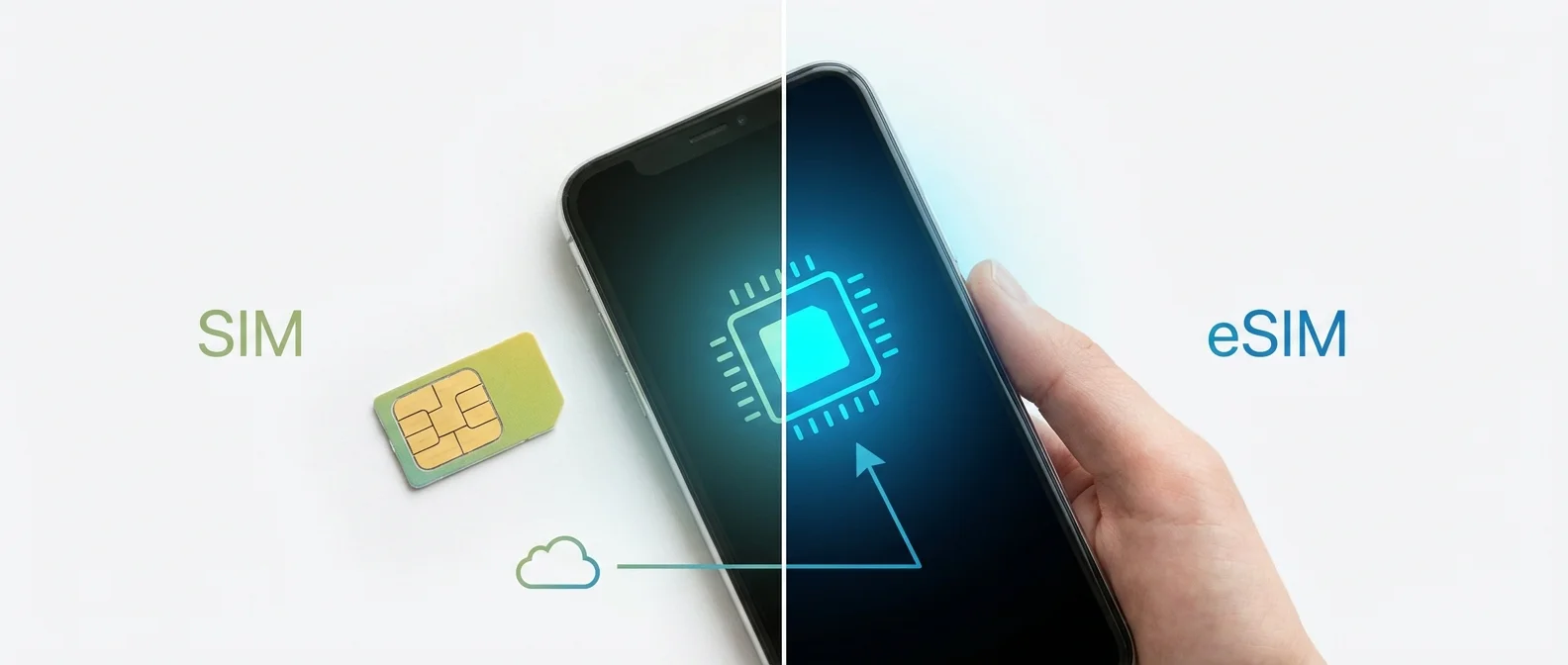
The days of fumbling with a SIM ejector pin every time you switch carriers or land in a new country are fading fast. eSIM technology — a tiny 6×5mm chip permanently soldered inside your device — is fundamentally changing how we connect to mobile networks. But the traditional physical SIM card isn't dead yet. Which one should you choose in 2026? Let's break it all down.
What Is an eSIM?
An eSIM (embedded SIM) is an eUICC (embedded Universal Integrated Circuit Card) chip permanently attached to your phone's circuit board. It can't be removed, lost, or broken. The standard was developed by the GSMA and officially launched in March 2016.
The first device with eSIM was the Samsung Gear S2 Classic 3G in February 2016, followed by the Apple Watch Series 3 in September 2017. For smartphones, the technology debuted on the Google Pixel 2 (2017). Apple adopted eSIM in iPhones starting with the iPhone XS/XR in 2018.
The concept is straightforward: instead of inserting a physical card, you download a digital profile via QR code or through your carrier's app. You can store multiple profiles simultaneously and switch between them without touching any hardware.
What Is a Physical SIM?
The physical SIM card (Subscriber Identity Module) is the classic removable card we all know. It started as a full-size card (1FF) in 1991 and evolved through mini SIM (2FF), micro SIM (3FF), and finally the nano SIM (4FF) used in most phones today.
The physical SIM remains the most widespread way to connect to a mobile network worldwide. Its fundamental principle is extremely reliable: the chip stores your identity credentials (IMSI) and encryption key, allowing the network to authenticate you.
Detailed Comparison: eSIM vs Physical SIM
Ease of Use
eSIM wins this one decisively. Activation via QR code takes just minutes, no store visit required. Switching carriers means no SIM ejector tool, no fiddling with tiny trays. If you're traveling, you can purchase a local data plan before you even board your flight — just scan a QR code and you're set.
A physical SIM requires either a trip to a store or waiting for postal delivery. Swapping between carriers means physically removing one card and inserting another — and on modern phones, that SIM tray can be surprisingly tricky to open without the right tool.
Security
eSIM offers inherently stronger security in several scenarios. Nobody can physically remove the SIM card if your phone is stolen — meaning your device remains trackable via the network. eSIM also makes SIM swapping attacks significantly harder, since transferring a profile requires additional identity verification steps.
That said, the physical SIM has one advantage: complete disconnection. If you need to go fully offline (for privacy, in sensitive locations, or in high-risk situations), you pull the SIM and you're done. With eSIM, you have to disable it through software — which isn't always as instant or certain.
Travel
This is where eSIM truly shines. You can add a local data plan through services like Airalo, Holafly, or Saily before your plane even takes off. You land, activate the local profile, and you have internet with no roaming charges — and no hunting for a SIM vendor at the airport.
With a physical SIM, you either pay for roaming (expensive outside the EU), or you find a local store at your destination, buy a card, possibly provide ID or a passport, and swap out your SIM — risking misplacing your home SIM in the process.
Device Compatibility
Physical SIM still enjoys near-universal support — even budget phones costing €70 have a nano SIM slot. eSIM, while now widespread, requires specific hardware. Here are the major eSIM-compatible devices in 2026:
eSIM-Compatible Devices (2026)
- Apple: iPhone XS/XR and newer — iPhone 14 (US) and iPhone 17/17 Pro eSIM-only in multiple countries, iPhone Air eSIM-only worldwide
- Samsung: Galaxy S21 and newer (via One UI 4+ update), Galaxy Z Fold/Flip series
- Google: Pixel 2 and newer — Pixel 10 (US) eSIM-only
- Xiaomi, OnePlus, Motorola: Select flagship models
- Smartwatches: Apple Watch Series 3+, Samsung Galaxy Watch, Google Pixel Watch
- Tablets/Laptops: iPad Pro/Air, Surface Pro, many Windows laptops
Cost
The eSIM itself costs nothing — there's no physical object to purchase. Activation via eSIM is typically free or costs the same as (or less than) a physical SIM. All three major Greek carriers (Cosmote, Vodafone, Nova) now fully support eSIM activation at no extra charge.
A physical SIM typically costs €5–€10 as a SIM pack from a store, though that charge is usually rolled into your first top-up or plan. In day-to-day use, there's no significant cost difference between the two.
The Trend: An eSIM-Only World
The industry direction is unmistakable. Apple led the charge: the iPhone 14 (US, September 2022) was the first iPhone sold without a physical SIM tray, exclusively in the United States. In September 2025, the iPhone 17 and iPhone 17 Pro launched as eSIM-only in multiple countries. And the iPhone Air became the first Apple device to ship eSIM-only worldwide.
Google followed with the Pixel 10 going eSIM-only in the US, while Samsung — though more cautious — has offered eSIM on all its flagships since 2021. The trend is irreversible: within the next 2–3 years, the majority of premium smartphones will be eSIM-only.
Why are manufacturers pushing this so aggressively? Three reasons:
1. Space: Removing the SIM tray frees up valuable internal space — space that can be used for a bigger battery, better haptic engine, or additional sensors.
2. Water resistance: Every physical opening (the SIM tray) is a potential water entry point. Without it, achieving IP68+ waterproofing becomes easier and more reliable.
3. Manufacturing cost: Fewer mechanical parts means lower production costs and fewer failure points. The SIM tray mechanism (spring, metal tray, contact pins) is a vulnerable component.
Drawbacks of eSIM
Despite its advantages, eSIM isn't perfect. Here are the most notable downsides:
Device transfers: Moving an eSIM to a new device isn't always as simple as popping out a card. You need to transfer the profile through your carrier or re-scan a QR code. Apple improved this considerably with eSIM Quick Transfer, but it doesn't work in every scenario.
Carrier support: In some countries (especially developing markets), many carriers still don't support eSIM. If you travel outside Europe or North America, you might find yourself with limited options.
Technical issues: In rare cases, eSIM activation can fail or be delayed due to server-side issues at the carrier. With a physical SIM, you insert the card and it simply works — every time.
No removal: In situations where you need complete disconnection (military facilities, sensitive locations, extreme privacy scenarios), the inability to physically remove the SIM can be a drawback.
Drawbacks of Physical SIM
The traditional SIM has weaknesses too, and they're becoming more apparent:
Wear and loss: Cards can crack, corrode, get lost, or suffer contact damage. Millions of users need SIM replacements every year.
SIM swapping vulnerability: Physical SIMs are more susceptible to SIM swapping fraud, where an attacker convinces your carrier to issue a new SIM with your number.
Identity theft risk: If someone steals your phone, they can remove the SIM and put it in another device, receiving your SMS messages (including one-time passwords).
Device space: The SIM tray takes up room that could be used for other components — a particularly critical issue in ultra-thin devices.
Which Should You Choose in 2026?
The answer depends on your usage patterns:
Choose eSIM if:
- You travel frequently and want easy data access without roaming charges
- You want maximum protection against SIM swapping
- You use a recent iPhone, Pixel, or Samsung flagship
- You want multiple profiles (e.g., personal + work)
- You're tired of dealing with SIM ejector tools and tiny trays
Stick with physical SIM if:
- You frequently switch between devices (especially between Android and iPhone)
- You travel to developing countries without eSIM support
- You use an older or budget phone
- You want the option of complete physical disconnection
- You prefer the tangible control of a removable card
The reality is that for most users in 2026, eSIM is the better choice. Major carriers worldwide support it, the most popular phones are compatible, and the advantages in convenience and security are substantial.
The Future: iSIM and Beyond
Technology doesn't stop at eSIM. The next evolution is called iSIM (integrated SIM), where SIM functionality is embedded directly into the device's main processor (SoC). This means an even smaller footprint, lower power consumption, and zero additional hardware cost.
Qualcomm, Samsung, and ARM have already demonstrated iSIM solutions, and commercial devices are expected to start appearing in 2027–2028. iSIM will be especially significant for the IoT world, where billions of tiny devices need network connectivity in the smallest possible form factor.
The GSMA continues developing eSIM standards, maintaining separate versions for consumer/IoT and M2M (Machine-to-Machine) use cases. This ensures the technology serves smartphones and wearables alongside industrial applications, connected vehicles, and smart city infrastructure.
Conclusion
The eSIM vs physical SIM debate is no longer a close contest. eSIM wins on convenience, security, travel flexibility, and device design. Physical SIM holds advantages only in niche scenarios: very old or budget devices, countries lacking eSIM support, and situations requiring complete physical disconnection.
The direction in 2026 is unmistakable: iPhone 17 and iPhone Air shipping without a SIM tray are leading the way. Google, Samsung, and others are following suit. The transition to an eSIM-only era isn't a question of “if” but “when” — and the answer is that it has already begun.
For the average user: if your device supports eSIM, it's worth making the switch. If you're buying a new phone, make sure it has eSIM support — otherwise you risk being left behind in a rapidly evolving mobile landscape.