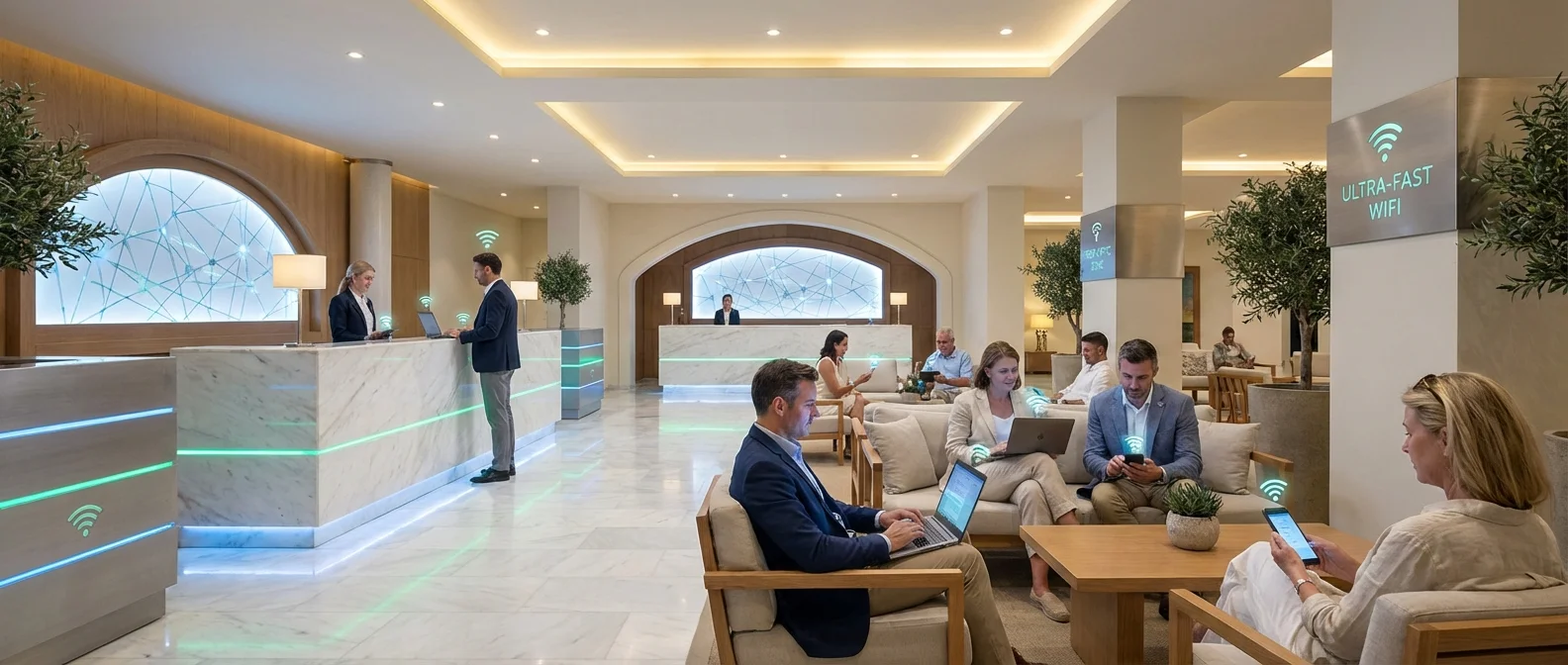
Greek tourism accounts for roughly 25% of the country's GDP, with over 33 million visitors arriving every year. In this fiercely competitive industry, one factor consistently tops every guest satisfaction survey — ahead of the pool, the breakfast spread, and even the view: WiFi quality. Fiber optic technology, specifically FTTR (Fiber to the Room), is fundamentally reshaping how hotels deliver connectivity, ushering in a new era of digital hospitality.
🏨 Why WiFi Became the Number One Amenity
Here's a fact that still catches many hoteliers off guard: in global guest satisfaction surveys, WiFi consistently ranks as the single most important amenity travelers consider when choosing accommodation. Above the location, above the gym, above fine dining — in certain demographic groups, reliable internet outranks virtually everything else. This isn't hyperbole; it's measurable reality backed by years of hospitality research.
The average hotel guest in 2026 travels with 3 to 4 connected devices: a smartphone, a laptop or tablet, a smartwatch, and often a dedicated streaming device like a Chromecast or Fire Stick. Many travelers — particularly the growing digital nomad segment — aren't simply browsing the web. They're working remotely, joining video conferences, uploading files to the cloud, and streaming 4K content during downtime. Their bandwidth demands are dramatically different from those of even five years ago.
The COVID-19 pandemic accelerated this digital transformation in hospitality faster than anyone predicted. “Bleisure” travelers — those who blend business trips with leisure — now represent a significant and growing market segment. For them, reliable high-speed internet isn't a perk; it's an absolute prerequisite. A five-star hotel on Mykonos or Santorini can lose bookings if guests encounter disconnections during a critical business video call.
In recent years, demands have escalated even further due to the rise of cloud gaming (GeForce NOW, Xbox Cloud Gaming) and AR/VR applications. Many younger travelers now expect the hotel connection to support lag-free gaming — something that requires low latency and stable bandwidth. While this may sound like a niche requirement, the trend is accelerating rapidly: by 2028, cloud gaming is expected to become a mainstream activity in hotel environments.
The challenge scales dramatically with property size. Consider that a large 5-star resort typically has 200 to 500 rooms. If each room hosts 2 guests carrying 3-4 devices each, that's 1,200 to 4,000 simultaneous connections — and that's before counting the lobby, restaurants, pool areas, bars, and conference halls. Legacy copper cabling (Ethernet Cat5/Cat6) and older-generation access points simply cannot handle this kind of demand at scale.
Don't overlook the streaming factor either. Platforms like Netflix, Disney+, YouTube, and Spotify are now an inseparable part of the hotel experience. A single 4K stream requires at least 25 Mbps, while 8K quality — gaining traction on newer televisions — demands 50-100 Mbps for just one stream. Multiply that across hundreds of rooms simultaneously, and you understand why the hotel's old 24 Mbps ADSL connection collapsed every evening.
There's also the cloud application dimension. Modern travelers use Google Drive, iCloud, OneDrive, and Dropbox — applications that automatically sync data in the background. If 200 rooms are simultaneously backing up vacation photos to the cloud, the upload bandwidth is exhausted instantly on a legacy connection. Fiber solves this with symmetrical upload/download speeds.
The Digital Nomad Challenge
The digital nomad segment deserves special attention — this category of travelers has grown explosively since the pandemic. These professionals work remotely while traveling, and Greece ranks among their top destinations thanks to its climate, cost of living, and quality of life. A digital nomad doesn't just need “internet to check email” — they need stable upload of at least 20 Mbps for video conferences, low jitter for VoIP calls, and a reliable connection without dropouts during critical presentations or client meetings.
Many hotels across Crete, the Cyclades, and the Dodecanese are already positioning themselves as “digital nomad-friendly” destinations, offering coworking spaces, guaranteed internet speeds, and special long-stay packages. The foundation of this strategy is network infrastructure — without a fiber backbone, the promises remain empty and the reviews turn negative fast.
The numbers speak for themselves: in surveys among digital nomads, 78% stated that internet quality was their primary factor when choosing accommodation — above price. Hotels that can guarantee stable 100+ Mbps download and 50+ Mbps upload can charge premium rates and attract long-stay bookings (1-3 months), which represent ideal revenue during the winter period — a time that traditionally poses challenges for island hotels.
🔌 FTTR: Fiber Optic All the Way to the Room
FTTR (Fiber to the Room) represents the most advanced approach to hotel network infrastructure available today. Instead of relying on traditional copper cabling from the central distribution point to each room, FTTR literally runs a fiber optic strand to every single guest room. The result is dramatically improved performance, reliability, and future-proof scalability.
The technology underpinning FTTR is GPON (Gigabit Passive Optical Network). This architecture uses passive optical splitters instead of active electronics at each branching point. That means fewer failure points, lower energy consumption, and virtually zero maintenance on the backbone network. A single GPON port can serve up to 64 endpoints — meaning dozens of rooms — with a downstream capacity of 2.5 Gbps.
Installing GPON in an existing building isn't always straightforward — but it's easier than many people think. Fiber optic cable is extremely thin (125 μm diameter, thinner than a human hair) and highly flexible, meaning it can be routed through existing cable conduits, ceiling voids, and cable trays without major structural work. In renovated or newly-built hotels, integration becomes even more seamless during the construction phase.
In practical terms, each room receives a compact ONT (Optical Network Terminal) — roughly the size of a small router — that converts the optical signal into Ethernet and WiFi. Modern hospitality-grade ONTs integrate WiFi 6E or WiFi 7 access points, delivering multi-gigabit wireless speeds within the room. Each guest enjoys a dedicated connection without competing for bandwidth with neighboring rooms through an overloaded hallway access point.
A particular advantage of the GPON architecture is its ease of upgradability. The physical fiber itself never changes — only the equipment at each end gets swapped. This means a hotel installing GPON at 2.5 Gbps today can upgrade tomorrow to 10G-PON or 25G-PON by simply replacing the OLT and ONTs — without touching a single meter of fiber in the walls and ceiling voids. This dramatically reduces the future cost of network upgrades.
The improvement over legacy installations is enormous. Copper (Ethernet Cat6) maxes out at roughly 1 Gbps over distances up to 100 meters, with proven degradation at longer runs. Fiber has no such limitations: it can carry data over kilometers without signal loss. For a sprawling resort covering several hectares, this is a critical advantage that copper simply cannot match.
The expert recommendation for premium hotels in 2026 is clear: 50 to 100 Mbps per room as a minimum, with burst capability to higher speeds. That might sound excessive, but consider: two simultaneous 4K streams consume around 50 Mbps, a video conference another 5-10 Mbps, and background cloud syncing adds more. A single room can easily saturate a 100 Mbps allocation during peak usage.
It's worth noting that the FTTR architecture also supports network segmentation — a critical security feature. The guest WiFi network can be completely isolated from the hotel's internal network (PMS, POS systems, security cameras, IoT devices). This means that even if a guest's device is compromised, it cannot reach the hotel's critical systems. In an era of increasing cyberattacks targeting hotel chains, this represents essential protection.
FTTR vs Legacy Wiring
The difference in architecture between FTTR and legacy installations is worth unpacking. In a conventional hotel network, each floor has one or two access points in the hallway, connected via Ethernet cable back to an IDF (Intermediate Distribution Frame) closet on that floor. WiFi signals must penetrate walls, doors, and bathroom fixtures — losing power at every obstacle. In hotels with stone walls or metal fire doors, coverage can be catastrophically poor. Guests closest to the access point enjoy decent speeds, while those at the end of the corridor struggle with intermittent connections.
With FTTR, every room has its own access point, fed directly by fiber. There are no walls to penetrate — the WiFi signal originates inside the room itself. Coverage is complete, speed is maximum, and each room operates as an independent wireless node. The guest doesn't share resources with anyone — something that was previously impossible without prohibitively expensive dedicated Ethernet runs to every room.
📡 WiFi 6E, WiFi 7, and the Wireless Revolution
Fiber solves the backbone problem, but the “last meter” connection inside the room remains wireless. This is where the latest WiFi standards — WiFi 6E (802.11ax on the 6 GHz band) and WiFi 7 (802.11be) — are transforming the wireless experience in hotel environments.
WiFi 6E introduced the 6 GHz band, a massive new spectrum allocation that effectively triples the available wireless “space.” In a hotel setting, this means far less interference between rooms, cleaner signals, and drastically reduced latency. Each room can operate on its own channel without “hearing” its neighbors, eliminating a chronic problem in hotel wireless networking where dozens of access points on the same floor step on each other's signals.
WiFi 7 pushes the envelope further: it supports 320 MHz channel widths (double those of WiFi 6E), MLO (Multi-Link Operation) enabling simultaneous use of multiple bands, and theoretical speeds up to 46 Gbps. In practice, a WiFi 7 access point inside a hotel room can deliver real-world speeds of 2-5 Gbps — more than enough for any conceivable use case today, including 8K streaming and cloud gaming.
The crucial point is that these high-speed wireless standards demand a matching wired backbone. A WiFi 7 access point fed through legacy Cat5e copper (capped at 1 Gbps) will never reach its potential. Only an FTTR infrastructure with a GPON backbone can fully “feed” a WiFi 7 access point — making the fiber-plus-WiFi 7 combination inseparable for any hotel serious about connectivity.
Another important WiFi 7 advantage in hotel environments is AFC (Automated Frequency Coordination) technology on the 6 GHz band. This allows access points to use higher transmit power in outdoor areas (pool, garden, restaurant terrace) without interference — solving a very practical problem at resorts with large outdoor spaces. Connecting these outdoor APs to the fiber backbone ensures speeds remain high even dozens of meters from the main building.
The ideal installation looks like this: a central OLT (Optical Line Terminal) in the server room, fiber runs to each room via passive splitters on every floor, and in the room an ONT with integrated WiFi 6E/7 providing both wireless and wired (Ethernet) connectivity. The guest does nothing special — they just connect to the WiFi and enjoy speeds that were unthinkable in a hotel setting just a few years ago.
The Importance of Spectrum Management
One point often overlooked in hotel network design is radio spectrum management. In a multi-story hotel, dozens of access points operate simultaneously, and without proper planning they overlap, creating interference that demolishes performance. Using WiFi 6E/7 with the 6 GHz band, combined with an intelligent controller that dynamically assigns channels to each access point, eliminates this problem entirely.
Modern WiFi controllers — products from companies like Cisco Meraki, Aruba, Ruckus, or Ubiquiti — can manage hundreds of access points centrally. They automatically adjust transmit power, channel selection, and band steering for each AP based on real-time data. In an FTTR-equipped hotel, each ONT/AP reports to the controller over the fiber backbone — ensuring optimal performance in every room without manual intervention from IT staff.
🧠 Smart Hotels: Beyond Just Internet Access
Fiber in hotels isn't just about fast internet for guests. It serves as the backbone for an entire generation of smart hospitality technologies that are fundamentally transforming the guest experience — while simultaneously slashing operational costs for hotel operators.
IoT (Internet of Things) systems form the core of the smart hotel concept. Smart thermostats automatically adjust room temperature based on occupancy or guest preferences. Intelligent lighting adapts via voice commands or a mobile app. Keyless entry systems let guests unlock their room with a smartphone. Digital concierge screens deliver room service ordering, property information, and local recommendations through a touchscreen or voice assistant.
An additional IoT use case gaining momentum is predictive maintenance. Sensors on HVAC systems, boilers, elevators, and laundry equipment monitor performance in real time, detecting anomalies before they become failures. An air conditioning unit that starts consuming 20% more energy than usual automatically alerts the maintenance team — preventing expensive breakdowns during summer peak season, when every room matters.
All of these systems require reliable, low-latency network connectivity — something only a fiber infrastructure can guarantee at the scale of hundreds of rooms. A smart thermostat needs minimal bandwidth, but it needs uninterrupted connectivity. An electronic lock must respond in milliseconds. A surveillance system needs stable multi-Mbps uplink around the clock. The aggregate demand from hundreds of IoT sensors across a large hotel can easily overwhelm a legacy network infrastructure.
Energy optimization is perhaps the most tangible financial benefit. Through IoT sensors connected to the fiber backbone, a hotel can monitor and adjust heating, cooling, and lighting in every room in real time. Empty room? The HVAC system scales down automatically. Guest left the balcony door open? The air conditioning pauses. Industry estimates indicate 15-30% energy savings through these automations — an amount that for a large resort can translate to tens of thousands of euros annually.
The significance of these savings isn't only financial — it's also environmental. Hotels are major energy consumers, and Greek legislation, aligned with EU sustainability directives, demands increasingly strict energy efficiency standards. Hotels with “green” certifications (e.g., Green Key, EU Ecolabel) enjoy tax advantages and visibility on specialized booking platforms that attract environmentally conscious travelers.
Meanwhile, modern PMS (Property Management Systems) — the software platforms that run hotels — are now deeply integrated with network infrastructure. Automated mobile check-in and check-out, dynamic pricing based on real-time occupancy data, pre-arrival room configuration — all of this depends on a robust fiber infrastructure capable of handling thousands of simultaneous connections without bottlenecks.
Key Advantages of FTTR in Hotels
- Speed: 50-100 Mbps per room minimum, with multi-gigabit burst capability
- Reliability: Fiber is immune to electromagnetic interference, unlike copper
- Security: Fiber doesn't emit electromagnetic signals, making it extremely difficult to tap
- Energy: Passive GPON networks consume less power than active Ethernet switches
- Future-proof: The same fiber can be upgraded to 10G-PON, 25G-PON without re-cabling
- IoT Ready: A fiber backbone supports hundreds of IoT devices without congestion
🇬🇷 The Greek Reality: Where Things Stand
Greece, as one of the world's top tourist destinations, sits at a critical juncture in its digital infrastructure upgrade. The tourism sector represents around 25% of GDP, with over 33 million arrivals annually. This creates enormous demand for reliable connectivity across thousands of hotels, resorts, and accommodations throughout the country.
The reality, however, presents stark contrasts. Large 5-star urban hotels in Athens and Thessaloniki have largely modernized, with many already running fiber backbones and WiFi 6 networks. By contrast, many island properties — including some mid-range and upscale establishments — still rely on VDSL or even ADSL connections, with WiFi 4 or WiFi 5 access points that simply cannot serve today's demands.
Greece's three major telecom providers — Cosmote, Vodafone, and Nova — now offer specialized B2B fiber solutions for the hospitality sector. Cosmote, as the dominant provider with the most extensive fiber network, delivers GPON solutions with dedicated lines for hotel installations. Vodafone and Nova follow with competitive packages. Pricing varies by location and requirements, but a typical FTTR installation for a 100-room hotel runs between €15,000 and €40,000 for equipment and deployment.
The major challenge remains on the islands. Despite significant investment in submarine cables in recent years, many smaller islands still have limited backbone bandwidth. Even if a hotel installs an internal fiber network, the connection to the outside world can remain a bottleneck. However, the situation is improving rapidly: new high-capacity submarine cables are being upgraded across dozens of islands, and by 2028 most popular tourist islands are expected to have reliable fiber backbones.
The Greek government, through digital transformation initiatives targeting tourism, is actively encouraging modernization. Subsidy programs through EU structural funds and the Recovery Fund are financing digital upgrades for hotels, including fiber infrastructure installation. Properties investing in digital upgrades can leverage tax incentives and financing tools that significantly reduce transition costs.
The Role of Reviews and Online Reputation
One factor many hoteliers underestimate is the direct impact of WiFi quality on online reviews. Platforms like Booking.com, TripAdvisor, and Google Reviews are filled with complaints such as “slow internet,” “impossible to make a video call,” or “WiFi didn't work in the room.” These negative reviews have a measurable impact on scores — and by extension, on bookings. A 0.5-point drop on Booking.com can translate to 10-15% fewer reservations.
Conversely, hotels that upgraded to fiber report significant improvement in positive connectivity reviews — which lifts overall scores. Digital nomads in particular are far more likely to leave positive reviews when the internet experience was exceptional, creating a positive flywheel effect: great internet → positive reviews → more digital nomads → higher occupancy.
It's also worth noting the importance of WiFi for social media sharing. Modern travelers constantly upload photos and stories to Instagram, TikTok, and Facebook — essentially free advertising for the hotel. But if the connection is slow and uploads fail, this free exposure is lost. A fast WiFi powered by a fiber backbone turns every satisfied guest into an influencer — a form of marketing that costs the hotel absolutely nothing.
Case Study: Island Resorts
A telling example comes from large resorts in the Dodecanese and Crete. These properties often sprawl across enormous grounds, with dozens of bungalows, multiple buildings, pools, and restaurants located hundreds of meters from the central server room. The traditional solution involved deploying multiple Ethernet switches in each building — an expensive, power-hungry setup with many potential failure points and ongoing maintenance requirements.
With FTTR, a single fiber trunk runs from the central OLT to each building, where a passive splitter distributes the connection to individual rooms. No active switches needed per building — just passive components that require no power or cooling. Reliability increases dramatically, while operational costs (electricity, cooling of technical spaces, maintenance) drop noticeably. For resort operators managing seasonal properties, the reduced complexity also means fewer on-site IT staff are needed during the season.
🔒 Security and Reliability: The Hidden Advantages
Beyond raw speeds, fiber optic offers two critical advantages that are often overlooked in discussions about hotel infrastructure: security and reliability.
Fiber is inherently immune to electromagnetic interference (EMI). In a hotel packed with electrical equipment — HVAC systems, elevators, kitchen appliances, lighting — copper is significantly affected by EMI, causing instability and speed degradation. Fiber, carrying light rather than electrical signals, is completely unaffected by these interferences.
On the security front, fiber optic is exceptionally difficult to tap. Copper cables emit electromagnetic fields that can theoretically be intercepted with the right equipment. Fiber emits nothing — accessing the data requires physically cutting the strand, which immediately triggers a signal loss alarm. For hotels hosting business travelers, politicians, or VIP guests, this isn't theoretical concern; it's a practical security matter that can influence which properties are selected for high-profile events and delegations.
Fiber's reliability shows in the numbers: a GPON network achieves uptime above 99.99%, with an exceptionally low failure rate. The passive components (splitters, patch panels) have no moving parts and require no power, drastically reducing potential failure points. For a hotel, this translates directly to fewer IT support calls, fewer complaints, and higher review scores.
It's worth noting that fiber also withstands extreme climate conditions — high humidity, salinity (critical on islands), temperature fluctuations — far better than copper. In a Greek island hotel, where salt air gradually corrodes metallic components, glass fiber remains pristine decade after decade. This dramatically reduces cable replacement needs due to corrosion — a problem far more familiar than many realize in island hospitality.
There's also the matter of investment longevity. The physical fiber installed today will remain functional for decades — the equipment at each end (OLT, ONT) gets upgraded, but the fiber itself never needs replacing. This means a FTTR installation made today will support technologies that haven't been invented yet — 25G-PON, 50G-PON, and whatever comes next — without any new cabling work.
Fire Safety and Building Codes
An additional advantage rarely mentioned: fiber optic cable carries no electrical current, which means zero risk of short circuits or cable-related fire from the network infrastructure itself. In contrast, copper cables carry electricity (especially in PoE installations), creating — however minimal — a risk in environments with ceiling voids packed with cabling. For hotels that must meet strict fire safety regulations, transitioning to fiber eliminates one more risk factor in their compliance obligations.
Management and Monitoring
A fiber network isn't simply “set it and forget it.” Proper management requires monitoring tools that track in real time the status of every ONT, data traffic flows, signal levels, and potential failure points. Modern GPON systems provide detailed dashboards — the network administrator can see at any moment how much bandwidth each room is consuming, whether any ONT is experiencing issues, or if signal quality is degrading at any point in the network.
This proactive monitoring capability means problems are detected before the guest even notices them — a massive improvement over traditional networks where the first indication of trouble was typically a complaint call to the front desk. For properties that outsource IT management, cloud-based GPON controllers allow remote monitoring from anywhere, reducing the need for an on-site network technician.
Installation Timeline
A typical FTTR installation in a 100-200 room hotel takes 2-4 weeks, ideally during the winter period (low season) for island properties. The process includes a site survey, network design, fiber cabling, splitter and ONT installation, configuration, and final testing. Modern pre-terminated fiber cables — strands with pre-installed connectors — significantly reduce installation time compared to older fiber splicing techniques.
It's important for hoteliers to plan the transition well in advance. The GPON equipment market is experiencing increased demand, and installation technicians — especially on the islands — are limited. A hotel that decides in May that it wants fiber by June will almost certainly face delays. Planning should begin at least 3-4 months before the desired completion date.
💰 Cost, ROI, and the Road Ahead
Installing FTTR in a hotel represents a significant investment, but the data clearly shows payback within 3 to 5 years through multiple revenue and savings streams. Let's break down the key financial picture.
Upfront costs depend on the property's size and layout. For a 100-room hotel, a complete FTTR deployment — including fiber cabling, splitters, the central OLT, and a WiFi 6E-equipped ONT per room — typically ranges from €15,000 to €40,000. For larger resorts with 300+ rooms, total costs can reach €80,000-€120,000, though economies of scale significantly reduce the per-room cost.
On the revenue side, the financial benefits are multiple and compounding. Energy savings of 15-30% through IoT automation can amount to €10,000-€50,000 annually depending on property size. The ability to command premium room rates — data shows that hotels with excellent WiFi can charge 10-15% higher rates — generates substantial additional revenue. Reduced complaints and improved review scores (negative WiFi reviews are remarkably common) lead to higher occupancy rates over time.
In the medium term, transitioning to fiber infrastructure enables hotels to adopt entirely new business models. Premium rooms with guaranteed 1 Gbps internet for digital nomads. Conference facilities with dedicated bandwidth rivaling tech company offices. Live streaming capabilities for events. Guest behavior analytics through IoT sensors for personalized service. These aren't futuristic scenarios — they're already being implemented by forward-thinking hotels worldwide.
An interesting model gaining traction is tiered internet access. Hotels offer free basic connectivity (e.g., 20 Mbps) to all guests, and a premium tier (e.g., 200+ Mbps) as an additional service — either complimentary for suites and VIP guests, or charged at €5-15/day. This creates additional revenue while simultaneously ensuring the network doesn't get overloaded. Naturally, implementing this model requires QoS (Quality of Service) capabilities that only a fiber GPON system can reliably provide at the scale of hundreds of rooms.
The US hospitality market alone is worth $224.9 billion (hotels and motels), and the global trend unmistakably points toward digital modernization. Hotels investing in fiber infrastructure today aren't merely solving a current problem — they're positioning themselves strategically for a decade of escalating digital demands. Conversely, hotels that remain on copper will see their digital infrastructure become inadequate within 2-3 years, with upgrade costs steadily increasing.
ROI in 3-5 Years
FTTR installation pays for itself through energy savings, increased room rates, and reduced IT operational costs. Hotels that upgraded to fiber report a 15-20% improvement in guest review scores.
Green Hospitality
Fiber-enabled IoT systems reduce energy consumption by 15-30%, contributing to sustainability goals — an increasingly important factor for modern travelers and government certification programs.
Digital Nomads & Bleisure
The growing digital nomad and bleisure travel market demands office-quality internet. Hotels with fiber infrastructure can specifically target this high-value demographic segment.
✅ Conclusion
The transition to fiber optic in hotels is no longer a question of “if” but “when.” FTTR technology, combined with WiFi 6E/7 and IoT automation, is transforming hospitality into an entirely new experience — both for guests enjoying seamless connectivity and for operators saving resources while improving their reputation.
For Greece, the stakes are even higher. In a country that depends on tourism for a quarter of its GDP, digitally upgrading hotels isn't a technological whim — it's an economic imperative. The 33+ million annual tourists arrive with growing digital expectations, and the properties that meet those expectations will win the competition for bookings.
The encouraging news is that the technology is mature, the costs are well-understood, and the providers (Cosmote, Vodafone, Nova) offer purpose-built solutions. With ROI achievable in 3-5 years, government incentives available, and a large market of guests willing to pay premium rates for quality connectivity, the case for fiber isn't just logical — it's urgent. The hotels that lead today will be the winners of tomorrow's tourism landscape.
Ultimately, fiber optic isn't merely a technology upgrade — it's an investment in the future of an entire industry. Greece, with its unique allure as a world-class destination, deserves hotel infrastructure that matches the expectations of millions of visitors. The transition to fiber is the first step in this new era of digital hospitality.