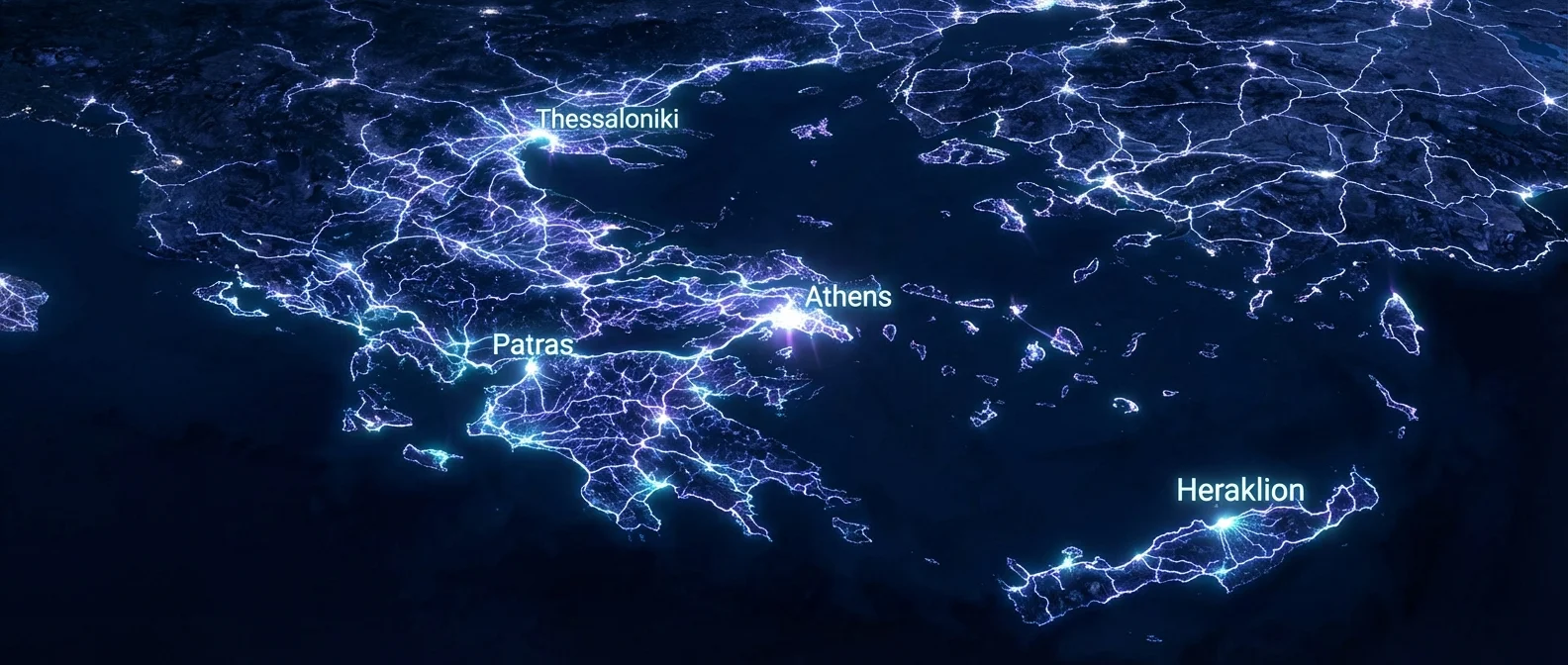
Fiber to the Home — commonly known as FTTH — is the backbone of modern internet infrastructure. Instead of relying on copper cables dating back to the last century, fiber optics transmit data at the speed of light, delivering speeds ranging from 1 to 10 Gbps. In Greece, however, reality falls far short of this promise. With FTTP coverage standing at just 28%, the country remains well below the European average — and the urgency to accelerate deployment has never been greater.
🔍 What Is FTTH and Why Does It Matter
Let's start by clearing up the terminology, because confusion runs deep. When we say FTTH (Fiber to the Home), we mean that optical fiber reaches all the way to your living space — an optical box is mounted on your wall, and your router connects directly to it. In this scenario, the entire path from the provider to your home consists of light pulses traveling through glass fiber, with no copper in between.
FTTB (Fiber to the Building) is similar, except the fiber terminates at the building boundary — typically the basement or entrance hall — and the final connection to your apartment uses copper wiring. This means somewhat reduced performance on the “last mile,” though it's still vastly superior to older ADSL networks.
What still dominates the Greek market, however, are FTTC/FTTN networks — Fiber to the Cabinet or Fiber to the Node. In this topology, fiber reaches the street cabinet in your neighborhood, and the last leg to your home runs over copper lines (VDSL/Vectoring). Your actual speed depends critically on the distance from your home to the cabinet: at 200 meters you might achieve 100 Mbps, but at 800 meters speeds drop significantly. In many Greek neighborhoods, these distances far exceed the ideal range, which explains why so many VDSL subscribers see far lower speeds than what their provider promised.
There's also an intermediate technology called FTTdp (Fiber to the Distribution Point), where fiber reaches a point mere meters from the premises. It delivers near-gigabit speeds without requiring full fiber cabling into every home — a pragmatic middle ground that could serve as a bridge between today's FTTC deployments and full FTTH.
So how is an FTTH network actually structured? Two main architectures exist. The first is PON (Passive Optical Network), which uses unpowered optical splitters — a single fiber is shared among up to 128 subscribers through passive dividers. This is the most widely deployed solution globally, thanks to its low installation and maintenance costs. The second is AON (Active Optical Network), which uses powered switches to provide a dedicated fiber for each customer. AON is more expensive but guarantees consistent speeds regardless of how many users are online simultaneously. In practice, PON dominates most European deployments.
One critical advantage of fiber optics: it's future-proof. The data transfer rate isn't limited by the fiber itself — only by the terminal equipment at each end. Upgrade the equipment, and speeds multiply automatically. This means a fiber strand installed today will serve users for decades, without needing replacement. For connections above 1 Gbps, single-mode fiber is preferred, as it carries light signals over longer distances without loss. Immunity to electromagnetic interference is yet another significant advantage over copper.
📊 The State of Broadband in Greece Today
The numbers speak for themselves — and they're not flattering. According to the most recent data, FTTP (Fiber to the Premises) coverage in Greece stands at 28%, while the EU average sits at 56%. This means fewer than 3 in 10 Greek households have access to a genuine fiber-optic connection. And even fewer are actually using one.
The picture worsens when looking at Very High Capacity Networks (VHCN). Greece registers just 28% coverage here as well, compared to an EU average of 73%. That's a gap of more than 45 percentage points — reflecting decades of underinvestment in fixed infrastructure. In practical terms, the majority of Greek households still depend on copper networks that were originally designed for telephony — not data.
Adoption of speeds exceeding 100 Mbit/s reaches only 20% of the population, versus 55% across the rest of Europe. Greece's average fixed broadband speed was measured at 44.60 Mbit/s (February 2023 data), ranking the country 92nd worldwide — one of the lowest positions in Europe. For an EU member state, that ranking is disproportionately low.
📌 Greece vs Europe: Key Broadband Indicators
- FTTP Coverage: 28% (Greece) vs 56% (EU average)
- VHCN Coverage: 28% (Greece) vs 73% (EU average)
- Adoption ≥100 Mbit/s: 20% (Greece) vs 55% (EU average)
- Average Speed: 44.60 Mbit/s — 92nd worldwide
- 5G Coverage: 86% (Greece) vs 81% (EU average) ✓
- 5G Spectrum: 99% allocated (vs 68% EU average)
- Internet Usage: 82% of population (2022)
- e-Government: 81% (Greece) vs 74% (EU average) ✓
The paradox is striking: while Greece excels in wireless coverage (86% 5G coverage, above the EU average of 81%, and 99% of 5G spectrum allocated versus the EU's 68%), it falls dramatically behind in fixed infrastructure. This suggests a strategic choice — or perhaps a forced direction — toward wireless networks, which cannot substitute for fixed fiber in the long run. 5G, impressive as it is, shares bandwidth among many users and cannot match a dedicated FTTH link in terms of latency and sustained throughput.
Greece has historically relied on copper networks. VDSL was only launched in 2012, which by European standards is considered late. The expansion model focused on FTTC/FTTN — fiber to the neighborhood cabinet — but this inherently limits final speeds due to the copper last-mile connection. The transition to true FTTH is the country's defining infrastructure challenge — and simultaneously its greatest opportunity.
🏗️ Major Projects: SFBB, UFBB, and the National Broadband Plan
The Greek government hasn't ignored the problem — at least not at the planning level. The National Broadband Plan (2021-2027) targets gigabit connectivity through infrastructure capable of delivering at least 100 Mbit/s, upgradeable to 1 Gbps. It's an ambitious roadmap aligned with the EU's Digital Decade 2030 goals, which mandate gigabit access for all EU households by the end of the decade.
On a practical level, two major projects have shaped — or are attempting to reshape — the broadband landscape. The first, codenamed SFBB (Super-Fast Broadband), was completed in September 2022. Through this program, approximately 140,000 vouchers were distributed to households and businesses, subsidizing the transition to higher-speed connections. While SFBB wasn't purely an FTTH initiative, it significantly boosted demand for high-speed broadband services and demonstrated that Greek consumers are willing to upgrade when financial incentives exist.
The second major project, UFBB (Ultra-Fast Broadband), is more targeted. Its goal is to extend fiber infrastructure to 18% of the population — primarily in areas that wouldn't be commercially attractive for private investment. This is essentially state intervention in “white zones,” areas where the market wouldn't invest on its own. UFBB remains ongoing, and completion timelines have not always been optimistic. Bureaucracy, finding qualified contractors, and construction complexity in mountainous and island regions present persistent obstacles.
The European Union is pushing hard with its Digital Decade target: gigabit connectivity for everyone by 2030. At the European level, total premises passed by FTTH/FTTB were expected to reach 187 million by 2025. Greece needs significant acceleration to approach these benchmarks. With current FTTP coverage at 28%, the road to the 2030 target looks daunting — but not impossible, if the major projects deliver simultaneously in the coming years.
🏢 Telecom Providers and Their Investments
Three major providers operate in the Greek telecommunications market: Cosmote (a subsidiary of OTE), Vodafone Greece, and Nova. Each plays a different role in fiber rollout, though all have committed to expanding fiber access. The competitive dynamic between them has at least one positive outcome: it accelerates investment.
Cosmote, as the incumbent operator (OTE was founded in 1949 as a state monopoly), controls the largest fiber network in the country: 35,000 kilometers of optical fiber. Its parent company, Deutsche Telekom, holds a 55% stake and has approved a €1.5 billion investment plan for fiber optic networks in Greece. OTE's revenue reached €3.468 billion in 2023, demonstrating the financial muscle available to fund large-scale fiber projects.
A significant development was the 2024 rebranding to Cosmote Telekom, as part of Deutsche Telekom's pan-European brand consolidation. This isn't merely a cosmetic change — it signals deeper integration into the German group's strategy, which places heavy emphasis on FTTH across all its markets. For the Greek user, this translates into practical benefits: expertise, financial tools, and network deployment know-how transferred from markets where Deutsche Telekom has already completed the FTTH transition.
Vodafone Greece has also developed fiber deployment plans, investing both in its own network and in infrastructure-sharing agreements. Its strategy relies on a co-investment model, reducing deployment costs through shared ducts and conduits. Nova (formerly Wind Hellas), following its merger, now serves as the third major pillar of the market, with its own fiber expansion plans focused on urban centers.
Cosmote launched VDSL in Greece in 2012, which has since expanded to approximately 1.3 million households. However, VDSL is an FTTC/FTTN technology — meaning fiber reaches the street cabinet, not the home. The necessary transition from VDSL to true FTTH will determine whether Greece meets its European targets. The good news is that the existing 35,000 kilometers of fiber provide a significant foundation on which the FTTH expansion can be built.
🌊 Submarine Cables and the Quantum Cable Project
Beyond domestic networks, Greece sits at the center of a major international project: the Quantum Cable. This is a 7,700-kilometer submarine fiber-optic cable that will connect Greece with Cyprus, Israel, Italy, France, and Spain. The route traverses the Mediterranean along a geographically strategic path.
The expected capacity is staggering: 160 Tbit/s — enough to handle roughly 60% of global internet traffic at peak hours. That figure alone conveys the scale of the undertaking. The Quantum Cable isn't just about domestic consumption: it positions Greece geographically as a node of international telecom significance, bridging the Southeastern Mediterranean with Western Europe.
However, building submarine cables doesn't automatically mean end users will see faster speeds. Submarine cables function as “highways” between countries — what matters for the end user is the “local road” leading to their home, meaning the FTTH connection. If domestic infrastructure remains stuck at FTTC/FTTN, the Quantum Cable's enormous capacity won't be fully utilized by ordinary citizens.
Nevertheless, the geopolitical significance is undeniable. Greece has the potential to evolve into a telecom hub, attracting data centers and technology companies seeking strategic connection points between three continents. Geography doesn't change — and Greece sits precisely at the crossroads of Europe, Asia, and Africa. But that scenario first requires a robust domestic FTTH network and modern data center facilities.
🔮 Outlook and Targets for 2026-2030
Greece still has four years to reach the 2030 goal of universal gigabit coverage. The question isn't whether the country will move in this direction — that's a given — but whether it will move fast enough. Going from 28% coverage to something approaching 100% requires massive investment, streamlined permitting processes, and effective public-private cooperation.
At the European level, FTTH/FTTB subscribers have been growing steadily — the increase between September 2017 and March 2019 was approximately 16%. The trend points clearly toward a future where copper is replaced by PON and AON networks. Europe was expected to reach 187 million premises passed by FTTH/FTTB by 2025 — a remarkable increase over previous years.
For Greece to close the gap, a series of actions is needed. First, acceleration of the UFBB project and any new state-funded programs. Second, simplification of permitting procedures for excavation and fiber installation — bureaucracy currently ranks among the biggest obstacles. Third, incentives for private operators to extend their networks beyond urban centers into suburban and rural areas. The islands face unique challenges in particular — laying submarine cables is expensive, but essential.
E-government adoption suggests demand is clearly there: the e-government usage rate in Greece stands at 81%, exceeding the EU average of 74%. This means Greek citizens are already actively using digital services — and for those to function seamlessly, reliable and fast connections are essential. Experience shows that better internet leads to greater adoption of digital services — and vice versa.
Internet usage among the population stands at 82% (2022 data), slightly below the European average. In the coming years, the digitization of services, remote work, cloud gaming, telemedicine, and IoT will dramatically increase bandwidth demands. The pandemic already proved how critical reliable home internet really is. Only genuine FTTH infrastructure can meet these needs in the long term.
The target is clear: by 2030, gigabit internet for every home, every business, every school. The technology exists. The resources, at least partially, are also there. What's missing — and what will determine everything — is the speed of execution. Greece doesn't need more plans. It needs execution. Fast, efficient, without bureaucratic delays.
Fiber to the Home isn't merely a technological upgrade — it's the prerequisite for Greece to participate as an equal in the digital age. With FTTP coverage at 28% and an average speed of just 44.60 Mbit/s, the road ahead is long. But the foundation is being laid: the SFBB and UFBB national programs, multi-billion-euro provider investments, and strategic projects like the Quantum Cable are sketching a different future. If all of these are delivered on time, Greece won't just appear on the fiber coverage map — it will be a central node within it.