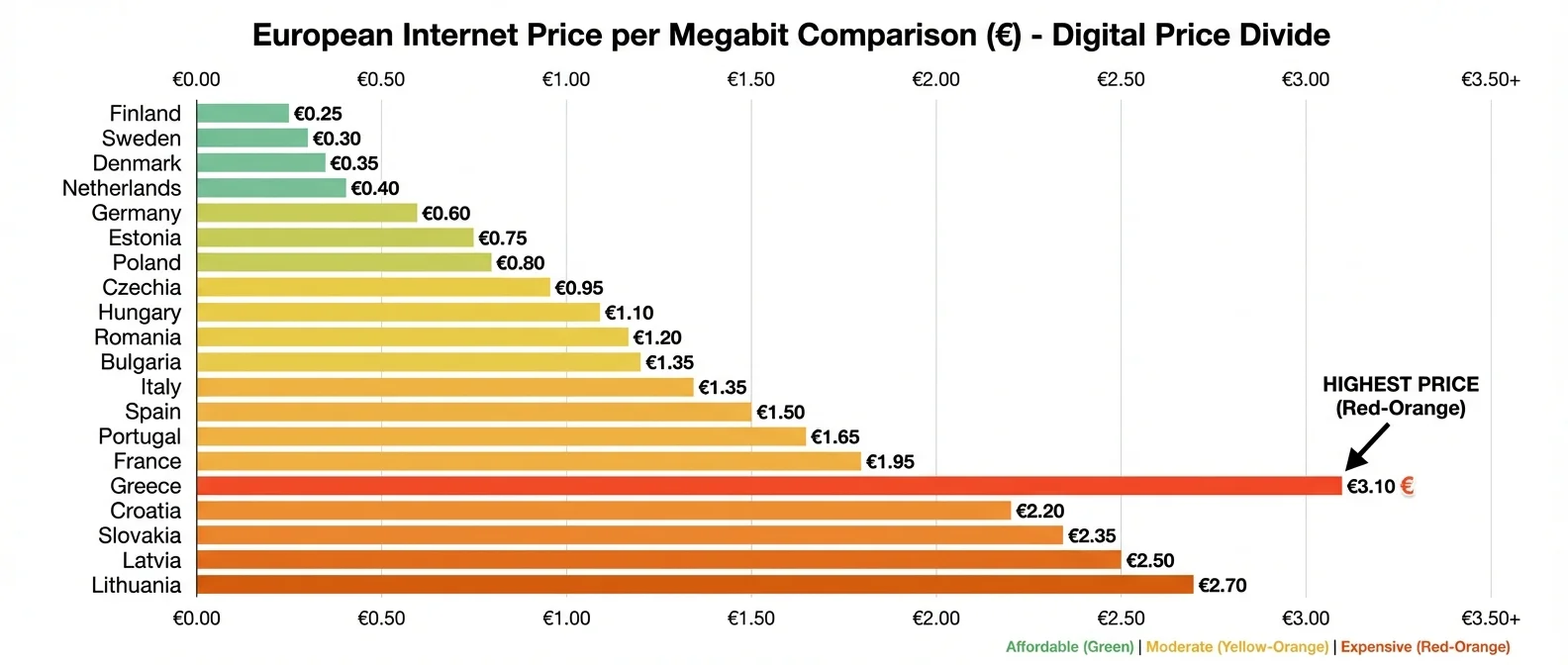
Greece consistently ranks near the bottom of the European Union when it comes to fixed broadband speeds — averaging just 80.14 Mbps download according to the Speedtest Global Index (October 2025). Meanwhile, the mobile picture looks far more encouraging, with 129.10 Mbps placing the country comfortably in the EU mid-range. How do we explain this contradiction? What's holding back the fixed network? And how quickly can Greece close the gap?
📊 Greece by the Numbers
Let's start with the hard data. According to the Speedtest Global Index for October 2025 — the most reliable real-world internet speed benchmark globally — Greece records the following performance:
In fixed broadband, the average download speed sits at 80.14 Mbps. That figure actually represents a significant improvement over February 2023, when Greece ranked 92nd worldwide with just 44.60 Mbps — nearly doubling in two years. Despite this progress, however, the country still lands among the lowest-performing EU member states.
In mobile broadband, the story is far more encouraging. At 129.10 Mbps average download, Greece sits in the EU mid-range, outperforming countries like Poland, Czech Republic, and Croatia. The country's 5G population coverage already reached 86% by 2022, exceeding the EU average of 81%, while Greece has allocated 99% of its available 5G spectrum (EU average: 68%).
This imbalance — decent mobile network, lagging fixed network — is perhaps the defining feature of the Greek telecom landscape. It reflects decades of underinvestment in fixed-line infrastructure (primarily fiber), while mobile spectrum and 5G tower deployment moved at a considerably faster pace.
🌍 Fixed Broadband: Europe Races Ahead
Comparing Greece with the rest of Europe makes the gap painfully clear. Countries like Romania (261.35 Mbps) and Denmark (256.74 Mbps) offer speeds more than three times higher than Greece. Even Spain (255.02 Mbps) and Hungary (230.29 Mbps) — nations with comparable or lower GDP — operate on an entirely different level.
Romania stands out as a particularly interesting case study: despite having a lower per-capita income, it managed to build one of Europe's fastest fiber networks, thanks to aggressive FTTH (Fiber to the Home) rollout by private ISPs and a favorable regulatory framework. Greece, by contrast, remained locked into copper for far too long — a technology that simply cannot support speeds beyond 100-200 Mbps, even with VDSL2/vectoring.
📊 Fixed Broadband — Download Speeds Across Europe (Oct. 2025)
| Country | Speed (Mbps) | Tier |
|---|---|---|
| 🇫🇷 France | 349.25 | Top tier |
| 🇷🇴 Romania | 261.35 | Very high |
| 🇩🇰 Denmark | 256.74 | Very high |
| 🇪🇸 Spain | 255.02 | Very high |
| 🇭🇺 Hungary | 230.29 | High |
| 🇳🇱 Netherlands | 218.31 | High |
| 🇵🇱 Poland | 207.54 | High |
| 🇸🇪 Sweden | 181.27 | Medium-high |
| 🇬🇧 United Kingdom | 154.10 | Medium |
| 🇩🇪 Germany | 101.08 | Low |
| 🇮🇹 Italy | 103.96 | Low |
| 🇧🇬 Bulgaria | 87.04 | Low |
| 🇬🇷 Greece | 80.14 | Very low |
It's worth noting that even Germany (101.08 Mbps) — Europe's largest economy — faces similar challenges, largely due to reliance on Deutsche Telekom's aging copper infrastructure. Germany, however, is already in the midst of an aggressive FTTH buildout that's expected to dramatically reshape its broadband map within the next 2-3 years.
On the other end of the spectrum, France at 349.25 Mbps demonstrates what coordinated government policy and provider competition can achieve. The “Plan France Très Haut Débit” started early and with substantial subsidies, driving near-universal fiber coverage in urban areas.
📱 Mobile Internet: The Pleasant Surprise
Where fixed broadband paints a disappointing picture, mobile internet gives Greece genuine reason for optimism. The average speed of 129.10 Mbps places the country at a respectable mid-EU level — close to Sweden (132.25 Mbps) and Finland (134.77 Mbps), both considered telecom pioneers.
This success is largely driven by an early and decisive 5G rollout. All three MNOs — Cosmote Telekom, Vodafone, and Nova — invested heavily in spectrum and infrastructure. Cosmote, rebranded as Cosmote Telekom in April 2025 and now offering its new MagentaONE bundles, records 90th-percentile 5G speeds exceeding 240 Mbps — faster than many countries manage on their fixed networks.
Vodafone launched its 5G network in Greece in January 2021 and has spent over €130 million on spectrum alone. Nova, following the Wind-Nova merger, is also pushing aggressively into 5G standalone infrastructure.
With 5G covering 86% of the population by 2022 — above the EU average of 81% — and 99% of available 5G spectrum already allocated (EU average: 68%), these figures show that, unlike its fixed network, Greece moved quickly and decisively on mobile 5G.
There's an important caveat, though: the bulk of those 5G speeds are concentrated in urban centers. On the islands and in rural areas, coverage remains patchy, with many residents still relying on 4G or even 3G connections.
🔧 Why Does Greece Lag in Fixed Internet?
The obvious question: if Greece performs well on 5G, why does it lag so badly in fixed broadband? The answer lies in a combination of technological, geographic, and policy-related factors.
Low FTTH/FTTP penetration: In 2022, only 28% of households had access to FTTP (Fiber to the Premises), while the EU average stood at 56%. VHCN (Very High Capacity Network) coverage sat at a similar level, versus 73% across the EU. Without fiber reaching homes, speeds are capped by the physical limitations of copper.
Copper dependency: Greece relied for decades on OTE's copper network — a legacy system designed for telephony, not data. Even with VDSL2 Vectoring technology, speeds top out at 100-200 Mbps, and only at short distances from DSLAMs.
Geography: Mountainous terrain and thousands of islands make infrastructure deployment expensive and time-consuming. Laying fiber to remote mountain villages or connecting them via submarine cables costs multiples of what flat, compact European nations spend.
Low high-speed adoption: In 2022, just 20% of fixed broadband subscribers used speeds of 100 Mbps or above, versus the EU average of 55%. This means that even where infrastructure exists, many consumers don't upgrade — whether due to cost or lack of awareness.
Delayed regulatory action: Local loop unbundling and incentives for fiber infrastructure competition arrived later in Greece compared to countries like Spain or Portugal. Spain, for example, began mass FTTH rollout as early as 2012, which is why it now delivers 255 Mbps average fixed broadband speeds.
🚀 What's Changing: Investments & Plans
The delay is now widely acknowledged, and several major upgrade initiatives have been set in motion over the past few years.
The National Broadband Plan 2021-2027 sets a target of gigabit connectivity for the entire country. It's an ambitious program combining EU funding (Recovery and Resilience Facility) with private investment, aiming to bring fiber to the home for millions of households.
The SFBB (Super-Fast Broadband) program was completed in September 2022, distributing approximately 140,000 vouchers to citizens and businesses for high-speed internet access. The Ultrafast Broadband project targets the 18% of the population living in areas without VHCN coverage, bringing fiber to rural and semi-urban zones.
At the same time, alternative technologies are reshaping the landscape. Starlink has been available in Greece since Q2 2022, delivering 150-300 Mbps via satellite — a practically instant solution for islands and remote areas where fiber deployment would take years. It offers a realistic alternative for underserved communities.
🔑 Key Upgrade Milestones
- National Broadband Plan 2021-2027: Gigabit target for the entire country, funded through the Recovery and Resilience Facility.
- SFBB: ~140,000 high-speed vouchers distributed (completed Sept. 2022).
- Ultrafast Broadband: Fiber to 18% of the population without VHCN coverage.
- Cosmote Telekom: Network upgrade to FTTH, MagentaONE plans with speeds up to 1 Gbps.
- Starlink: Available since Q2 2022, 150-300 Mbps for islands and remote areas.
- 5G spectrum allocation: 99% allocated — EU average just 68%.
All three providers (Cosmote Telekom, Vodafone, Nova) are now investing in FTTH and 5G standalone infrastructure, though deployment pace depends heavily on permits, bureaucracy, and geographic challenges. The vertical integration question — with OTE owning both the last-mile network and the retail provider (Cosmote) — remains an ongoing regulatory discussion.
🔮 Outlook for 2026-2027
What can we realistically expect over the next two years?
The National Broadband Plan is expected to dramatically increase FTTH coverage. According to official targets, by the end of 2027 the majority of the urban population should have access to speeds of at least 100 Mbps, with a significant share reaching gigabit. If these targets are met, Greece could approach 150-200 Mbps in average fixed broadband — a dramatic improvement from its current standing.
On the mobile side, 5G standalone adoption will push speeds even higher. Operators are already deploying 5G SA networks, which offer lower latency and higher peak throughput compared to the current 5G NSA implementations. Real-world speeds above 500 Mbps won't be unusual by the end of 2027.
Consumer adoption of higher tiers remains a critical factor. Even if infrastructure rolls out, the national average will stay low unless the share of subscribers on 100+ Mbps plans grows significantly from the current 20%. Consumer awareness, competitive pricing, and the growing demand of bandwidth-heavy services (4K/8K streaming, cloud gaming, remote work) are all expected to drive upgrades.
Internet usage in Greece stands at 82% (2022), leaving meaningful room for growth. As more citizens gain access to faster internet — via fiber, 5G, or satellite — demand will cement investments and create a virtuous cycle of continued upgrades.
The race isn't lost. With targeted investment, regulatory pressure, and the strategic use of alternative technologies (Starlink, fixed wireless 5G), Greece can meaningfully narrow its speed gap with the EU average by 2027. The clock, however, is ticking.