The SIM card has been on a relentless downsizing journey for over three decades. From the credit-card-sized full-size SIM of 1991, we progressed through mini-SIM, micro-SIM, and nano-SIM before arriving at eSIM. Now, the industry is preparing its next leap: iSIM (integrated SIM), a technology that embeds SIM functionality directly into the device's processor. In February 2023, Qualcomm and Thales unveiled the first GSMA-certified iSIM solution — a milestone that signals the dawn of an era without physical SIM cards of any kind.
📖 Read more: eSIM vs Physical SIM: The Complete 2026 Comparison
🔬 What Is iSIM — The Next Generation of Network Authentication
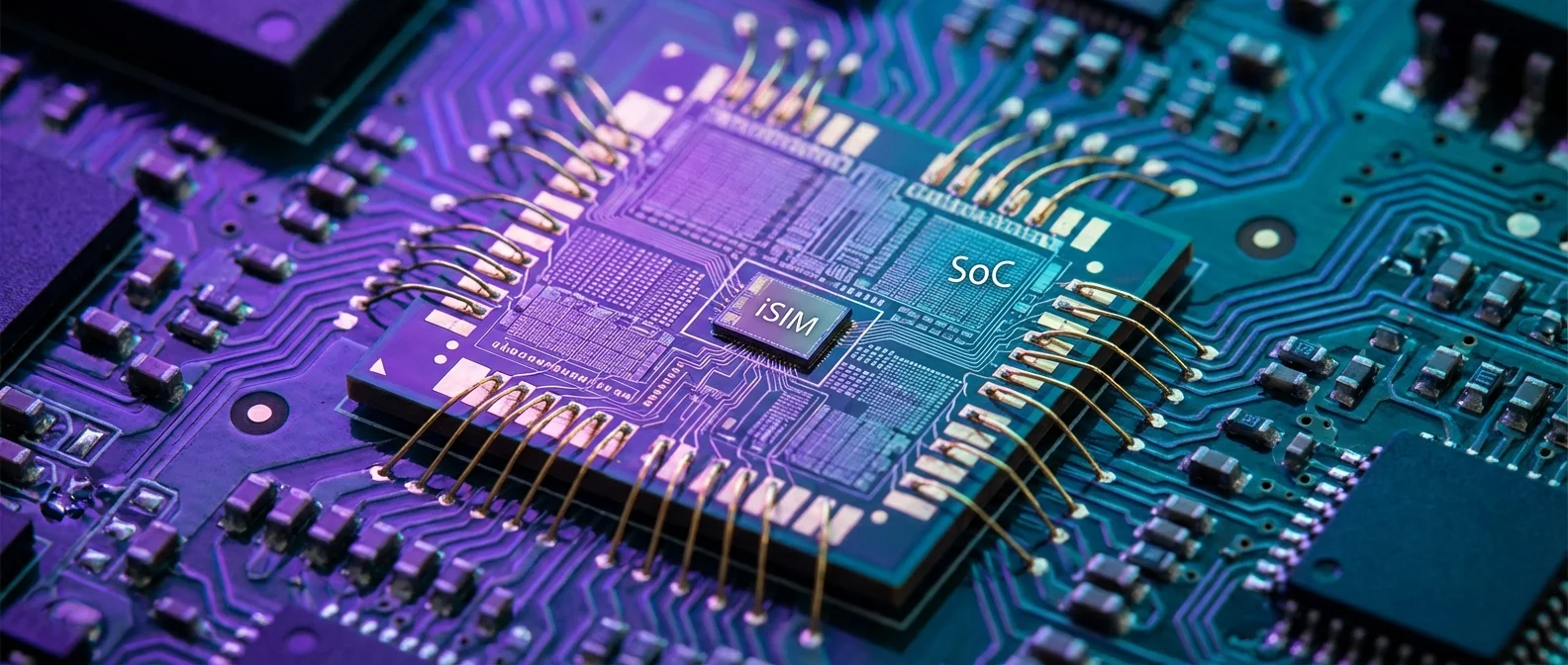
The name iSIM stands for “integrated SIM.” Unlike eSIM, which is a separate chip soldered onto the device's circuit board, iSIM is built directly into the SoC (System on Chip) — the main processor. In practical terms, network authentication becomes part of the very same chip that runs everything else on your device.
This means there's no need for a physical SIM card or a separate eSIM chip. The processor handles it all: computing power, graphics, modem, and now SIM. The space savings are remarkable — while an eSIM measures roughly 5mm × 6mm, iSIM operates at the nanometer scale as an integral part of the processor die.
iSIM Technical Specifications
- Location: Embedded within the SoC (System on Chip)
- Size: Nanometer scale — invisible to the naked eye
- Power consumption: Significantly lower than eSIM
- Profile updates: Over-the-Air (OTA), just like eSIM
- Security: GSMA eUICC Security Assurance (eSA) certified
- Manufacturing: No soldering required — integrated during SoC fabrication
📏 The Evolution of the SIM Card — From 1991 to 2026
The history of the SIM card is a story of continuous miniaturization. Each new generation took up less space, allowing manufacturers to design thinner and more compact devices. The shift from physical cards to digital solutions (eSIM) was significant, but iSIM goes one step further by eliminating the last remaining separate hardware component.
SIM Card Evolution Timeline
| SIM Type | Year | Size | Key Feature |
|---|---|---|---|
| Full-size SIM (1FF) | 1991 | 85.6 × 53.98 mm | Credit card sized |
| Mini-SIM (2FF) | 1996 | 25 × 15 mm | First major size reduction |
| Micro-SIM (3FF) | 2003 | 15 × 12 mm | Popular in smartphones from 2010 |
| Nano-SIM (4FF) | 2012 | 12.3 × 8.8 mm | Current standard, introduced with iPhone 5 |
| eSIM | 2016 | 5 × 6 mm | Embedded chip, digital activation |
| iSIM | 2023+ | Nanometers | Inside the SoC processor |
⚡ iSIM vs eSIM — The Key Differences
At first glance, iSIM and eSIM seem similar: both are digital, both support remote provisioning over the air, and neither requires a physical card. However, the technical differences are substantial and impact both manufacturers and end users.
An eSIM is a separate chip (eUICC) soldered onto the device's motherboard during assembly. It occupies physical space — roughly 5mm × 6mm — and requires its own power supply. An iSIM, by contrast, is integrated into the processor's silicon itself. There's no separate component, no soldering needed, and power consumption drops dramatically.
eSIM vs iSIM Comparison
| Feature | eSIM | iSIM |
|---|---|---|
| Location | Separate chip on PCB | Inside the SoC |
| Size | ~5 × 6 mm | Nanometers (part of die) |
| Power consumption | Moderate | Very low |
| Manufacturing complexity | Requires PCB soldering | Integrated during SoC fabrication |
| OTA provisioning | Yes | Yes |
| Security | GSMA eUICC | GSMA eSA |
| Cost per unit | ~$1-2 | Near zero (part of SoC) |
| Ideal for | Smartphones, tablets, wearables | IoT, wearables, sensors, vehicles |
The most important practical difference is that iSIM drastically simplifies manufacturing. Device makers no longer need to purchase separate eSIM chips, solder them to the board, or allocate dedicated space in their designs. This reduces production costs — especially for mass-produced devices — which is absolutely critical in the IoT ecosystem where every fraction of a euro counts.
📖 Read more: 5G vs 4G: Real Speed Differences Explained
🌐 Why iSIM Changes Everything for IoT
If eSIM paved the way for digital SIM cards in smartphones and smartwatches, iSIM is the technology that will bring cellular connectivity to billions of tiny devices that can't currently accommodate even an eSIM. Think sensors as small as a shirt button, smart eyewear, connected clothing, miniature drones, and millions of IoT devices spread across smart cities.
— Alex Sinclair, CTO, GSMA
The ultra-low power consumption of iSIM is perhaps its most important advantage for IoT applications. Sensors running on small batteries — or even energy harvesting from the environment — can now have native cellular connectivity without draining their power supply in a matter of hours.
— Luc Vidal, BICS
Real-World iSIM Applications in IoT
The potential applications of iSIM span sectors where cellular connectivity was previously difficult or impossible. In smart cities, millions of sensors can monitor air quality, traffic flow, water levels, and energy consumption — all with a direct connection to the 5G/LTE network without intermediate gateways.
In the automotive sector, iSIM is particularly compelling. A major German automaker already leverages iSIM technology to ship connected vehicles worldwide, with the ability to remotely provision the local network profile via OTA. No technician needs to swap a SIM card — the vehicle connects automatically to the local network upon arrival.
In wearables, smart glasses and smart rings can now support cellular connectivity without the physical footprint an eSIM demands. In healthcare, microscopic sensors in portable medical devices can relay data in real time to physicians. For drones (UAVs), beyond-visual-line-of-sight (BVLOS) navigation requires reliable cellular connectivity at minimal weight — precisely what iSIM delivers.
🏭 Who's Building iSIM — The Industry Behind the Technology
Qualcomm leads the charge in iSIM development. In February 2023, partnering with Thales — a global leader in digital security — they announced the first iSIM solution certified by the GSMA under the eUICC Security Assurance (eSA) scheme. This means iSIM meets the same rigorous security standards as the latest eSIM generations.
Qualcomm's Snapdragon processors already integrate iSIM capability, starting with premium tiers and gradually expanding to mid-range chipsets. Samsung is also working on its own iSIM implementation within Exynos processors. Within the next 2-3 years, the majority of smartphones and IoT devices will likely run on SoCs with native iSIM support.
Thales, as the leading digital security provider, supplies the software and security protocols running inside the iSIM. The company brings decades of experience in SIM management — from the earliest physical cards to modern eSIM platforms. The iSIM transition represents a natural evolution of that expertise.
📊 Market Projections — 300 Million Units by 2027
According to Kaleido Intelligence, the iSIM market is projected to reach 300 million units by 2027, representing approximately 19% of total eSIM shipments. While that figure might seem modest, it's worth noting that the technology was only certified in 2023. Adoption rates are expected to accelerate sharply after 2027 as more SoC manufacturers integrate iSIM into their chips.
📖 Read more: 6G Roadmap 2030: When Will It Be Ready
The primary growth driver isn't smartphones — eSIM already works well enough there. The big winner will be the IoT sector, where an estimated 30 billion+ connected devices are expected by 2030. The vast majority of these devices will be small, inexpensive, and power-constrained — precisely the scenario where iSIM excels.
🔒 Security — Same Standards, New Architecture
A reasonable concern is whether embedding SIM authentication into the processor compromises security. The answer is no. iSIM uses an isolated tamper-resistant element within the SoC. This secure enclave is physically and logically separated from the processor's other cores.
GSMA eUICC Security Assurance (eSA) certification guarantees that iSIM meets security standards at least equivalent to those of eSIM. Cryptographic keys are stored in hardware-protected memory, impossible to extract even with physical access to the chip. This makes iSIM suitable even for high-security applications such as banking services, government networks, and autonomous vehicles.
🔮 What This Means for Consumers
For the average consumer, the transition to iSIM won't feel like a sudden upheaval. Instead, it will be a gradual shift: smartphones over the coming years will use iSIM instead of eSIM, with no meaningful change in user experience. Activation will work exactly the same way — via QR code or OTA download.
The indirect benefits, however, will be significant: more room for a larger battery or slimmer design, lower power consumption translating to longer battery life, and the ability to add cellular connectivity to gadgets that currently rely solely on Bluetooth. Imagine earbuds, rings, glasses, and even clothing with standalone network connectivity.
In the long run, the real transformation will concern how we interact with the digital world. Cellular connectivity won't remain a premium-device feature — it will become so ubiquitous and affordable, thanks to iSIM, that everyday objects will be able to “talk” to the network. That is the vision of massive IoT, and iSIM is the technology that will make it a reality.
📝 Conclusion
iSIM represents the natural evolution of eSIM — smaller, cheaper, more energy-efficient, and ready for billions of IoT devices. With the first GSMA-certified implementation from Qualcomm and Thales arriving in February 2023 and projections of 300 million units by 2027, the industry is moving swiftly toward a future free of physical SIMs in any form. For consumers, the change will be gradual but profound — and the greatest benefits will emerge in the IoT world, where every object will be able to connect to the network without compromises in size, cost, or energy.