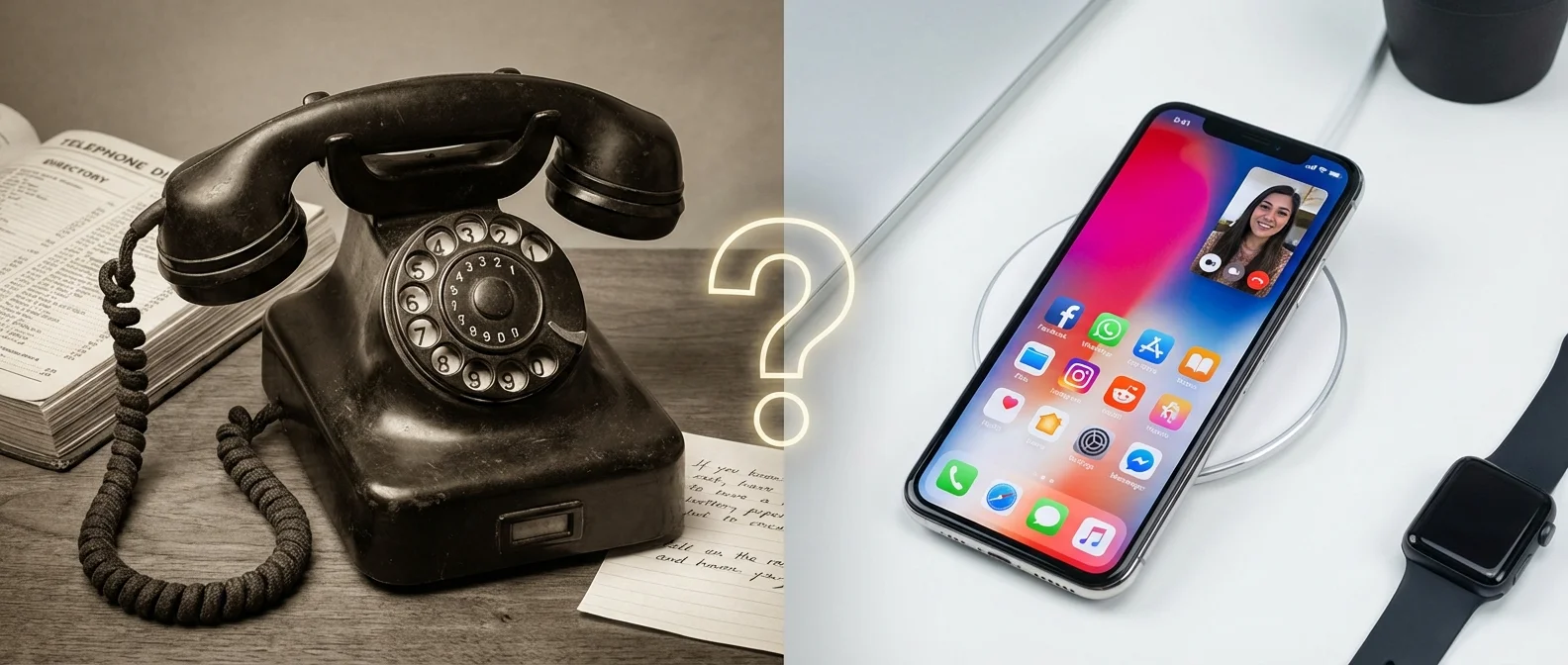
The landline once served as the backbone of household communication. Today, with smartphones in every pocket, free video calls via WhatsApp and Viber, and 5G networks delivering fiber-like speeds wirelessly, more and more people are asking: do we still need a landline? In Greece, where the copper network remains dominant and Cosmote Telekom controls the fixed-line market, the answer isn't so straightforward. Let's look at the facts.
📞 The Evolution of Landline Telephony
Landline telephony has a history spanning over 150 years. From the era of Alexander Graham Bell to digital ISDN exchanges, the fixed line was the sole means of telephone communication for decades. The technology behind it relied on the PSTN (Public Switched Telephone Network) — an analog system of paired copper wires that carried voice as an electrical signal.
The strength of this system lay in its simplicity and reliability. The copper line required no power at the premises — it was fed from the telephone exchange. Even during a blackout, the phone worked. This was a critical advantage in the pre-mobile era, especially for emergency calls.
However, the rise of mobile telephony in the 1990s and the smartphone revolution after 2007 fundamentally changed the landscape. Gradually, the landline shifted from a necessity to a luxury — or a relic of a bygone era. Many countries began pursuing a digital switchover, replacing analog PSTN networks with VoIP-based solutions running over the internet. Estonia and the Netherlands had already retired their legacy PSTN networks by 2023, while the UK is expected to complete its transition by 2027.
For Greek consumers, the question is no longer “how much does a landline cost” but “is it even worth paying for something I don't use?” The answer depends on your individual situation — and the data reveals a clear trend.
📉 The Global Decline
The numbers speak for themselves. The global decline of landline telephony is one of the most consistent trends in telecommunications over the past 20 years — with no sign of reversal.
In the United States, the shift is nearly complete: 73% of households rely exclusively on mobile phones, just 25% maintain both landline and mobile, while only 1% depend solely on a landline. In 2009, The Economist predicted that “the last landline in America will be disconnected sometime around 2025” — a forecast that ultimately wasn't far off.
In Australia, the situation is even more dramatic: only 14.5% of households used a landline in 2021, while 60% relied exclusively on mobile as early as June 2020. In Germany, however, the picture is quite different: 82.9% of households still had at least one landline in 2022, mainly because broadband packages automatically include a fixed line. A similar situation exists in the UK, where 73% of households had a landline in 2020 — primarily due to broadband bundles.
The common pattern across all developed countries is clear: the landline survives mainly as an accessory to broadband packages, not as a standalone service. Almost nobody pays for landline telephony alone anymore — the line comes bundled with internet, and if it were ever removed, few would notice.
🇬🇷 The Situation in Greece
The Greek fixed-line market has some distinct characteristics compared to Western Europe. The dominant provider remains Cosmote Telekom (formerly OTE, rebranded in April 2025, a subsidiary of Deutsche Telekom with a 55.6% stake), which manages the national copper network and the gradual rollout of fiber.
FTTP (Fiber to the Premises) coverage in Greece stood at just 28% in 2022, compared to the European average of 73%. This means the majority of Greek households still rely on copper DSL/VDSL connections for internet — and these connections automatically include a landline. The equation “internet = landline” remains a technical necessity in much of Greece.
The National Broadband Plan 2021–2027 aims to expand fiber coverage, while the SFBB (Super-Fast Broadband) program provided 140,000 subsidized vouchers for broadband connections. Meanwhile, Cosmote Telekom offers MagentaONE bundles combining fixed, mobile, internet, and TV — effectively encouraging customers to keep the landline as part of a broader package.
Greece in Numbers (2025–2026)
- FTTP coverage (2022): 28% (vs EU average 73%)
- Average fixed broadband speed: 80.14 Mbps (Speedtest, October 2025)
- Dominant provider: Cosmote Telekom (Deutsche Telekom 55.6%)
- Landline cost: €15–25/month (line rental, excluding internet)
- Copper network: Still dominant — PSTN retirement not yet scheduled
- SFBB vouchers: 140,000 subsidized broadband vouchers (2021–2027 program)
A critical point: unlike countries such as Estonia or the Netherlands that have already retired their analog PSTN, Greece has no retirement timeline yet for its copper network. This means the traditional landline will continue to exist technically for several more years — the question is whether it's worth paying for.
✅ Reasons to Keep the Landline
Despite the global decline, there are specific scenarios where the landline still holds real value. This isn't about nostalgia — it's about practical considerations that apply to particular groups of users.
Bundled Internet: The most common reason in Greece. If you use a DSL or VDSL connection, the landline is a technically inseparable component — you cannot have internet without it. Even with fiber packages, many providers include the landline. In practice, you're already paying for it as part of your bundle.
Blackout reliability: Traditional copper lines are powered from the telephone exchange — they require no electricity at your home. During a power outage, your landline may be your only connection. However, if your landline runs through a VoIP router (which is increasingly common), this advantage disappears.
Elderly users: Many older family members — especially those over 70 — feel more comfortable with a landline. They know the number, no charging is required, and the handset is always in the same place. This is a significant factor in a country with a sizable aging population.
Professional use: Businesses, freelancers, lawyers, doctors — many still use a landline number for professional credibility, fax (yes, still), and PBX phone systems. A fixed number lends trustworthiness to clients.
Security systems: Some older alarm systems still rely on a landline for signal transmission. While many modern systems use GSM/4G or internet, in some homes the landline remains essential for this purpose.
Emergency calls: The landline provides automatic location identification when dialing 112/166 — unlike mobile, where location accuracy can be lower in certain rural areas.
❌ Reasons to Cut the Cord
On the other hand, the arguments for ditching the landline are equally compelling — and for many households, more relevant to today's reality.
Cost: Even if the landline is included in your internet package, that doesn't mean you're not paying for it. Line rental in Greece ranges between €15–25/month — money that could be saved if internet without a landline were an option, something that's gradually becoming feasible through fiber or 5G FWA.
Disuse: How many times did your landline ring last month? If the answer is “only telemarketers and robocalls,” then you're paying for a service you don't actually use. With Viber, WhatsApp, FaceTime, Zoom, Teams, and Skype, voice communication has migrated entirely to the internet.
Younger generation: People under 35 have virtually no relationship with landline telephony. For them, a landline number is as outdated as a floppy disk. The next generation of households simply won't install one.
Fiber without copper: With the gradual rollout of FTTP, internet connections no longer require a physical copper line. Fiber reaches the home directly via optical cable — the landline becomes VoIP, meaning calls over the internet rather than physical copper wire.
5G FWA (Fixed Wireless Access): An increasingly popular alternative: home internet via 5G, with no cables at all. Cosmote, Vodafone, and Nova already offer 5G FWA plans in several areas, completely eliminating the need for a landline.
🌐 Alternatives: VoIP & 5G FWA
If you've decided you no longer need a landline, what are your options? The technology of 2026 offers multiple solutions — many of them free or far cheaper than a landline.
VoIP Apps
Viber, WhatsApp, FaceTime, Skype, Teams, Zoom — free voice and video calls over the internet. All you need is WiFi or mobile data. Sound quality is equal to or better than a traditional analog landline.
5G FWA
Home internet via 5G, with no copper cables. Speeds reaching 100–300 Mbps, setup in minutes (plug & play), and no need for a landline. Ideal for areas without fiber coverage.
VoIP Telephony (SIP)
For those who want to keep a fixed number without a physical line: VoIP providers allow you to use a landline number over the internet, on any device — smartphone, laptop, or IP phone.
VoIP (Voice over Internet Protocol) technology is gradually replacing traditional telephony worldwide. In essence, it converts voice into digital data transmitted over the internet. No physical line is needed, no fixed location required — your number follows you on any internet connection, on any device. Countries like France, Germany, and Japan are already transitioning from PSTN to VoIP/fiber.
In the UK, BT (British Telecom) has announced Digital Voice — a VoIP system that fully replaces analog lines. Your number stays the same, but the underlying technology changes entirely: calls travel over fiber/broadband instead of analog copper. The deadline for shutting down the copper network in the UK was pushed from 2025 to 2027, but the direction is unmistakable.
For Greek consumers, the most realistic alternative right now is a combination of fiber internet + VoIP apps or 5G FWA + mobile phone. In both cases, the need for a traditional landline vanishes.
🔮 The Future of the Landline in Greece
What lies ahead for the Greek fixed-line market? The trend is clear, but the transition will be gradual — slower than in other European countries, owing to the particularities of Greek infrastructure.
The expansion of fiber will progressively reduce reliance on the copper network. The more households that gain FTTP access, the less necessary the physical landline becomes — voice service can be delivered entirely via VoIP. The National Broadband Plan 2021–2027 aims for significant growth, but Greece remains well behind the European average.
The growth of 5G FWA is a game changer, especially for areas where fiber won't arrive anytime soon. On islands, in rural areas, and in suburbs without fiber, 5G FWA offers a reliable alternative without copper — finally breaking the decades-long link between “home internet” and “landline telephony.”
The PSTN retirement in Greece has no timeline yet, but it's inevitable. Cosmote Telekom, as a subsidiary of Deutsche Telekom, will eventually follow its German parent company's transition to all-IP networks. The question isn't “if” but “when” — and the most realistic estimate puts this after 2030.
Landline vs Alternatives: Comparison
| Criterion | Landline | VoIP / 5G FWA |
|---|---|---|
| Cost | €15–25/month rental | Free – €10/month |
| Audio quality | Stable, good | HD Voice (better) |
| Blackout reliability | Yes (copper) | No without UPS |
| Portability | Fixed location | Anywhere with internet |
| Video calls | Not supported | Full support |
| Security systems | Legacy systems | Modern GSM/IP |
| Future outlook | Gradual phase-out | Growing adoption |
The bottom line depends on your situation. If you use DSL/VDSL with a broadband bundle, the landline is already included — there's nothing to worry about. If, however, you can switch to fiber or 5G FWA without a landline, you'll save money without losing anything meaningful. If you're young, use your mobile for everything, and have no reason for a fixed number — the answer is clear: you don't need it.
Landline telephony served the world reliably for over a century. But in 2026, for the vast majority of Greek consumers, it's a technology kept alive more by inertia than by genuine need. The world is moving forward — and the landline, inevitably, will be left behind.