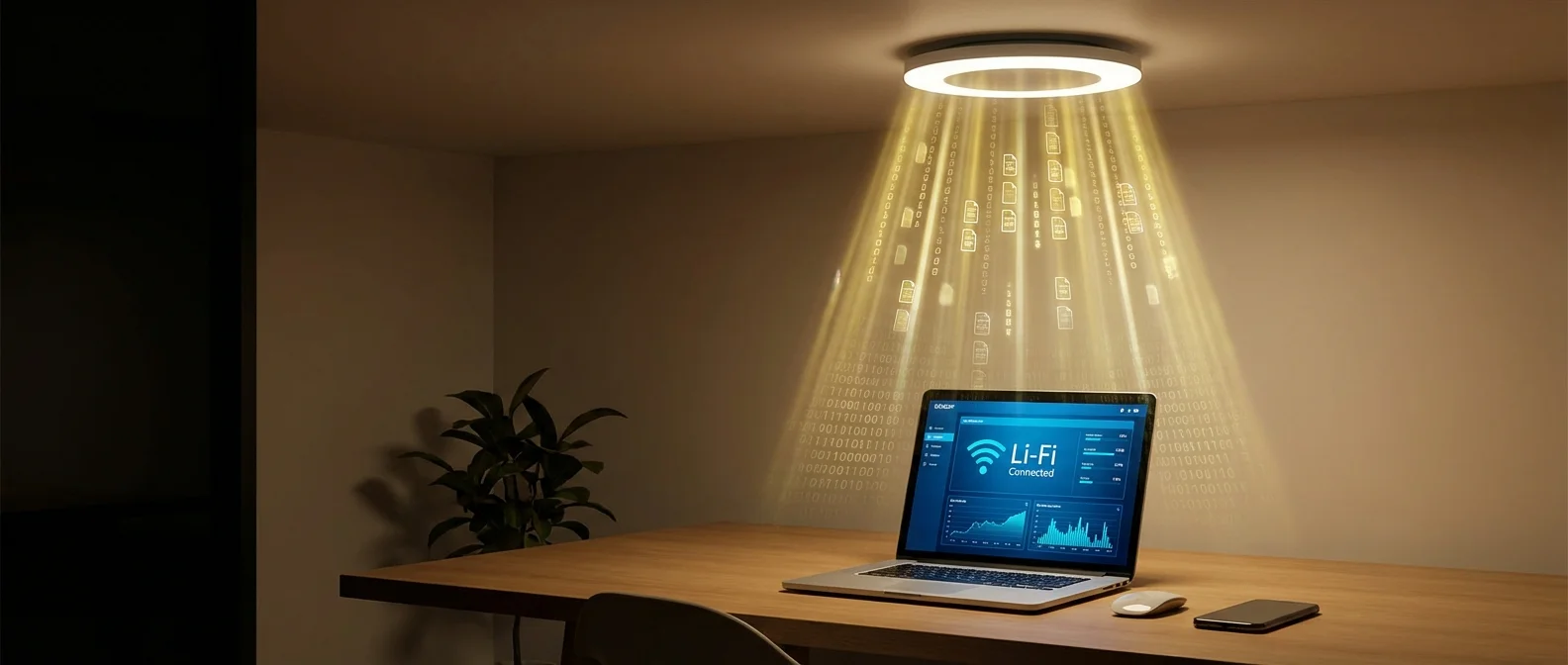
Imagine downloading an entire HD movie in seconds using nothing but the light from an LED bulb. It sounds like science fiction, but that's the core idea behind Li-Fi — a wireless communication technology that transmits data through light instead of radio waves. With lab speeds exceeding 224 Gbps, Li-Fi promises to fundamentally change how we connect.
📖 Read more: Mesh WiFi 2026: Best Systems Compared
What Is Li-Fi?
Li-Fi (Light Fidelity) is a wireless communication technology that uses LED light to transmit data. It belongs to the Optical Wireless Communications (OWC) family and leverages visible light, ultraviolet, and infrared spectrum.
The term was coined by Professor Harald Haas of the University of Edinburgh during his TED Global 2011 talk. In that presentation, Haas demonstrated live that an ordinary LED bulb could transmit data, effectively opening a new chapter in telecommunications.
How Li-Fi Works
- LED current switching: The transmitter toggles the current feeding the LED on and off at tremendous speed — millions of times per second
- Invisible to the human eye: The switching is so fast that the eye perceives no flickering — the bulb appears to shine normally
- Photodiode receiver: The receiving device (laptop, smartphone) has a light sensor that decodes the pulses into binary data
- Bidirectional communication: Modern Li-Fi systems support full-duplex operation — sending and receiving data simultaneously
Speeds & Records
The evolution of Li-Fi speeds over recent years proves this technology is far from merely experimental — it's advancing at an impressive pace:
It all started in 2009 when the Fraunhofer Institute achieved 125 Mbps. That was followed by 513 Mbps in 2010, over 1 Gbps in 2012, and 10 Gbps under lab conditions in 2013. For context, the best home WiFi routers at the time topped out at around 600 Mbps.
In July 2023, IEEE published the 802.11bb standard — the first global standard for light-based networking. This was a critical milestone: it ensured interoperability between devices from different manufacturers.
Li-Fi vs WiFi: The Big Comparison
The Li-Fi vs WiFi debate isn't about which technology is “better” — it's about which one fits each scenario. Here are the key differences:
Li-Fi vs WiFi Comparison
| Feature | Li-Fi | WiFi |
|---|---|---|
| Transmission medium | Visible light (LED) | Radio waves |
| Max speed | 224 Gbps (lab) | 46 Gbps (WiFi 7) |
| Range | Single room | Tens of meters |
| Wall penetration | No | Yes |
| Security | Very high | Moderate |
| EM interference | None | Possible |
| Installation cost | High | Low |
| Market maturity | Emerging | Fully established |
Li-Fi's critical advantage is security: since light can't pass through walls, nobody in the next room or out on the street can intercept the data. At the same time, the absence of electromagnetic interference makes it ideal for environments where radio frequencies are problematic.
On the other hand, WiFi excels in practicality and flexibility — it works everywhere, passes through walls, and requires no hardware in every room. In many scenarios, the two technologies don't compete but rather complement each other.
Real-World Applications
Li-Fi is no longer just a lab experiment. Several industries are already leveraging its unique characteristics:
Aviation
Zero risk of interfering with aircraft radar or navigation systems. Companies like Oledcomm are developing Li-Fi solutions for in-flight connectivity that replace unreliable on-board WiFi.
Hospitals
Radio waves can interfere with medical equipment (MRI machines, patient monitors). Li-Fi eliminates that risk, delivering reliable connectivity right next to critical devices.
Underwater Communication
Radio waves don't propagate well through water. Li-Fi is used with ROVs (remotely operated vehicles) to transmit data beneath the ocean surface.
Military & NATO
Terra Ferma (USA) has been supplying Li-Fi systems to NATO military installations since January 2025. The inability to intercept signals through walls provides a strategic advantage.
Warehousing & Logistics
Indoor positioning via LED lights — centimeter-level accuracy, perfect for autonomous warehouse robots and inventory tracking.
📖 Read more: WiFi 7: What Changes & Best Routers 2026
Smart Advertising
Municipal streetlamps can push promotional data to nearby smartphones via light — targeted location-based advertising without Bluetooth or WiFi.
Key Milestones
Li-Fi's journey from academic concept to commercial product has been marked by several notable milestones:
Li-Fi Timeline
- 2011: Harald Haas introduces the term “Li-Fi” at TED Global. In October, the Li-Fi Consortium is founded by Fraunhofer IPMS
- 2012: PureLiFi is founded in Edinburgh as the first company dedicated exclusively to Li-Fi
- 2014: First commercial Li-Fi system debuts at MWC Barcelona
- June 2018: BMW in Munich tests Li-Fi in an industrial environment in collaboration with the Fraunhofer Heinrich-Hertz-Institute
- August 2018: Kyle Academy in Scotland becomes the first school in the world to use Li-Fi
- July 2023: IEEE 802.11bb is published — the first global standard for light-based networking
- January 2025: Terra Ferma (USA) begins Li-Fi deployments for NATO military bases
Companies Leading the Market
A handful of companies are at the forefront of Li-Fi commercialization, each with a distinct strategy:
PureLiFi (Edinburgh, Scotland) — the pioneer company founded by Harald Haas, focusing on enterprise solutions and chipsets for device manufacturers. Signify (formerly Philips Lighting) — leverages its massive lighting portfolio to integrate Li-Fi into existing installations. Oledcomm (France) — specializes in aviation and healthcare applications. Terra Ferma (USA) — military and NATO deployments, commercially active since January 2025.
All of the above now offer full-duplex systems exceeding 1 Gbps — fast enough for 4K streaming, cloud gaming, and serious enterprise use cases.
Technical Layers (PHY Layers)
The Li-Fi standard defines three physical layers (PHY layers) depending on the use case:
Li-Fi PHY Layers
| Layer | Environment | Speed |
|---|---|---|
| PHY 1 | Outdoor | 11.67 kbps – 267.6 kbps |
| PHY 2 | Indoor | 1.25 Mbps – 96 Mbps |
| PHY 3 | Color Shift Keying | 12 – 96 Mbps |
PHY 1 is designed for outdoor use — for example, transmitting data from traffic lights to vehicles (V2I communication). PHY 2 covers typical indoor needs, while PHY 3 uses color shift keying — a technique that encodes data by varying the color of light rather than its intensity.
Challenges & Limitations
Despite the excitement, Li-Fi faces serious challenges that explain why it hasn't replaced WiFi yet:
Key Limitations
- Can't pass through walls: Every room needs its own LED transmitter — there's no single access point like WiFi
- Installation cost: Replacing or upgrading lighting across an entire building is a significant investment
- Depends on lighting: LEDs need to be on — though they can operate at intensities invisible to the human eye
- Limited range: Performance drops significantly at greater distances or off-angle positions
- Device ecosystem: Very few smartphones and laptops have built-in Li-Fi receivers — an external dongle is typically required
The Future of Li-Fi
With the publication of IEEE 802.11bb and steadily improving commercial systems, Li-Fi is on a growth trajectory. The market is expected to expand significantly in the coming years, especially in sectors where its advantages are irreplaceable.
Integrating Li-Fi receivers into future smartphones and laptops will be the game-changer. Companies like PureLiFi are developing miniature chipsets that can be embedded in mobile devices, eliminating the need for external dongles.
Combined with the rollout of 6G, Li-Fi could serve as a complementary indoor network — an ultra-fast, secure “last meter” of connectivity. Picture a future where every LED light fixture in offices, airports, hospitals, and schools doubles as an internet access point — that's the promise of Li-Fi.