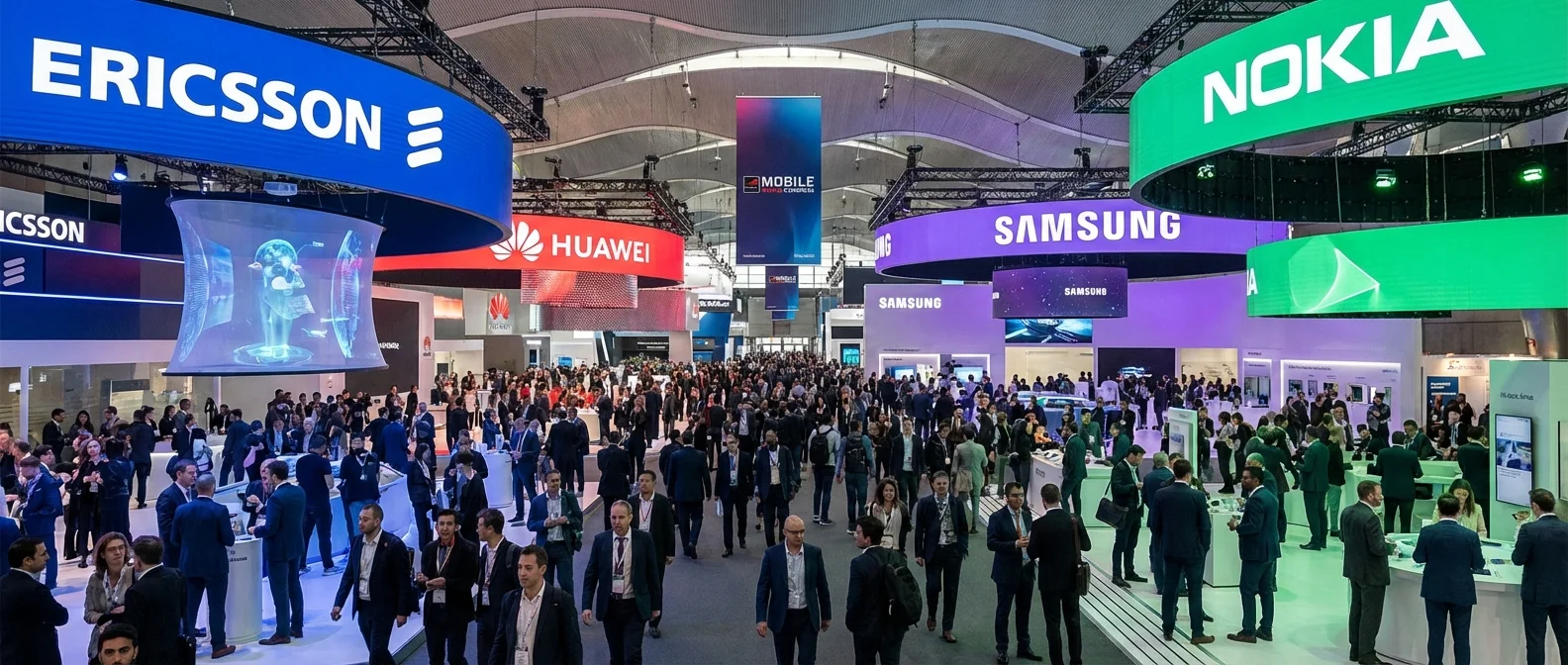
In less than ten days, Barcelona will once again host the world's largest telecommunications exhibition. MWC Barcelona 2026 (March 2-5) at Fira de Barcelona Gran Via is expected to attract over 100,000 visitors from 200+ countries, with hundreds of exhibitors preparing announcements that will shape the next decade of mobile communications. Here's everything we expect to see this year.
MWC 2026: The Industry's Biggest Gathering
The Mobile World Congress, organized by the GSMA since 1987, is the pulse of the mobile telecommunications industry. This year, the 39th edition is once again hosted at the impressive Fira de Barcelona Gran Via in L'Hospitalet de Llobregat. Based on 2025 figures that exceeded 109,500 visitors, organizers are targeting a new attendance record.
The central thematic pillars for 2026 revolve around five axes: 5G-Advanced, the path to 6G, AI-native networks, sustainability, and new consumer devices. Every major network equipment manufacturer — from Ericsson and Nokia to Huawei and Samsung Networks — is expected to present their vision for the next-generation transition.
5G-Advanced & the Road to 6G
The dominant technological narrative at this year's MWC will undoubtedly be the maturation of 5G-Advanced (3GPP Release 18). After years of development, 2026 marks the year when commercial 5G-SA deployments begin delivering real results — from network slicing in enterprise environments to ultra-reliable low-latency communication (URLLC) for industrial applications.
Simultaneously, we expect the first substantive 6G demos at the research level. Samsung, Nokia Bell Labs, and NTT Docomo have already pre-announced presentations on sub-THz communications and reconfigurable intelligent surfaces (RIS). The goal is clear: terabit-per-second speeds and latency below 1ms by 2030.
Network Evolution: From 5G to 6G
| Feature | 5G (Current) | 5G-Advanced | 6G (Projected) |
|---|---|---|---|
| Peak Speed | 10 Gbps | 20 Gbps | 1 Tbps |
| Latency | 1-4 ms | <1 ms | <0.1 ms |
| AI Integration | Limited | AI-assisted | AI-native |
| Spectrum | Sub-6 GHz / mmWave | Same + optimized | Sub-THz / THz |
| Satellite Integration | Not native | Basic NTN | Full NTN |
| Commercial Availability | Now | 2025-2027 | ~2030 |
AI-Native Networks & On-Device AI
Artificial intelligence is no longer just a trendy buzzword in telecommunications — it's a foundational architectural requirement. At MWC 2026, we expect extensive demonstrations of AI-native networks where intelligence is embedded at every layer: from spectrum management and energy optimization to automatic fault detection and predictive maintenance.
Ericsson is expected to showcase its next-generation Cognitive Network platform, while Nokia will focus on its MantaRay AI framework for network automation. On the on-device AI front, new chipsets — Snapdragon 8 Elite 2, Dimensity 9400+, Exynos 2600 — are expected to bring LLM capabilities directly to smartphones, with real-time translation, generative AI photography, and smart assistants running entirely on-device.
New Devices & Consumer Products
MWC remains the favorite stage for device reveals. Samsung is expected to share the first details about the Galaxy S26 lineup, while rumors point to an entirely new foldable form factor. Xiaomi, OnePlus, HONOR, and Motorola (with a new RAZR) will all compete for their share of attention.
The XR and spatial computing sector is particularly exciting. The Samsung-Qualcomm partnership for XR glasses is at an advanced stage, Meta is preparing new mixed reality glasses, and the Apple Vision Pro ecosystem continues to expand. We expect lightweight AR glasses prototypes that will bring the spatial computing experience closer to the average consumer.
Open RAN & Satellite Networks
The maturation of Open RAN is one of the most important technology themes at this year's MWC. After years of testing, the first large-scale commercial Open RAN deployments are becoming reality. Providers like Rakuten, Vodafone, and Deutsche Telekom are expected to present results from their pilot implementations, proving that open networks can compete with traditional solutions in performance and reliability.
Equally exciting is the field of Non-Terrestrial Networks (NTN). The integration of satellite connectivity directly into mobile phones — without special hardware — is now reaching commercial stage. Qualcomm, MediaTek, and AST SpaceMobile are expected to announce new agreements with telecom providers for satellite-to-phone services across Europe and Asia.
Sustainability & Green Networks
Energy efficiency is a central theme at MWC 2026. Telecom providers are committed to reducing Scope 3 emissions by 50% by 2030. We expect to see:
- AI-driven energy management — automatic antenna shutdown during low-traffic hours
- Liquid cooling for data centers and base stations
- Solar-powered base stations for remote areas
- Circular economy initiatives for network equipment recycling
Private 5G & Industry 4.0
Private 5G networks for enterprises represent perhaps the biggest commercial opportunity to emerge at MWC 2026. Network slicing technology now enables the creation of virtual, dedicated networks on the same infrastructure — fundamentally changing how industries, hospitals, and ports manage their communications.
We expect live demos of autonomous vehicles in factory environments, robotic surgery via 5G, and digital twins of entire industrial facilities. Siemens, Bosch, and BMW have already confirmed their participation with extensive exhibition stands.
Direct-to-Device
Satellite connectivity without specialized equipment. Messages, SOS calls, and basic data at any point on the planet — the next big revolution in connectivity.
XR & Spatial Computing
Lightweight AR glasses, mixed reality experiences, and new XR ecosystems. The Samsung-Qualcomm partnership and Meta glasses will steal the show.
Network Cybersecurity
Quantum-safe encryption, AI-powered threat detection, and zero-trust architectures. 5G/6G network security is emerging as a top priority.
Greek Presence at MWC
Greek telecom providers won't be absent from Barcelona. COSMOTE (part of the Deutsche Telekom group) is expected to present progress on 5G-SA deployment in Greece, while Vodafone Greece will participate through the Group pavilion with a focus on Open RAN. Nova (formerly Wind) is expected to announce new partnerships for enterprise 5G solutions.
It's worth noting that Greek startups in the IoT and smart city solutions space will have a presence at 4YFN (4 Years From Now), MWC's startup incubator event. The Greek technology scene is gradually gaining visibility on the global telecommunications stage.
What to Expect: Our Predictions
Based on leaks, official pre-announcements, and industry trends, these are our top predictions for MWC 2026:
First, artificial intelligence will dominate every aspect of the exhibition — from network management to devices. Second, we'll see the first truly commercial-ready 6G technologies at the research level. Third, Open RAN will finally prove its viability with real performance data. Fourth, satellite connectivity will go mainstream with new agreements between carriers and satellite companies.
MWC 2026 isn't just a trade show — it's the roadmap for the next decade of telecommunications. Starting March 2, Barcelona will transform for four days into the capital of connectivity's future. Stay tuned for full coverage immediately after the exhibition.