📖 Read more: 5G Greece 2026: Coverage Map & Speed Tests
📡 Nokia AI RAN Goes from Lab to Live Network
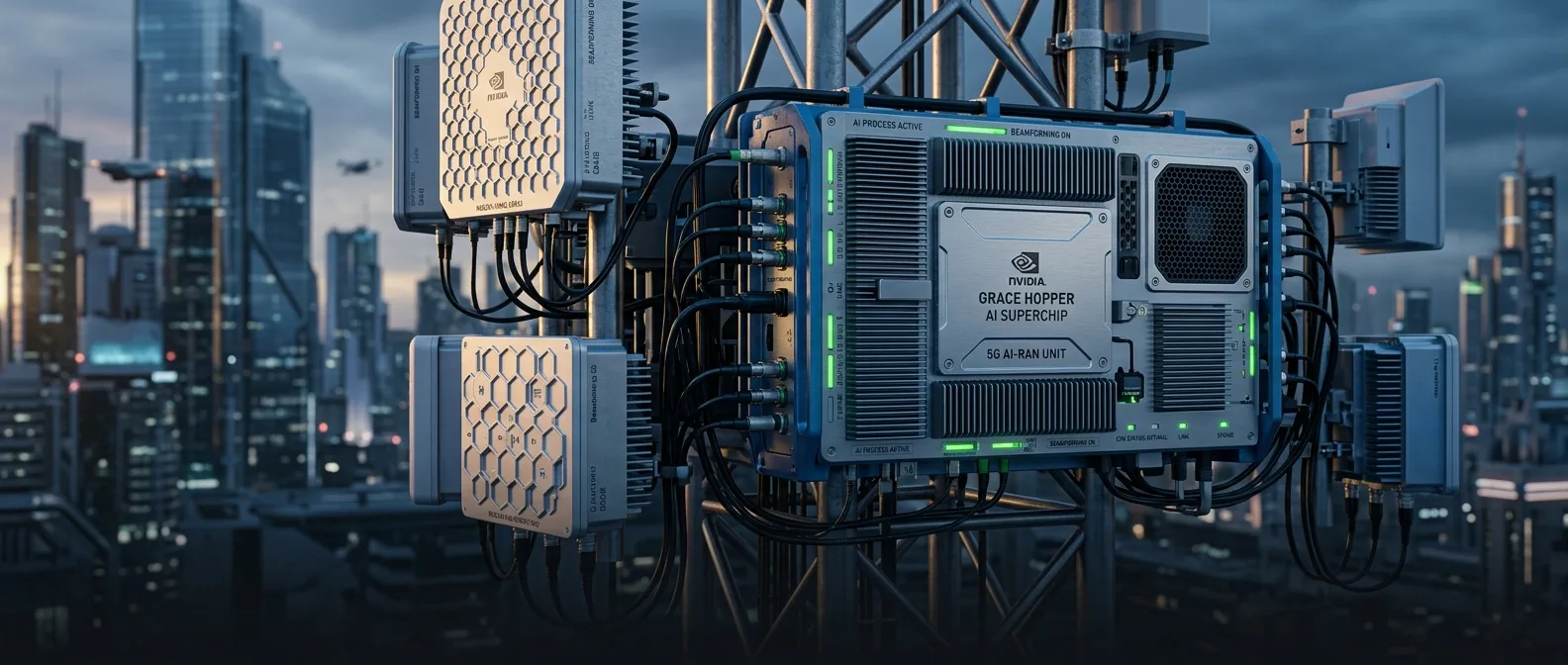
Nokia AI RAN isn't a research project anymore. By late 2025, the Finnish company completed functional tests of its anyRAN software on NVIDIA's GPU-accelerated AI-RAN platform with three major players: T-Mobile in the US, Indosat in Southeast Asia, and SoftBank in Japan. T-Mobile's trial at the AI-RAN Innovation Centre in Seattle used real over-the-air signals. A Nokia AirScale Massive MIMO radio on the 3.7 GHz band served actual user equipment doing video streaming, generative AI queries, and AI-based video captioning. All of this ran simultaneously with RAN processing on a single NVIDIA Grace Hopper 200 server.What this means in practice: Instead of separate hardware for RAN and AI workloads, you run both on the same GPU. The result: less space at cell sites, lower power consumption, and cheaper maintenance.
Indosat's Southeast Asian Breakthrough
Indosat Ooredoo Hutchison (IOH) went one step further — they completed the first AI RAN-powered Layer 3 5G call in Southeast Asia. They used their open, cloud native network with Nokia AirScale remote radio heads and RAN software accelerated by NVIDIA GPUs. This proves something crucial: AI and RAN workloads can run simultaneously on shared GPU infrastructure in a live operator environment. Not in a lab — on a real network with real users making real calls.💰 The Business Model That Changes Everything
SoftBank tested something that could become a breakthrough for operators. Using their AITRAS Orchestrator system, they identified spare AI-RAN compute capacity and used it to run third-party AI tasks. In other words: the RAN becomes an AI-enabled platform that can make money beyond connectivity. Think about it: operators have infrastructure everywhere. If they can monetize spare compute capacity for external AI applications, the RAN transforms from cost center to profit center.Physical AI at the Network Edge
NVIDIA and T-Mobile aren't stopping at RAN. They're testing physical AI applications running on the distributed edge network with the NVIDIA Metropolis platform. In San Jose, LinkerVision and other developers are testing "City Operations Agents" that use computer vision to optimize traffic light timing. Levatas with Skydio automates inspection of hundreds of thousands of miles of electrical transmission lines. Fogsphere provides safety AI agents for SAIPEM that detect and respond in real-time to dangerous events at construction sites.🏗️ The Hardware Ecosystem Taking Shape
Nokia expanded its AI-RAN partner ecosystem. Dell Technologies was joined by Quanta and SuperMicro for servers, while everything runs on Red Hat OpenShift for orchestration. The interesting part is they're using COTS-based choices — commercial off-the-shelf hardware instead of proprietary solutions. This makes the technology more accessible and gives operators more choices.NVIDIA Grace Hopper 200
Runs AI and RAN workloads simultaneously on one server
Nokia AirScale Massive MIMO
3.7 GHz (n77 band) radio tested in T-Mobile's lab
NVIDIA RTX PRO Blackwell Server Edition
For edge infrastructure, NVIDIA brings two solutions: the ARC-Pro with RTX PRO 4500 Blackwell for power-constrained cell sites and the RTX PRO 6000 Blackwell for higher-capacity mobile switching offices. The QCT QuantaEdge EGN77C-2U, based on the NVIDIA Aerial RAN Computer Pro platform, offers a compact, energy-efficient solution for inline GPU-accelerated RAN processing. Integration with Nokia's anyRAN approach gives operators flexibility to evolve from current 5G deployments to future AI-RAN and 6G capabilities.📖 Read more: 5G on Greek Islands: Holiday Internet 2026
🌍 Global Momentum Building
It's not just T-Mobile, Indosat, and SoftBank. BT, Elisa, NTT DOCOMO, and Vodafone Group are also evaluating AI-RAN technology powered by the NVIDIA AI Aerial platform. Rémy Pascal from Omdia commented that "the addition of leading operators from America, Asia, and Europe, along with a growing ecosystem of partners, shows that AI-RAN is gaining traction and has become a strategic direction for the industry.""AI workloads are forcing network changes at every level, including the radio layer itself."
Justin Hotard, President and CEO of Nokia
The Vision of International Collaboration
NVIDIA and Red Hat are collaborating to enable AI-RAN technologies on a common cloud-native platform, using Red Hat OpenShift and Red Hat AI Enterprise. The goal is to scale NVIDIA-accelerated RAN and AI workloads across hybrid cloud environments. Chris Wright, CTO of Red Hat, emphasizes that "success depends on the ability to scale and monetize these complex workloads in diverse environments without increasing operational silos."🚀 5G Advanced Toward AI-Native 6G
2026 finds Nokia completing its transition from pure RAN vendor to AI-RAN platform provider. Its anyRAN software now works proven on GPU-accelerated infrastructure, while the partner ecosystem has matured for commercial deployments. The technology drives evolution from today's 5G Advanced networks toward AI-native 6G. Instead of hardware-heavy upgrade cycles, operators can now upgrade their networks through software updates.NVIDIA's Metropolis VSS 3 Blueprint enables AI agents to reason over video footage from edge to cloud. It can summarize long-form video 100x faster than manual reviews and find specific events in less than five seconds.
🎯 Frequently Asked Questions
When will Nokia AI RAN be commercially available?
Functional tests completed in late 2025 with T-Mobile, Indosat, and SoftBank. Nokia targets commercial deployments within 2026, with the partner ecosystem ready for production scale-up.
What's the cost of upgrading to AI-RAN infrastructure?
No public cost figures exist, but using COTS hardware and the ability to do software upgrades instead of hardware replacement makes the investment more accessible than traditional RAN upgrades. ROI comes from monetizing spare compute capacity for third-party AI workloads.
How does AI-RAN technology affect power consumption?
Shared GPU infrastructure for AI and RAN workloads reduces total power consumption compared to separate hardware systems. Energy-efficient designs like the QuantaEdge EGN77C-2U target compact solutions for cell sites.
Sources: