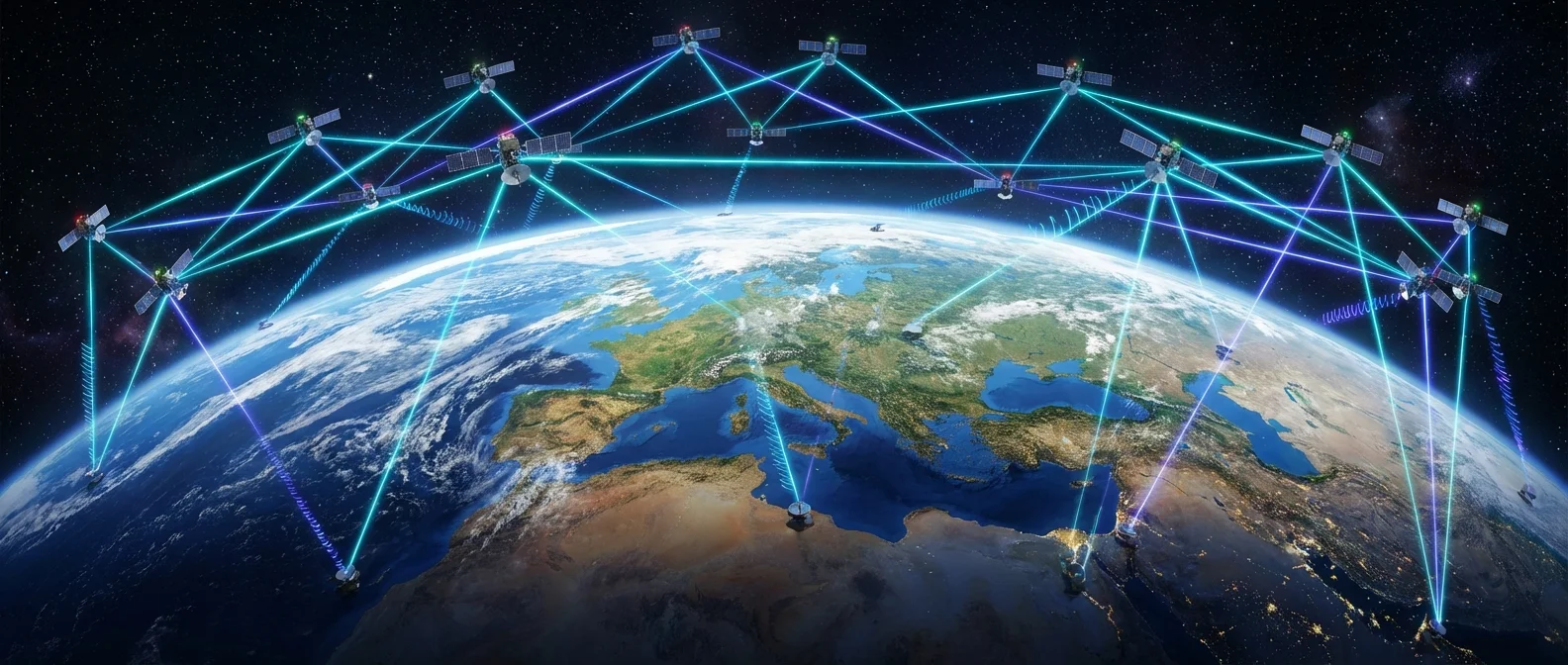
Cellular networks were designed to cover populated areas — but 80% of the Earth's surface remains unconnected. Non-Terrestrial Networks (NTN) are changing this fundamentally: satellites, high-altitude platforms, and drones are now being integrated directly into 5G standards, promising connectivity everywhere — from the middle of the Aegean Sea to the most remote islands on the planet.
📖 Read more: Direct-to-Cell: Satellite Internet on Your Regular Phone
What Are Non-Terrestrial Networks
NTN is a framework standardized by 3GPP to integrate non-terrestrial communication nodes into existing mobile networks. Rather than relying exclusively on ground-based cell towers, NTN leverages three main platform categories: satellites at various orbital altitudes, High-Altitude Platform Stations (HAPS), and Unmanned Aerial Vehicles (UAVs).
The critical innovation isn't satellites themselves — those have existed for decades — but their unification with 5G NR standards. This means an ordinary smartphone will be able to connect to a satellite without any specialized equipment.
The Three NTN Layers
- Satellites: LEO (160-2,000 km), MEO (2,000-35,786 km), GEO (35,786 km) — each orbit tailored for different requirements
- HAPS: Platforms at ~20 km altitude in the stratosphere — stationary positions for months, low latency
- UAV/Drones: Lower altitudes, flexible deployment — ideal for emergencies and temporary coverage
3GPP Standards: From Release 17 to 18
NTN standardization effectively began with 3GPP Release 17, published in 2022. This was the first standard to define specifications for 5G NR satellite access, addressing technical challenges like timing delay compensation and Doppler effect management.
Release 18 (5G-Advanced), completed in 2024, added significant enhancements: support for NTN on IoT bands (NB-IoT and eMTC via satellite), optimized inter-satellite handovers, and expanded frequency band coverage.
| Orbit Type | Altitude | Latency | Coverage/Sat | Status |
|---|---|---|---|---|
| LEO | 160-2,000 km | ~20-40 ms | Small | Active |
| MEO | 2,000-35,786 km | ~100-150 ms | Medium | Developing |
| GEO | 35,786 km | ~600 ms | Massive | Active |
| HAPS | ~20 km | ~1-2 ms | Local | Pilot |
Direct-to-Cell: The Big Promise
Direct-to-cell (D2C) technology represents perhaps the most exciting development in the space. Instead of requiring a satellite terminal, the satellite communicates directly with a regular mobile phone. The first generation of D2C focuses on text messaging and emergency calls, but the trajectory leads toward broadband data connectivity.
SpaceX, in partnership with T-Mobile, is developing direct-to-cell via specialized Starlink satellites. Initial tests are already underway, with text messaging services operating in pilot mode. AST SpaceMobile has gone a step further — its BlueBird satellites completed the first successful 5G broadband calls from space in 2024, proving that broadband D2C is feasible.
The Major NTN Players
Starlink (SpaceX)
Over 6,000 LEO satellites in orbit. Speeds of 50-200 Mbps, latency ~25 ms. T-Mobile partnership for direct-to-cell. Terminal ~€450.
AST SpaceMobile
BlueBird satellites with massive ~64 m² antennas. First 5G broadband D2C calls in 2024. Goal: direct coverage to ordinary smartphones.
OneWeb (Eutelsat)
~600 LEO satellites, speeds up to 150 Mbps. Focus on enterprise clients, governments, and maritime. Full global coverage.
Amazon Kuiper
Planning a constellation of 3,236 satellites. Launches underway. Integration with AWS cloud services. Direct Starlink competitor.
Constellations in Planning
- Telesat Lightspeed: 298 LEO satellites, focused on enterprise use
- China SatNet (Guo Wang): 12,992 satellites — the largest planned constellation
- EU IRIS²: European sovereign constellation for secure connectivity
Chipsets and Devices
Consumer NTN adoption critically depends on chipset availability. Qualcomm introduced Snapdragon Satellite in 2023, embedding NTN support into mobile processors. MediaTek follows with its own NTN solutions, while Samsung has integrated satellite SOS connectivity into recent Galaxy models.
📖 Read more: 6G Roadmap 2030: When Will It Be Ready
NTN frequency bands defined by 3GPP include S-band (2 GHz), L-band (1.5 GHz), Ka-band (26-40 GHz), and Ku-band (12-18 GHz). Each band serves different needs — S-band is ideal for D2C due to low power requirements, while Ka-band offers high throughput for fixed terminals.
Applications: From Maritime to IoT
NTN use cases span multiple sectors:
Maritime and aviation: Ships and aircraft operate in areas without terrestrial coverage. NTN provides reliable connectivity for crews, passengers, and IoT sensors. Greece's merchant fleet, the largest in the world, stands to benefit directly.
Rural and remote areas: Where deploying ground-based towers isn't economically viable, satellites bridge the gap. Tourist destinations on isolated islands gain broadband connectivity.
Disaster recovery: During earthquakes, wildfires, or floods, terrestrial networks often collapse. NTN ensures uninterrupted communications for first responders.
IoT sensors: Sensor networks on farms, forests, and maritime platforms — NTN-IoT (NB-IoT via satellite) connects millions of low-power devices.
Greece and NTN: Why It Matters Here
Greece is arguably the EU country that stands to benefit most from NTN. With over 6,000 islands (200+ inhabited), an extensive coastline, and vast maritime territory, network coverage gaps are inevitable with traditional technologies alone.
Greek NTN Use Cases
- Island coverage: Remote islands with weak or nonexistent 4G/5G coverage gain satellite connectivity
- Aegean Sea: Maritime connectivity for thousands of vessels, ferries, and boats
- Tourism: Reliable internet at tourist destinations lacking terrestrial infrastructure
- Wildfire protection: Coverage of forested and mountainous areas for IoT fire sensors
- IRIS² program: Greece as an EU member will benefit from the European satellite constellation
Challenges and Limitations
Despite their impressive capabilities, NTN face significant technical challenges. Latency remains an issue — even in LEO orbit, the ~20-40 ms is noticeable in real-time applications, while GEO orbit's ~600 ms round-trip makes video calls impossible. Doppler shift due to LEO satellite speed (~7.5 km/s) requires continuous compensation.
Handovers between satellites — as a LEO satellite passes over an area within minutes — are far more complex than terrestrial cell handovers. Power constraints also matter significantly: a smartphone transmits at much lower power than a satellite terminal, limiting D2C bandwidth.
What's Ahead: 2026-2030
The NTN trajectory over the coming years looks remarkable. During 2026, the first commercial D2C services via Starlink are expected, while AST SpaceMobile plans intensive BlueBird constellation expansion. Amazon Kuiper begins large-scale launches, and the EU's IRIS² constellation enters its construction phase.
In 3GPP Release 19, currently under development, NTN will be integrated even deeper into 5G-Advanced, with support for regenerative payloads (satellites with full processing capability), mobility between terrestrial and non-terrestrial networks, and unified resource management. By 6G (2030+), NTN is expected to become an equal part of the network architecture — connectivity will no longer depend on whether there's a cell tower nearby.