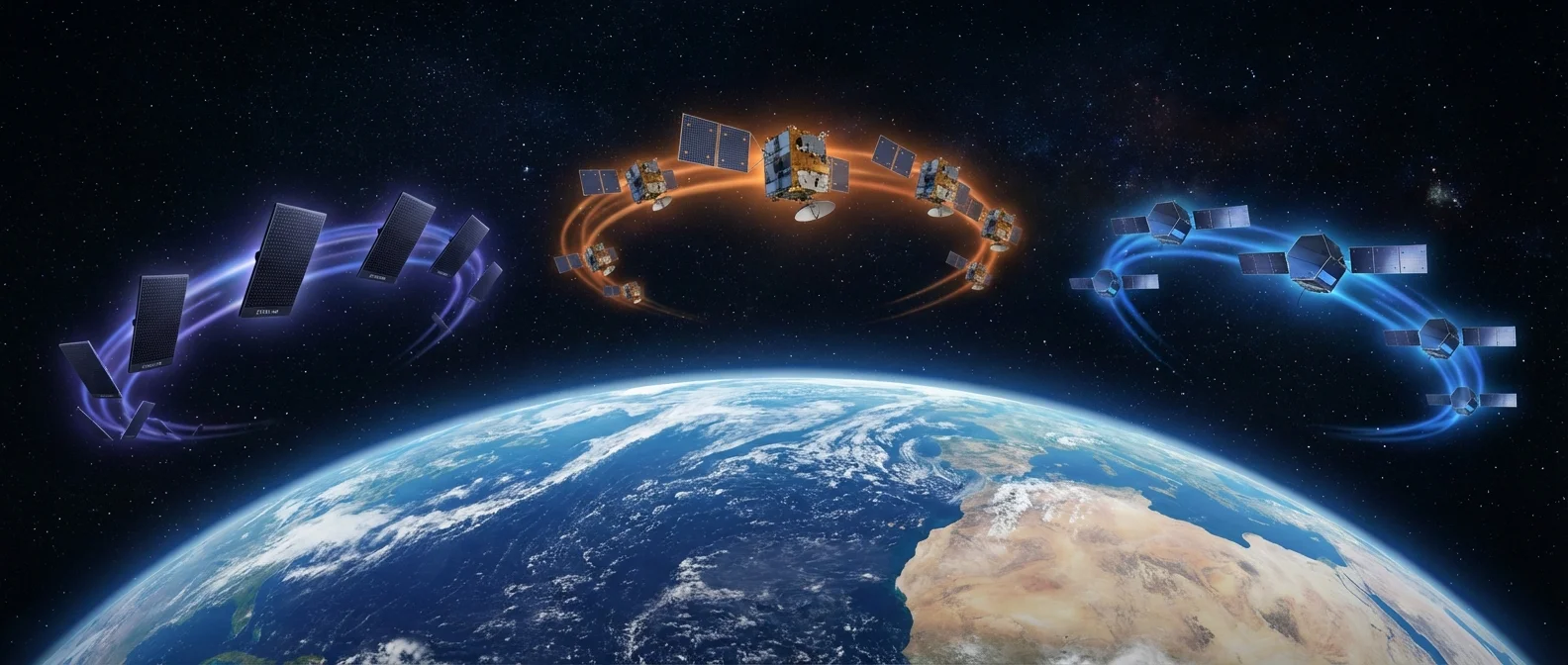
Three titans — SpaceX, Eutelsat OneWeb, and Amazon — are locked in a race to dominate low-Earth orbit satellite internet. One already serves 8+ million customers worldwide; another targets exclusively government and enterprise clients; and the third is pouring billions into catching up. In this comprehensive comparison, we break down every angle: satellites, speeds, pricing, coverage, terminals — and which provider makes sense for each use case.
📖 Read more: Satellite Internet for Greek Islands: Complete Guide 2026
🚀 The Three Contenders — Who They Are
The LEO satellite internet market in 2026 is no longer a one-horse race. Three fundamentally different companies — with different business models, strategies, and target audiences — are competing for a slice of a market projected to exceed $30 billion by 2030.
Starlink (SpaceX)
Starlink is the undisputed incumbent. It launched commercially in 2020, and by February 2026 it operates over 7,000 satellites in low Earth orbit (~550 km), serving 8+ million customers across 100+ countries. The model is direct-to-consumer: buy a terminal, pay a subscription, get connected. Gen 2 satellites feature inter-satellite laser links, eliminating the need for ground stations at every hop. Starlink offers Residential, Business, Maritime, Aviation, and RV plans — the broadest product lineup of any LEO provider.
Eutelsat OneWeb
OneWeb was founded in 2012 with ambitious plans, filed for bankruptcy in 2020 during the pandemic, and was rescued by the UK government and Bharti Global. In September 2023, it merged with French GEO operator Eutelsat to form the Eutelsat Group — Europe's largest satellite operator. It runs 652 satellites in orbit at 1,200 km altitude (Ku-band), built by Airbus (~150 kg each), distributed across 12 orbital planes. The critical distinction: OneWeb does not sell directly to consumers. It operates exclusively as a B2B provider through telecom operators, governments, defense agencies, maritime operators, and airlines. Global coverage was completed in March 2023 with 618 satellites in orbit.
Amazon Leo (Project Kuiper)
Amazon has entered the arena with serious firepower. Investing over $10 billion and targeting a 3,236-satellite constellation at 590-630 km, Project Kuiper was rebranded to Amazon Leo in November 2025. As of December 2025, 212 production satellites have been launched — but commercial service has not yet begun. A public beta waitlist opened in November 2025, with service anticipated within 2026. Technically, it boasts optical inter-satellite links at 100 Gbps, three terminal tiers (Leo Nano, Leo Pro, Leo Ultra), and a factory in Kirkland, Washington capable of producing 5 satellites per day. The project is led by former SpaceX VP Rajeev Badyal.
📊 The Big Comparison — Numbers & Specs
Let's put all three networks side by side. The following table covers the most important specifications of each provider as of early 2026:
OneWeb vs Starlink vs Amazon Kuiper — Full Comparison
| Feature | 🟠 Starlink | 🔵 OneWeb | 🟢 Amazon Leo |
|---|---|---|---|
| Satellites in orbit | 7,000+ | 652 | 212 (non-commercial) |
| Orbital altitude | ~550 km (LEO) | 1,200 km (LEO) | 590-630 km (LEO) |
| Coverage | 100+ countries | Global (B2B only) | Not yet available |
| Download speeds | 50-200 Mbps (up to 300+) | Variable (via partners) | 100 Mbps - 1 Gbps (planned) |
| Latency | 20-40 ms | ~70-100 ms | ~30-50 ms (target) |
| Terminal cost | ~€599 (Europe) | Via operator (B2B) | Nano / Pro / Ultra (tiered) |
| Monthly cost | ~€65/month (Greece) | B2B commercial agreements | Not yet announced |
| Target market | Consumer + Enterprise | B2B / Government only | Consumer + Enterprise |
| Inter-satellite links | Yes (laser, Gen 2) | No (Gen 1) | Yes (OISL, 100 Gbps) |
| Status in 2026 | Fully operational | Operational (B2B) | Beta / Launching |
🏆 Strengths — What Each Provider Does Best
Each provider excels in different areas. There is no single “outright winner” — the right choice depends entirely on your specific needs.
Starlink — The Coverage King
- Largest constellation: 7,000+ satellites
- 8+ million customers — proven at scale
- Available in 100+ countries
- Every plan type: home, business, maritime, aviation
- Laser inter-satellite links (Gen 2)
- Industry-leading 20-40 ms latency
OneWeb — The European Champion
- Part of Eutelsat Group — European sovereignty
- Airbus-built satellites — premium quality
- Ideal for government & defense contracts
- Global B2B coverage since March 2023
- Telco backhaul for underserved regions
- 12 orbital planes, Ku-band
Amazon Leo — The Tech Powerhouse
- Optical ISL at 100 Gbps — best-in-class
- Leo Ultra terminal: up to 1 Gbps
- AWS Ground Station integration (12 facilities)
- Factory producing 5 satellites/day in Kirkland
- $10+ billion investment — massive backing
- Three terminal tiers: Nano, Pro, Ultra
📡 Technical Deep Dive — Behind the Numbers
Orbits & Latency
Orbital altitude directly determines latency. Starlink sits at 550 km, Amazon Leo at 590-630 km, while OneWeb orbits at 1,200 km — more than double the altitude. This means OneWeb signals travel a significantly longer round trip, resulting in latency of ~70-100 ms versus Starlink's 20-40 ms. For gaming, video calls, and real-time applications, that difference is very noticeable.
Inter-Satellite Links: The Future's Backbone
Both Starlink (Gen 2) and Amazon Leo feature laser inter-satellite links — satellites communicate directly with each other without needing a ground station for every hop. OneWeb Gen 1 lacks ISL entirely, meaning every satellite needs a ground station within range — a significant limitation over open oceans and polar regions. The JoeySat Gen 2 test satellite launched in May 2023 is expected to bring ISL capability to future OneWeb generations.
Amazon Leo's optical ISL are particularly impressive at 100 Gbps — each satellite can relay enormous bandwidth to adjacent satellites via laser, creating a “network in the sky” that operates independently of ground infrastructure.
Terminals — Your Gateway to Orbit
Amazon distinguishes itself with three terminal tiers designed for different budgets and use cases:
Amazon Leo Terminals — Three Tiers
| Model | Size | Speed | Use Case |
|---|---|---|---|
| Leo Nano | 7 inches | Up to 100 Mbps | Budget option, IoT |
| Leo Pro | 11 inches | Up to 400 Mbps | Homes, small businesses |
| Leo Ultra | 20×30 inches | Up to 1 Gbps | Enterprise, heavy users |
Starlink offers a single standard consumer terminal at ~€599 in Europe — a one-size-fits-all approach. OneWeb doesn't sell terminals directly; they're deployed through commercial agreements with telecom operators and system integrators.
💰 Pricing & Cost Structure — What You'll Pay
Each provider's pricing strategy reflects its broader business model:
Starlink: Transparent consumer pricing. In Greece: ~€599 for the terminal plus ~€65/month for the residential plan. Business, Maritime (~€4,600/month), and Aviation plans are available at considerably higher price points. The pricing clarity reflects maturity and scale.
OneWeb: No public pricing whatsoever. It operates solely through B2B commercial agreements — telecom operators purchase capacity and resell to their own customers. Individual consumers cannot purchase OneWeb service directly unless their local operator uses it as backbone.
📖 Read more: Starlink vs Fixed Internet: 2026 Comparison
Amazon Leo: European pricing has not been announced. Amazon is expected to adopt aggressive pricing — potentially undercutting Starlink on terminal costs — with three pricing tiers corresponding to the Nano, Pro, and Ultra terminals.
🌍 Best Provider by Use Case
🏠 For Consumers (homes, rural & remote areas)
Today, Starlink wins hands-down. It's the only service you can actually buy, install, and use immediately. Speeds of 50-200 Mbps and latency of 20-40 ms are sufficient for 4K streaming, video calls, and gaming. OneWeb doesn't serve individual customers at all, and Amazon Leo isn't commercially available yet. From the second half of 2026, Amazon Leo could become a serious alternative — particularly if pricing is competitive.
🏢 For Enterprise & Government
The competition is more balanced here. OneWeb/Eutelsat Group maintains strong relationships with European governments, defense agencies, and major telecoms — especially for telco backhaul in underserved regions. Starlink Business offers higher speeds and priority access. Amazon Leo, with its deep AWS integration, will attract companies already embedded in Amazon's cloud ecosystem — offering seamless satellite-to-cloud connectivity via AWS Ground Station's 12 facilities worldwide.
🚢 For Maritime & Aviation
Starlink Maritime already dominates on commercial vessels, cruise ships, and mega-yachts, while Starlink Aviation serves major airlines. OneWeb provides maritime and aviation connectivity through B2B agreements, particularly for government and military vessels. Amazon Leo has not yet announced any maritime or aviation plans — that will change, but not before general commercial launch.
🏔️ For Remote & Island Communities
For remote continental and island regions (such as Greek islands without fiber), Starlink remains the only immediately practical solution. OneWeb serves as backbone capacity through local telecom operators, while Amazon Leo promises a low-cost terminal (the 7-inch Leo Nano) that could make satellite connectivity far more affordable — but only once commercial service begins in 2026.
⚠️ Weaknesses & Challenges for Each Provider
Starlink — Key Concerns
- Congestion: Speeds degrade significantly in densely populated areas
- Cost: ~€65/month + €599 terminal — more expensive than fixed broadband
- Regulatory: Licensing restrictions in certain countries
- Kessler effect: 7,000+ satellites increase the risk of orbital debris cascades
OneWeb — Key Concerns
- B2B-only: Not available to individual consumers
- No ISL: Gen 1 satellites rely entirely on ground stations
- Higher latency: ~70-100 ms due to 1,200 km orbit
- Bankruptcy history: Filed for bankruptcy in 2020 — financial stability questions linger
- Leap year bug: A 48-hour outage on December 31, 2024
Amazon Leo — Key Concerns
- Not operational yet: Only 212 satellites launched, no commercial service
- FCC deadline: Must launch half its constellation (~1,618 satellites) by July 2026
- Unannounced pricing: No European prices disclosed yet
- Far behind: 212 vs 7,000+ Starlink satellites
- Timeline slips: Multiple delays in launch schedule to date
🔮 Future Outlook — What to Expect in 2026-2030
The satellite internet market is at an inflection point. The next four years will determine whether all three players can coexist — or whether the market will consolidate around one or two dominant providers.
Starlink will continue expanding its constellation toward 12,000+ satellites. The most transformative development will be Direct-to-Cell technology — allowing ordinary smartphones to connect directly to Starlink satellites, eliminating dead zones worldwide. Maturity and scale remain its greatest competitive moats.
OneWeb/Eutelsat is planning Gen 2 satellites with inter-satellite links and enhanced capabilities. The Eutelsat merger provides access to GEO satellites for hybrid LEO+GEO solutions. European digital sovereignty remains a powerful selling point, particularly for governments and defense organizations seeking alternatives to American-controlled infrastructure.
Amazon Leo must launch half its constellation by July 2026 to meet its FCC deadline. In February 2026, the first Ariane 6 launch carried 32 satellites to orbit. Launches use Atlas V, Falcon 9, and Ariane 6 rockets, with Blue Origin's New Glenn planned for future missions. The deep integration with AWS creates a unique competitive advantage: space + cloud in a unified ecosystem — something no competitor can replicate.
The Verdict — Who Wins in 2026
Right now, Starlink wins on nearly every front — largest constellation, most customers, lowest latency, most mature service, broadest plan selection (residential, business, maritime, aviation). It's the only LEO satellite service you can actually sign up for and use today.
OneWeb/Eutelsat wins in the government, defense, and European digital sovereignty space — a critically important advantage for nations seeking alternatives to American-dominated satellite infrastructure.
Amazon Leo will be the most formidable challenger in the medium term — its technology (1 Gbps terminal, 100 Gbps OISL, AWS integration) is genuinely impressive, but commercial service is anticipated later in 2026. Until then, the undisputed king of LEO satellite internet remains Starlink.
📝 Conclusion
The three-way competition in LEO satellite internet will ultimately benefit consumers enormously. Three of the world's most powerful entities — SpaceX, Eutelsat Group, and Amazon — are investing tens of billions of dollars in satellites, terminals, ground stations, and laser links. Each company targets a different market segment: Starlink serves the broadest audience, OneWeb focuses on government and enterprise through telecom partners, and Amazon Leo aims to combine cloud and space into an integrated proposition.
For end users — particularly in remote and island communities lacking fiber infrastructure — this competition means better pricing, faster speeds, and more options in the near future. For now, Starlink remains the sole practical choice for most consumers. But the golden rule of technology markets holds true: the more competition enters, the lower prices fall and the better service gets.