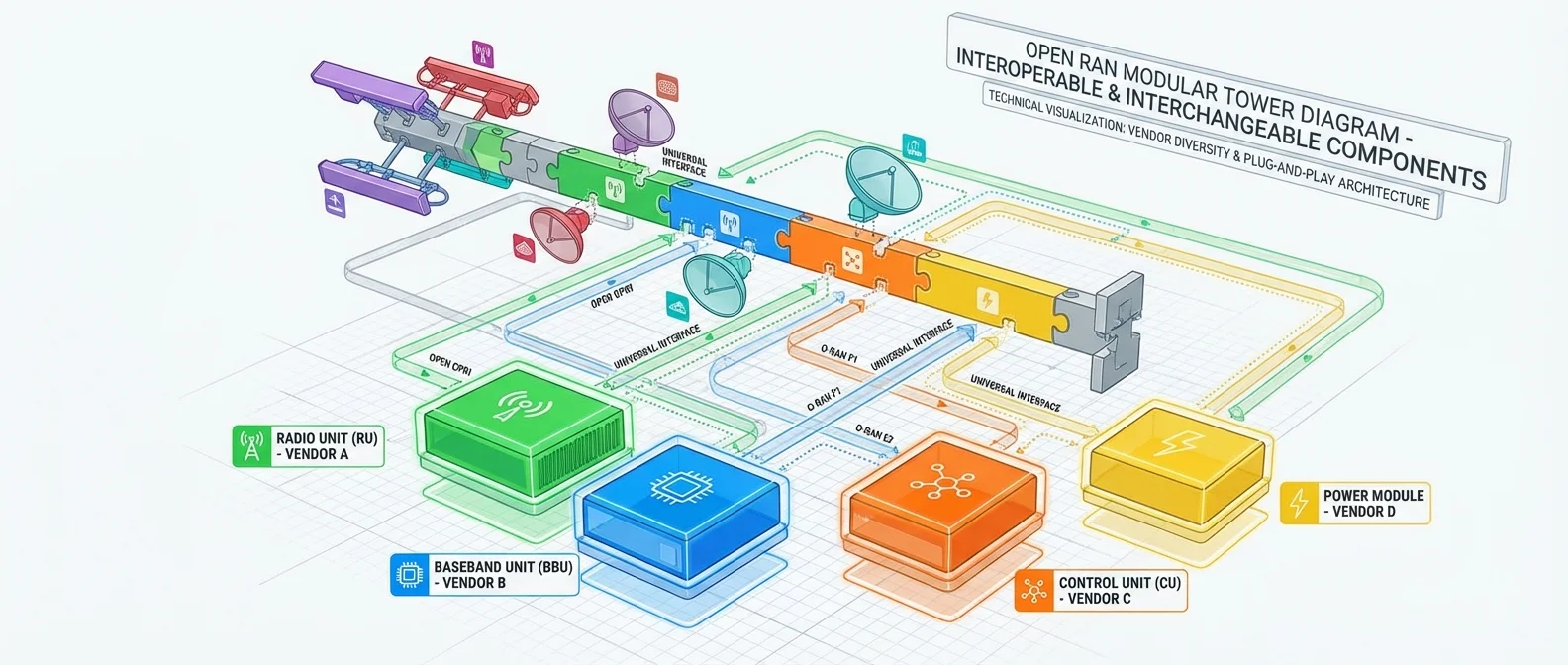
For decades, mobile networks have been built with closed, proprietary equipment — a handful of companies controlling the entire market. Open RAN (Open Radio Access Network) breaks this model by opening interfaces, decoupling hardware from software, and bringing real competition to telecommunications. It is arguably the biggest structural change in mobile networks since the 3G era, and it's already reshaping how operators around the world plan their network investments.
What Is Open RAN?
Open RAN is a mobile network architecture based on 3GPP standards that disaggregates Radio Access Network components and makes them interoperable through open interfaces. Instead of buying an entire stack from a single vendor (Ericsson, Nokia, or Huawei), operators can now mix and match components from different manufacturers. Think of it like the PC revolution: before IBM-compatible PCs, computers were monolithic. Open RAN brings the same modular philosophy to mobile infrastructure.
The 3 Core Blocks of Open RAN
- Radio Unit (RU) — The antenna and RF front-end, mounted on the cell tower
- Distributed Unit (DU) — Real-time signal processing, located near the RU
- Centralised Unit (CU) — Connection management and higher-layer protocols
Between the RU and DU, the eCPRI 7.2x Open Fronthaul interface replaces proprietary connections with an open standard.
Additionally, the RAN Intelligent Controller (RIC) adds a layer of intelligence — using AI/ML for automated, real-time network optimization, something impossible with traditional closed systems. The RIC operates in two modes: Near-RT (near real-time, decisions within 10ms-1s) and Non-RT (longer-term optimizations and machine learning policies).
Cloudification: The Heart of Open RAN
A fundamental pillar of Open RAN is cloudification — the decoupling of hardware and software. Network software becomes cloud-native, running on commodity, general-purpose servers (COTS — Commercial Off-The-Shelf) instead of expensive, specialized equipment from each manufacturer. This means an operator can use Dell or HP servers to run RAN software from Mavenir or Samsung, just as they would run applications in a data center.
The O-RAN Alliance: The Force Behind the Movement
The O-RAN Alliance was founded in 2018 by five major telecom operators: AT&T, China Mobile, Deutsche Telekom, NTT DOCOMO, and Orange. Today it counts over 30 operator members and approximately 300 contributors — technology companies, academic institutions, and startups.
The Alliance absorbed the activities of the earlier xRAN and C-RAN forums, establishing itself as the central standardization body for open radio access networks. Its specifications complement (rather than replace) 3GPP standards. The Alliance operates 10+ working groups covering topics from Open Fronthaul to cloud architecture, security, and AI/ML-based optimization. Each year, new specifications, test profiles, and PlugFest results are published.
Comparison: Traditional RAN vs Open RAN
Where does the new architecture differ?
| Feature | Traditional RAN | Open RAN |
|---|---|---|
| Vendor Lock-in | Full — single vendor | Free choice per component |
| Deployment Cost | High (proprietary hardware) | 20-40% lower (COTS servers) |
| Upgrade Flexibility | Vendor-dependent | Independent per-layer upgrades |
| Integration | Simple — single vendor | More complex — multi-vendor |
| Performance | Optimized end-to-end | Rapidly improving |
| AI/ML Optimization | Limited | RIC — real-time optimization |
Who Is Adopting Open RAN?
Rakuten Mobile (Japan)
The world's first fully virtualized mobile network. A greenfield deployment with cloud-native architecture since 2020, proving that Open RAN works at national scale.
Dish Network (USA)
Building the first 5G Open RAN network in the US from scratch. A greenfield deployment with full cloudification on AWS, demonstrating the model's viability.
Vodafone & Deutsche Telekom
Brownfield deployments on existing networks. Vodafone has Open RAN sites in the UK and Turkey, while DT runs pilots in Germany — and the DT group includes COSMOTE in Greece.
Key Vendors
Mavenir, Samsung, Fujitsu, NEC and Altiostar (acquired by Rakuten). New players challenging the monopolistic triad of Ericsson-Nokia-Huawei.
The Geopolitical Dimension: Why Do the US and EU Care?
Beyond technology, Open RAN has deep geopolitical significance. The EU and the US are actively promoting Open RAN as a strategy to reduce dependence on Huawei and Chinese technology in 5G networks more broadly. After the security debates of the late 2010s, where several nations banned or restricted Huawei equipment, Open RAN emerged as the constructive alternative: rather than simply banning a vendor, build an ecosystem where no single vendor can dominate.
"Supply chain diversity is not merely an economic issue — it's a matter of national security. Open RAN gives us the ability to build networks without dependence on any single country."
The EU 5G Toolbox explicitly recommends Open RAN for supply chain diversification, while the US is funding Open RAN research and development through legislative initiatives like the CHIPS and Science Act. India has launched its own 5Gi standard with Open RAN principles, the United Kingdom has invested £250 million in Open RAN R&D, and Japan continues to lead through Rakuten's global success as a reference deployment.
What Does This Mean for Greece?
COSMOTE, as part of the Deutsche Telekom group, is in a privileged position — DT is a founding member of the O-RAN Alliance and is already running pilot Open RAN deployments in Germany. Any technology successfully tested on DT's network quickly becomes available to subsidiary operators, including COSMOTE in Greece.
Vodafone Greece, through the Vodafone Group which leads Open RAN in Europe, is also expected to follow. Vodafone Group has committed to 2,500+ Open RAN sites across Europe by 2027. For Greek consumers, this potentially means lower service costs, faster network upgrades, and greater market competition. Increased competition among equipment suppliers translates into lower investment costs for operators, which in the long term benefits the end user.
Challenges and Risks
Despite the benefits, Open RAN is not without obstacles. Traditional vendors like Ericsson and Nokia point out that their integrated solutions offer greater performance and reliability, and they're not entirely wrong — at least for now.
Key Obstacles
- Integration complexity — Multi-vendor integration requires more testing and troubleshooting
- Security — More open interfaces means a larger attack surface
- Skills gap — Operators need new skill sets (cloud-native, automation, DevOps)
- Maturity — Brownfield deployments remain more complex than greenfield
- Energy consumption — COTS servers still consume more energy than specialized hardware
However, progress has been impressive. Early Open RAN systems significantly lagged in throughput and latency. Today, next-generation products are approaching the performance of traditional solutions, while the addition of purpose-built chips (accelerators) to COTS servers is bridging the energy efficiency gap. Most analysts agree the question is not “if” but “when” Open RAN will dominate.
The Open RAN market is expected to exceed $20 billion by 2028, according to industry analyst estimates. The share of new RAN deployments using Open RAN architecture is expected to reach 15-20% by 2028, up from just 5% in 2024. Key trends to watch:
- Energy-efficient RAN — AI-driven power management via RIC to reduce energy costs
- Private 5G networks — Industries adopting Open RAN for private networks in factories and ports
- Open RAN as a Service — Cloud providers (AWS, Azure, Google) offering managed Open RAN platforms
- 6G readiness — The open architecture will serve as the foundation for 6G networks beyond 2030, with native AI integration
- Convergence with edge computing — Open RAN's distributed nature naturally aligns with multi-access edge computing (MEC) for ultra-low latency applications
Open RAN is not just a technical change — it's a movement that will reshape the entire telecommunications industry. From equipment monopolies to open innovation, the transition has already begun.