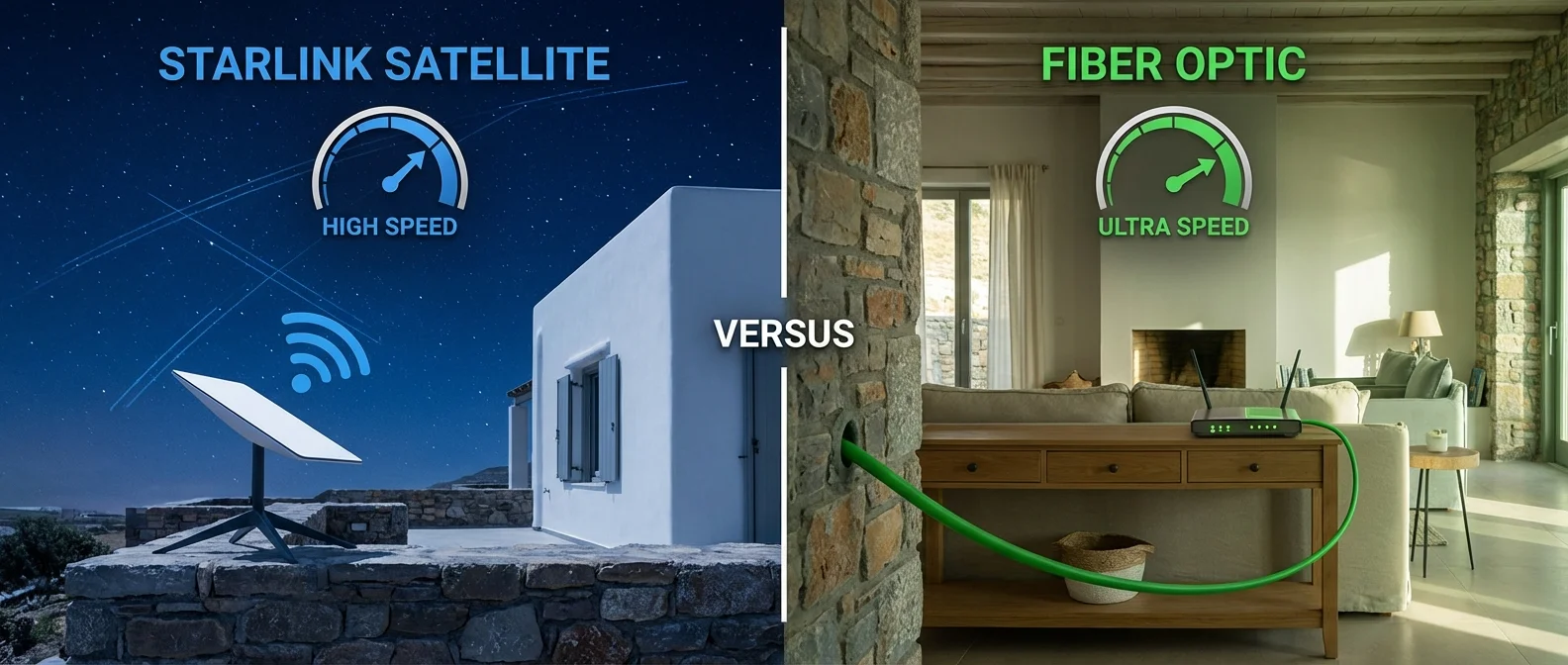
Starlink or fixed broadband? That's the question thousands of Greeks face when searching for reliable internet. The answer isn't straightforward — it depends on where you live, what you need, and your budget. In this article, we put Starlink side by side with fiber (FTTH), VDSL, and FWA — complete with hard numbers, comparison tables, and practical use-case scenarios tailored to the Greek reality.
📖 Read more: Starlink Greece 2026: Prices & Experience
📊 The Big Comparison — Numbers & Technologies
Before diving into the details, let's look at the big picture. In Greece as of 2026, there are four primary internet options: FTTH (fiber), VDSL, FWA (Fixed Wireless Access), and Starlink. Each technology has its own strengths and weaknesses.
Internet Technology Comparison Table 2026
| Feature | FTTH (Fiber) | VDSL | FWA | Starlink |
|---|---|---|---|---|
| Download | 100 Mbps - 1 Gbps | 50-100 Mbps | 30-100 Mbps | 50-150 Mbps |
| Upload | 100 Mbps - 1 Gbps | 5-10 Mbps | 5-20 Mbps | 10-20 Mbps |
| Latency | 1-5 ms | 8-15 ms | 15-40 ms | 25-35 ms |
| Monthly cost | €35-75/month | €25-35/month | €25-35/month | ~€65/month |
| Upfront cost | €0-50 | €0-30 | €0-50 | ~€349 |
| Data cap | Unlimited | Unlimited | Varies by provider | 1 TB/month |
| Availability | ~50% of population | ~80% of population | ~70% of population | Everywhere |
| Weather impact | None | None | Slight | Rain/snow |
| Installation | Technician required | Technician required | Self-install | Self-install |
🏠 FTTH (Fiber) — The Speed King
Fiber-to-the-Home (FTTH) is the gold standard of internet technology. In Greece, the three major providers — Cosmote, Vodafone, and Nova — offer packages up to 1 Gbps. The advantages are clear: download speeds up to 1,000 Mbps (symmetrical on many plans), latency of just 1-5ms, unlimited data, rock-solid stability regardless of weather, and monthly costs of €35-75.
The major drawback? Availability. As of February 2026, FTTH coverage in Greece reaches roughly 50% of the population — mainly in urban centers. If you live in a city, you can probably get fiber. If you're on an island or in a village, the odds drop dramatically. The government is investing through the SFBB (Super-Fast Broadband) project, but full coverage is still years away.
Fiber Packages in Greece 2026
| Provider | Speed | Price/month | Notes |
|---|---|---|---|
| Cosmote | Up to 1 Gbps | €35-75 | Largest FTTH footprint |
| Vodafone | Up to 1 Gbps | €35-70 | Own network in city centers |
| Nova | Up to 1 Gbps | €35-65 | Rapid expansion via SFBB |
📡 VDSL — The Most Common Option
VDSL (Very-high-bit-rate Digital Subscriber Line) remains the most widely available fixed-line technology in Greece. It uses existing copper lines with fiber running to the street cabinet (FTTC), delivering speeds of 50-100 Mbps depending on distance from the cabinet. The price is low (~€25-35/month), but upload speeds are limited (5-10 Mbps).
Compared to Starlink, VDSL is cheaper and more stable, but its upload speeds lag behind. It also depends on physical infrastructure — if the copper line is old or far from the cabinet, performance suffers.
📖 Read more: Cosmote vs Vodafone vs Nova 2026: Provider Comparison
📶 FWA — Fixed Internet Without Cables
FWA (Fixed Wireless Access) uses 4G/5G mobile networks to provide fixed internet. It's essentially a router with a mobile antenna delivering 30-100 Mbps. In Greece, Cosmote, Vodafone, and Nova offer FWA solutions at €25-35/month — competitively priced against VDSL.
In areas lacking a fixed telephone line but with decent mobile coverage, FWA is an excellent alternative. However, quality depends entirely on 4G/5G coverage — in remote areas, it may prove unreliable.
🛰️ Starlink — Strengths & Weaknesses
Starlink Advantages
- Works everywhere — islands, mountains, countryside
- No infrastructure needed — self-install in 30 minutes
- 50-150 Mbps download — respectable speeds
- 25-35ms latency — gaming and video calls work fine
- No contract lock-in — cancel anytime
- Portability with Starlink Mini
Starlink Disadvantages
- ~€65/month + €349 hardware — pricier option
- 1 TB monthly data cap
- Variable speeds — depends on time and location
- Rain and snow can interrupt the connection
- Requires clear view of the sky
- Upload speed only 10-20 Mbps
👤 Use-Case Scenarios — Which Is Right for You?
Scenario 1: Urban Dweller in Athens/Thessaloniki
If you live in a major city with FTTH access, fiber wins hands down. More speed (up to 1 Gbps), lower latency (1-5ms), unlimited data, and lower cost (~€35-55/month). Starlink makes no sense here — unless you want it as a backup.
Scenario 2: Greek Island Resident Without Fiber
This is where Starlink truly shines. If your only options are sluggish ADSL (2-10 Mbps) or flaky 4G, Starlink delivers 50-150 Mbps with zero infrastructure dependencies. Yes, it costs more — but the quality leap is enormous.
Scenario 3: Farmer/Rancher in a Mountain Village
Many mountainous areas lack both fixed telephone lines and mobile coverage. Starlink is the only viable solution. Self-installation means no technician visit, and the connection is reliable as long as you have electricity.
Scenario 4: Tourism Business
A hotel or vacation rental in a tourist area can use Starlink as a primary or backup WiFi connection for guests. The 50-150 Mbps bandwidth handles typical multi-user streaming and browsing needs comfortably.
📖 Read more: OneWeb vs Starlink vs Amazon Kuiper — Who Wins
Scenario 5: Business Needing Backup Connectivity
The ideal approach for businesses is a hybrid setup: fiber as the primary connection + Starlink as backup. If the fixed line drops, Starlink takes over automatically — virtually zero downtime. This is especially valuable for companies reliant on cloud services, VoIP, and online sales.
🇬🇷 The State of Fiber in Greece — 2026
FTTH coverage in Greece as of February 2026 is estimated at roughly 50% of the population. The government is investing significantly through the SFBB (Super-Fast Broadband) program aimed at bringing fiber to rural and non-urban areas. However, completing these projects will take years — on some islands and mountain regions, FTTH may not arrive until 2030 or later.
In the meantime, Starlink bridges the digital divide. It doesn't replace fiber — but it does something equally important: it delivers decent internet where fiber won't reach for years to come.
💡 The Ideal Combo — Fiber + Starlink
The Optimal Hybrid Approach
For businesses and demanding users, the best setup combines both:
- Primary connection: Fiber (FTTH) — speed, stability, unlimited data
- Backup: Starlink — automatic failover if fiber goes down
- Cost: ~€35-55/month fiber + ~€65/month Starlink = ~€100-120/month
- Result: Near-zero downtime, especially critical for cloud-based work
📝 Final Verdict
Which Should You Choose?
| If you... | Then... |
|---|---|
| Live in a city with FTTH | Get Fiber — faster, cheaper, more reliable |
| Live on a village/island without fiber | Get Starlink — the only realistic option |
| Need a backup connection | Starlink as secondary — ideal failover |
| Want cheap internet | VDSL or FWA — €25-35/month, no hardware |
| Are a gamer/streamer | Fiber — 1-5ms latency, unlimited data |
| Travel frequently | Starlink Mini — internet anywhere |
There's no single “winner” between Starlink and fixed broadband. Each technology serves different needs. Fiber is faster, cheaper, and more stable — but it doesn't reach everywhere. Starlink is more expensive and variable — but it works anywhere in Greece, even on the most remote island. The right choice depends entirely on your specific needs and what's available in your area.