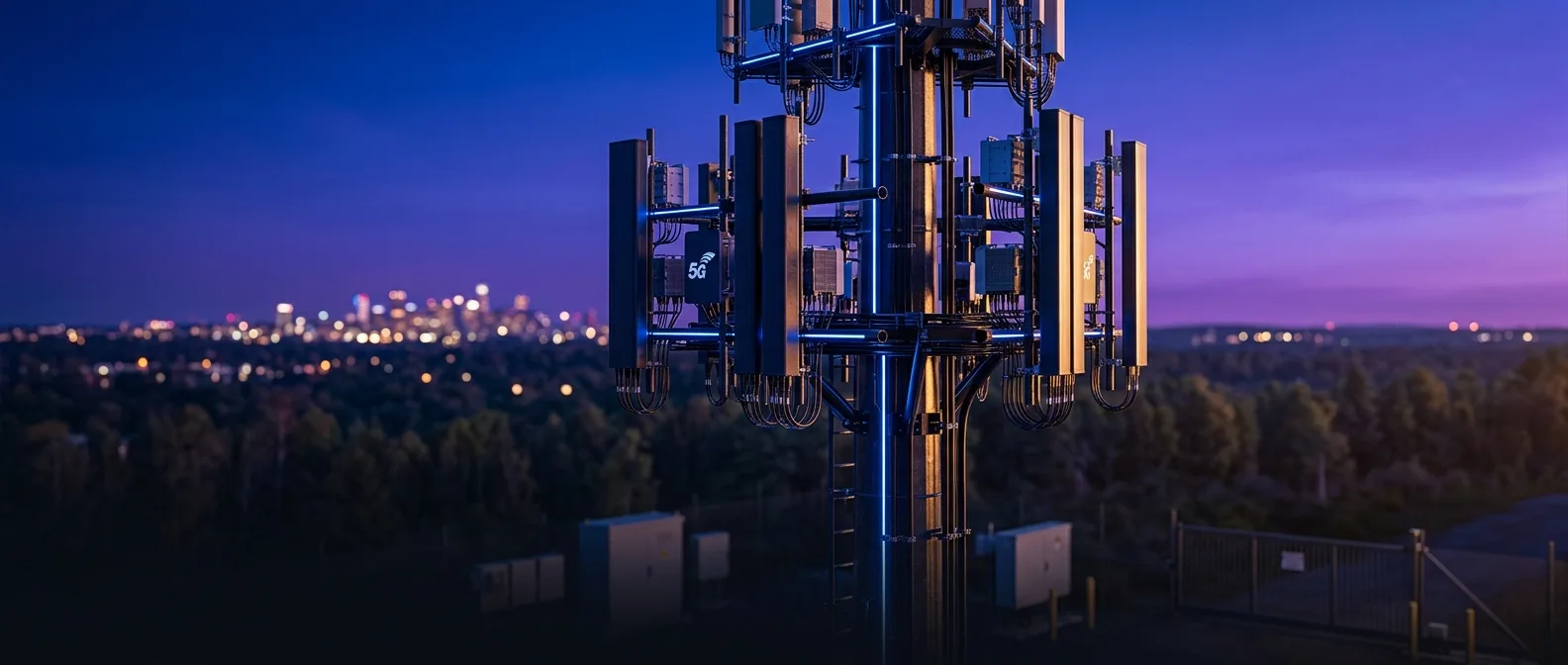
Four tech giants just formed an alliance that could rewrite how cellular networks operate. T-Mobile, NVIDIA, Ericsson, and Nokia launched the first AI RAN Innovation Center in Bellevue, Washington this September 2024. Their goal? Embed artificial intelligence directly into radio access networks (RAN), with 2026 targeted for networks that learn and predict.
📖 Read more: Google Teams Nokia & One NZ: AI Networks 2026
🔬 What AI RAN Means and Why It's Different from Open RAN
AI RAN isn't just an Open RAN upgrade. It's a completely different approach that puts artificial intelligence at the operational core. Where Open RAN focuses on vendor independence and open standards, AI RAN takes that foundation and builds something more ambitious. Picture networks analyzing billions of data points every second. Networks that learn user patterns and predict when Times Square will need extra capacity on New Year's Eve. That's exactly what T-Mobile promises with AI RAN. The breakthrough comes through integrating NVIDIA GPUs directly into the radio access network. This doesn't just mean faster processing — it means running AI workloads parallel to traditional telecom functions.AI RAN vs Open RAN difference: Open RAN disaggregates components and makes them more flexible. AI RAN takes that architecture and adds accelerated computing for real-time AI decisions at the air interface.
⚡ The Four-Way Alliance and Bellevue Innovation Center
The AI RAN Innovation Center isn't just another lab. It's the result of a strategic alliance bringing together different specializations: T-Mobile brings real-world network knowledge, NVIDIA the Aerial AI platform, Ericsson and Nokia global telecom expertise. The timing isn't coincidental. These companies are all founding members of the AI-RAN Alliance announced at Mobile World Congress 2024. But while many alliances stay theoretical, this one invests in a physical innovation center.What Makes the Bellevue Center Special
Choosing Bellevue wasn't random — it sits near T-Mobile headquarters and Microsoft's ecosystem. Here, engineers from all four companies will develop algorithms that optimize network performance in real time. The timeline accelerates beyond proof-of-concepts to commercial deployments starting mid-2025.📊 Gaming, AR, and 5G Advanced: First Applications
T-Mobile isn't starting AI RAN from scratch. They've already begun integrating AI into their 5G Advanced network, focusing on three key areas requiring ultra-low latency.Gaming & AR/VR Lag reduction through L4S technology
Network Slicing Dedicated connections for mission-critical apps
RedCap Devices Billions of new IoT devices
Network Slicing with Smart Prediction
T-Mobile already launched T-Priority for first responders and Security Slice for enterprises. With AI RAN, these slices become more dynamic — networks will predict when emergency services need extra capacity and provide it proactively.🧠 Beyond Telecom: AI as a Service at the Edge
AI RAN extends beyond telecommunications infrastructure. The "multi-purpose network" concept means the same infrastructure can run AI workloads for third-party applications. Imagine a manufacturing plant using T-Mobile's AI RAN for real-time quality control. Or smart cities leveraging distributed computing power for traffic optimization. This "AI as a Service" (AIaaS) vision through cellular networks could transform multiple industries.Huang isn't exaggerating. When we talk about GPUs in radio access networks, we're talking about the same technology powering ChatGPT, but distributed across cell towers. Nokia proposes something even more ambitious: using 6G sensors for environmental monitoring at national scale."AI will reinvent the wireless communication network and industry — going beyond voice, data, and video to support a wide range of new applications like generative AI and robotics."
Jensen Huang, CEO NVIDIA
🚀 Technical Challenges and Next Targets
Despite impressive progress, AI RAN faces significant technical challenges. First is power consumption — GPUs require substantially more power than traditional network processors. The second challenge is complexity. While Open RAN already creates integration challenges, AI RAN adds additional complexity layers. Companies must find ways to make AI transparent to traditional telecom workloads.Real-time Decision Making
Algorithms analyzing network performance in milliseconds and making dynamic optimizations
Edge Computing Integration
Distributed AI processing bringing computational power closer to users
The €45 Billion Market
According to estimates, the AI in RAN market is expected to grow 45% annually from 2023 to 2028. Asia-Pacific is considered the largest market, but T-Mobile's American initiative aims to steal the spotlight. Of course, these numbers remain speculative. The AI RAN market is in embryonic stages, and real estimates will come when we see the first commercial deployments.🌐 The Future: 6G and Digital Twins
The biggest target isn't 5G Advanced but preparing for 6G. The AI RAN Innovation Center already works on AI-based air interfaces that will be native to next-generation networks. Digital twins take new dimensions. Instead of just modeling physical infrastructure, they'll simulate entire ecosystems — from traffic patterns to environmental conditions. NVIDIA's HEAVY.AI built on the Omniverse platform targets wireless site optimization that will drastically reduce operational costs. But this is just the beginning. Ericsson develops its own AI RAN roadmap to avoid dependence on NVIDIA solutions while collaborating with tech giants. This competition drives innovation across the telecommunications sector.Sources: