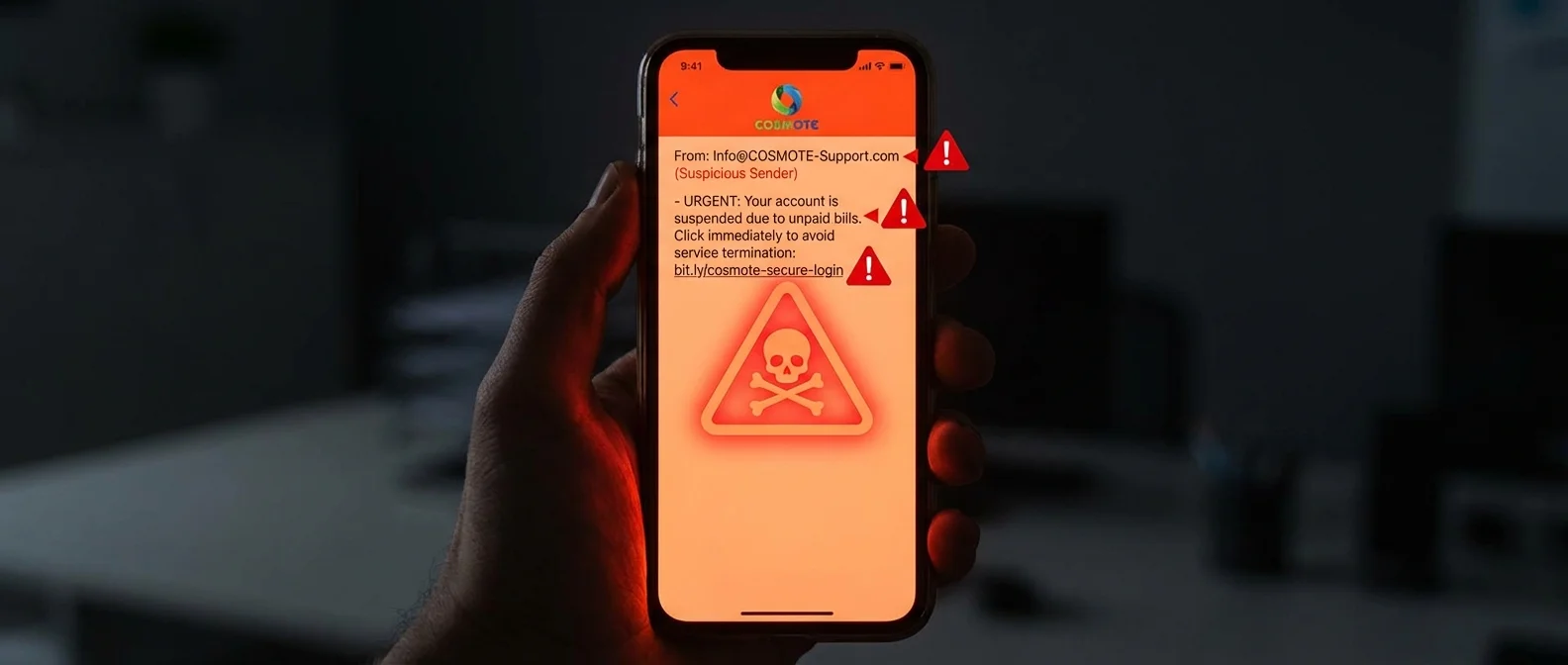
Phishing ranks as the most common form of cybercrime worldwide according to the FBI, and in Greece the telecom sector has become a prime target for sophisticated attacks. Fake SMS messages from “COSMOTE,” emails about an “expired Vodafone subscription,” phone calls impersonating technical support — the tactics keep getting more advanced. In 2023, 94% of organizations globally were hit by phishing attacks, and Greece is following a similar trajectory. This comprehensive guide breaks down every type of telecom phishing, how to spot it, and how to protect yourself effectively.
📖 Read more: 5G on Greek Islands: Holiday Internet 2026
🎣 What Is Telecom Phishing?
The term phishing — a play on the word “fishing” — was first coined in 1995 in connection with AOHell, a cracking toolkit that targeted America Online users. In the telecom world, it refers to any scam that uses fake communications — SMS, email, phone calls, or even QR codes — to steal personal data, passwords, or money by impersonating a trusted telecom provider.
The main types of phishing targeting the telecom sector include:
The 6 Types of Telecom Phishing
- Email Phishing: Mass fake emails mimicking providers like COSMOTE, Vodafone, and Nova
- Spear Phishing: Targeted attacks on specific individuals or companies using personalized content
- Smishing (SMS Phishing): Fraudulent text messages pretending to come from your carrier
- Vishing (Voice Phishing): VoIP-based phone calls impersonating tech support or banks
- Quishing (QR Code Phishing): Malicious QR codes that bypass traditional email filters
- Man-in-the-Middle: Real-time interception of communications between users and their provider
PhaaS (Phishing as a Service) platforms like Darcula now allow even people with zero technical skills to create convincing fake websites that impersonate legitimate telecom providers. Modern phishing campaigns are even targeting MFA/2FA systems, using real-time relay tools that intercept authentication codes as they're generated.
📱 Smishing: The Most Common Threat in Greece
In Greece, smishing is by far the most prevalent form of telecom phishing. The reason is straightforward: mobile phones display limited URL information, making it extremely difficult to spot suspicious links on small screens.
How It Works in Practice
Scammers send bulk SMS messages that appear to come from COSMOTE, Vodafone, or Nova — using sender ID spoofing techniques. These messages typically contain:
- A notification about an “expired account” or “unpaid bill” for a small amount like €2.99 or €4.50
- A warning that “your service will be disconnected within 24 hours”
- A link to a fake website designed to look like the provider's payment page
- A request to “verify your details” by entering your banking credentials
Smishing SMS Example
"COSMOTE: Your account expires in 24 hours. Pay €4.50 now to avoid disconnection: https://cosmote-pay.gr.fake-domain.com/verify"
⚠️ Red flag: The URL doesn't belong to COSMOTE — the real domain is cosmote.gr
According to the Anti-Phishing Working Group (APWG), smishing attacks have surged dramatically since 2020, with the telecom sector consistently ranking among the top three most targeted industries. In Greece, the EETT (Hellenic Telecommunications & Post Commission) receives hundreds of complaints every month about fraudulent text messages.
📧 Email Phishing & Spear Phishing
Traditional email phishing remains one of the most effective weapons in a scammer's arsenal. In the telecom space, phishing emails typically take the form of fake invoices, account notifications, or “urgent security updates.”
Mass Email Phishing
In mass phishing campaigns, attackers send thousands of emails mimicking the visual identity of well-known providers. These messages typically include:
- The provider's logo (COSMOTE, Vodafone, Nova) — often slightly altered
- A generic greeting: “Dear Customer” instead of your actual name
- A fake invoice PDF (which may contain malware)
- A “Pay Now” button linking to a fake payment page
Spear Phishing: The Targeted Version
Unlike mass emails, spear phishing targets specific individuals — for example, a company's CFO or IT manager. Attackers gather information from LinkedIn, social media, and public databases to craft highly convincing messages. A typical spear phishing attack in the telecom sector might involve:
- CEO Fraud: An email “from the CEO” requesting urgent payment of a telecom provider invoice
- Fake corporate invoices: A “COSMOTE Business” invoice containing the target company's actual details
- Payment account change request: An email impersonating the provider, asking for payment to a new IBAN
📞 Vishing: Phone-Based Scams
Vishing (voice phishing) uses VoIP technology to make automated or manual calls that impersonate well-known providers, banks, or government agencies. Through caller ID spoofing, the calling number can appear as the provider's actual customer service line.
📖 Read more: MVNOs in Greece: Why Alternative Mobile Operators Don't Exist
Common Vishing Scenarios in Greece
Among the most widespread techniques in the Greek market:
- "COSMOTE Technician": A supposed technician informs you of a “problem with your line” and asks for your account password or remote access to your computer
- "Vodafone Security Department": You're notified of “suspicious activity” on your account and asked to provide your ID number or an OTP code
- "You've won a prize": An automated robocall promising a free €500 smartphone if you “confirm your details”
- "ELTA/customs clearance": A call about a package awaiting you, requesting customs fees of €3–5 paid by card
VoIP technology makes these calls incredibly cheap — attackers can place thousands of calls per hour at minimal cost, using automated IVR (Interactive Voice Response) systems that closely mimic real customer service phone menus.
📸 QR Code Phishing (Quishing)
A relatively new but rapidly growing threat is quishing — phishing through malicious QR codes. This technique is particularly insidious because QR codes bypass traditional email security filters, which cannot “read” QR code images.
Where Quishing Shows Up
In the telecom sector, quishing appears in the following forms:
- Fake QR codes in emails: Instead of a link, the email contains a QR code “for easier bill payment”
- Stickers in public spaces: QR codes placed over authentic ones at COSMOTE/Vodafone retail stores
- Fake promotional flyers: “Scan for free 10GB” with a QR code leading to a fake login page
- Parking meters & electronic payments: Genuine payment QR codes replaced with fraudulent ones
Security research shows that quishing emails have increased by over 400% between 2023 and 2025. The reason is simple: corporate email gateways are excellent at filtering malicious URLs in text, but they struggle to analyze URLs hidden inside QR code images.
🛡️ How to Spot Phishing
Identifying a phishing attempt comes down to a set of consistent red flags that appear regardless of the type of attack:
8 Phishing Red Flags
- Sense of urgency: “Your service will be cut off in 2 hours” — legitimate providers always give reasonable notice
- Generic greeting: “Dear Customer” instead of your name — your provider knows who you are
- Suspicious URLs: The link doesn't match the real domain (e.g., cosmote-secure.xyz instead of cosmote.gr)
- Spelling & grammar mistakes: Professional companies don't send messages full of errors
- Requests for credentials: No legitimate provider will ever ask for your password, PIN, or OTP via SMS/email
- Unknown sender: Always check the actual email address — not just the display name
- Unexpected attachments: PDF, ZIP, or executable files you weren't expecting
- Doesn't match reality: An “overdue” bill when you know you've already paid
Specifically for SMS (Smishing)
On mobile devices, detection is harder due to the limited space for displaying URLs. Key rules to follow:
- Never tap on links in SMS messages — go directly to the provider's app or website instead
- Check whether the SMS appears in the same thread as genuine messages from your carrier
- If the sender shows a phone number (e.g., +30...) instead of an alphanumeric ID (e.g., “COSMOTE”), treat it as suspicious
⚡ What to Do If You've Been Targeted
If you clicked on a suspicious link or handed over your details, act immediately. Every minute counts — attackers use stolen data very quickly.
Step 1: Change Your Passwords
Immediately change the password of the compromised account — along with any other account that uses the same credentials. Start with your telecom provider, then your email and social media.
Step 2: Contact Your Bank
If you entered bank card details, call your bank right away to block the card. Request a replacement and review your recent transactions for any unauthorized charges.
Step 3: Report to the Authorities
File a complaint with EETT (Hellenic Telecommunications & Post Commission) and the Cyber Crime Division. Keep screenshots as evidence of the scam.
Step 4: Freeze Your Accounts
Request a freeze on your telecom account by calling your provider directly. Enable an additional security PIN for any account changes going forward.
It's equally important to notify your telecom provider, as they can block the sender's number or take down the phishing page, protecting other customers in the process. COSMOTE, Vodafone, and Nova all offer dedicated forms for reporting fraudulent messages.
📖 Read more: Unlimited Data Greece: Who Really Delivers
🔐 Protective Measures
Prevention remains the best defense. The following measures significantly reduce your phishing risk — though experts caution that no system is 100% foolproof, since even multi-factor authentication (MFA) can be bypassed with sophisticated real-time relay tools.
Multi-Factor Authentication (MFA)
Enable 2FA/MFA on all your telecom accounts. Prefer authenticator apps (e.g., Google Authenticator, Authy) over SMS-based OTP, since SMS codes can be intercepted through SIM swap attacks.
Password Manager
Use a password manager to generate unique, complex passwords for every service. Managers can also detect fake sites — if the password doesn't auto-fill, you may not be on the right website.
Security Apps
Install anti-phishing apps (e.g., Google Safe Browsing, Bitdefender Mobile Security). Always keep your operating system and apps updated to patch known vulnerabilities.
Verify Before You Click
Before tapping any link, verify through the official app or by calling your provider at their known number (e.g., 13888 for COSMOTE, 13830 for Vodafone, 13831 for Nova).
📊 Phishing Types Compared
Each phishing type has distinct characteristics in terms of delivery method, detection difficulty, and risk level:
Phishing Types: Risk Analysis
| Type | Medium | Detection Difficulty | Risk Level | Target |
|---|---|---|---|---|
| Email Phishing | Moderate | Moderate | Mass | |
| Spear Phishing | High | Very High | Targeted | |
| Smishing | SMS | High | High | Mass |
| Vishing | Phone/VoIP | Moderate | High | Mass/Targeted |
| Quishing | QR Code | Very High | Moderate | Random |
| Man-in-the-Middle | Network | Extremely High | Critical | Targeted |
🔮 Trends & the Future of Phishing
Phishing techniques are constantly evolving. The major trends for 2026 in the telecom space include:
- AI-powered phishing: Artificial intelligence is being used to craft flawless fake messages — free of spelling errors, in perfectly natural language
- Deepfake vishing: Calls using AI-generated voices that mimic real people (e.g., an actual customer service representative)
- MFA targeting: Sophisticated relay tools that steal session tokens in real time, bypassing even two-factor authentication
- Rise of PhaaS: Phishing-as-a-Service platforms are lowering the barrier to entry — no technical skills required
- Multi-channel attacks: Combined smishing + vishing + email campaigns in a single coordinated operation for maximum credibility
Role of EETT & Regulatory Authorities
The EETT, as Greece's national telecom regulator, works with providers to block fake sender IDs and malicious numbers. At the European level, the eIDAS 2.0 regulation and the NIS2 Directive impose stricter security standards on telecom operators. Reporting phishing incidents to EETT (tel. 11535) or the Cyber Crime Division (tel. 11188) is critical for tracking down and stopping scammers.
📋 Conclusion
Telecom phishing isn't just a technical issue — it's an everyday threat affecting every mobile phone user in Greece. With 94% of organizations targeted by phishing attacks, sophisticated PhaaS tools, and AI-powered social engineering, the landscape is only getting more complex.
That said, defense starts with simple principles: don't click on suspicious links, enable multi-factor authentication, use a password manager, and above all — never act under pressure. If you receive a suspicious message “from COSMOTE, Vodafone, or Nova,” go directly to the official app or call your provider at their known number.
Reporting every phishing attempt to the EETT and the Cyber Crime Division doesn't just protect you — it protects the entire community. In the digital world of 2026, awareness and vigilance are our most powerful tools.