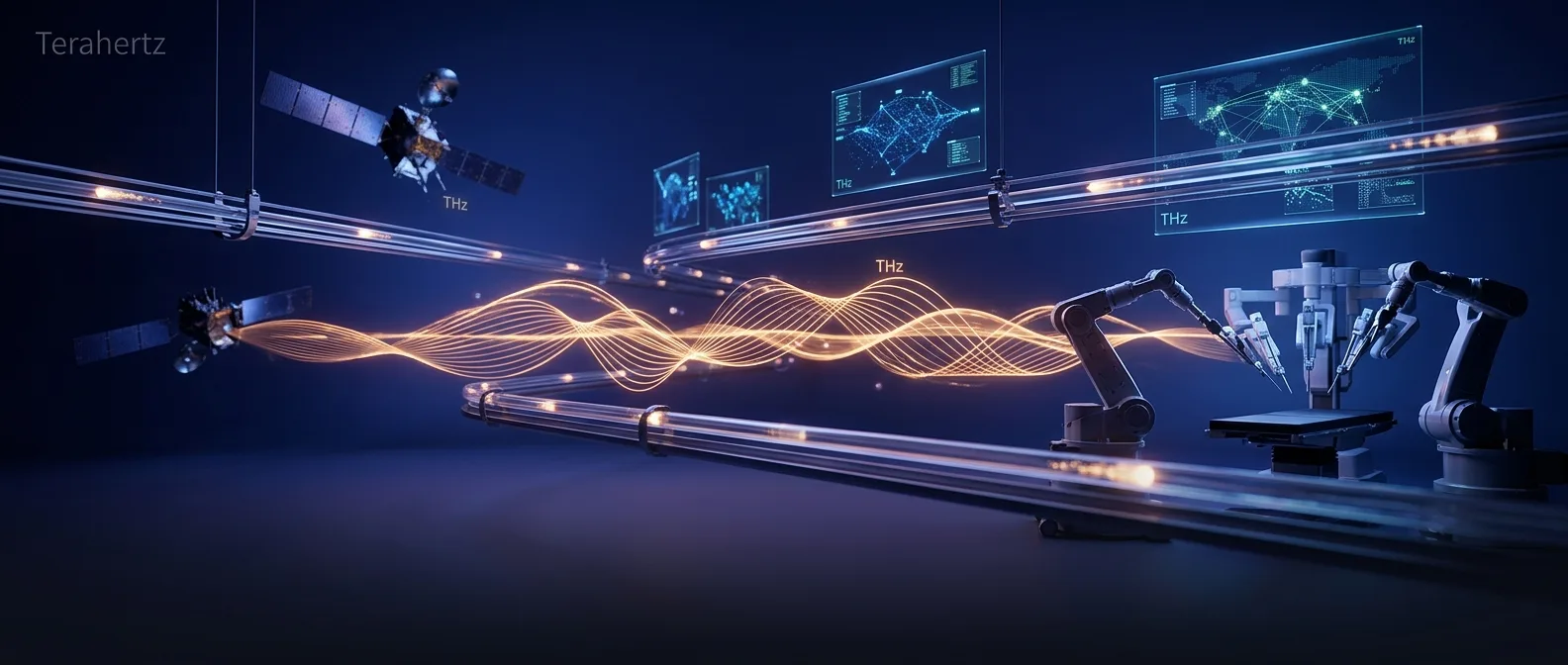
Thirty-one companies just joined forces at ETSI to crack terahertz 6G networks. The applications they're targeting — remote surgery, autonomous robots, holographic telepresence — sound like science fiction. But when you have spectrum that can push terabits per second, the impossible becomes inevitable.
The European Telecommunications Standards Institute (ETSI) just dropped two reports that map out how terahertz frequencies will power 6G networks. We're talking about spectrum from 100 GHz to 10 THz — frequencies that make today's 5G look sluggish. The ISG THz group, formed in December 2022, has identified nineteen different use cases that could reshape wireless communications by 2030.
This isn't theoretical anymore. Researchers at the University of Adelaide are building actual devices that operate in these frequency ranges. They're targeting data rates beyond one terabit per second across "multi-kilometer" distances. That's not just faster internet — that's a completely different category of wireless capability.
🔬 Remote Surgery and Medical Robotics
Remote surgery tops ETSI's list of terahertz applications, and for good reason. Picture a surgeon in New York controlling a robot in rural Montana for an emergency procedure. This demands sub-millisecond latency and absolute reliability — exactly what terahertz networks promise to deliver.
Terahertz signals have a unique property: they offer simultaneous ultra-high data rates and precise sensing capabilities. The same network that carries surgical data can provide real-time environmental mapping and tissue analysis.
ETSI describes this as "support for humans needing treatment anywhere and anytime." The scenario isn't just about distance — it's about emergency situations where no specialist is available locally. A cardiac surgeon could guide a robot through a complex procedure while physically located thousands of miles away.
Collaborative Industrial Robots
Collaborative mobile robots represent another breakthrough application for terahertz networks. Imagine an automated production line where dozens of robots coordinate in real-time, sharing factory status data and adapting to changes without human intervention.
What makes terahertz particularly suited for these applications is their capacity for ultra-high throughput at local scales. We're talking speeds that exceed one terabit per second — fast enough to transmit holographic data in real-time. That level of bandwidth opens up entirely new possibilities for robot coordination and environmental awareness.
⚡ Spectrum Challenges and Technical Hurdles
Terahertz spectrum isn't just "faster Wi-Fi." Frequencies from 100 GHz to 10 THz have completely different propagation characteristics. ETSI's second report identifies eight bands between 100-275 GHz that have sufficient bandwidth for mobile services.
But there's a catch. Terahertz signals get absorbed easily by the atmosphere, particularly by water molecules. This means long-distance transmission will require smarter solutions — like Reconfigurable Intelligent Surfaces (RIS) that can "steer" signals around obstacles.
Molecular Absorption and Solutions
Molecular absorption has been the main reason terahertz networks were considered impractical for decades. Now advances in micro- and nano-fabrication are enabling new approaches. Researchers are developing devices that can generate and control these frequencies with greater precision than ever before.
At the University of Adelaide, teams are targeting data rates beyond one terabit per second across multi-kilometer distances. That sounds ambitious, but it directly addresses the core technical requirements for 6G applications. The key is working with the physics rather than fighting it.
🎮 Entertainment and Immersive Experiences
In-flight and train entertainment emerges as another area where terahertz networks could shine. Think holographic telepresence in seat 14A or fully immersive XR experiences during a cross-country flight.
ETSI describes scenarios where passengers can participate in interactive immersive XR applications. This isn't just improved in-flight WiFi — we're talking about completely new experiences that require massive data rates and absolute reliability.
Mission Critical XR
Augmented and virtual reality applications for critical missions, including training and rescue operations
Real-time Industrial Control
Control of industrial processes in real-time with ultra-low latency requirements
Intra-device Communications
One particularly interesting application involves "intra-device communications" — communication between components within the same system. For example, between a supercomputer's processor and memory.
At this level, terahertz can replace traditional wiring with wireless connections that offer greater flexibility and speed. This is especially useful in data centers where heat and wiring complexity pose major challenges. Imagine a server rack where components communicate wirelessly at terabit speeds.
🛡️ Security and Privacy Protection
With so many new applications, security becomes critical. ETSI emphasizes the need for "secure, private, and sustainable ISAC implementations," particularly for applications that directly affect humans.
Terahertz networks have an inherent security advantage: their signals don't propagate easily over long distances. This makes eavesdropping and man-in-the-middle attacks more difficult. But it also creates new challenges for network architecture.
The ISG THz group provides an opportunity for ETSI members to coordinate their pre-standardization research efforts for THz technology through various European collaborative projects
Thomas Kürner, ISG THz Chairman
The ETSI team is already preparing new reports on channel modeling, system architectures and RAN, as well as computing integration with ISAC (Integrated Sensing and Communications). This shows that terahertz networks won't just be "faster 5G" — they'll be fundamentally different.
Sustainability and Energy Consumption
But there's a question that doesn't get answered easily: how sustainable will these systems be? Generating and controlling terahertz signals requires significant energy, and devices operating at these frequencies tend to drain batteries faster.
ETSI acknowledges this challenge and emphasizes the need for "sustainable implementations." But exactly how this will be achieved remains unclear. The details are still being worked out.
🎯 Frequently Asked Questions
When will we see the first commercial terahertz networks?
According to ETSI and international 6G initiatives, the first commercial applications are expected around 2030. However, pilot applications in controlled environments — like factories or hospitals — could appear earlier.
Will terahertz networks replace 5G?
Not entirely. Companies like Ericsson and Nokia estimate that 6G will operate primarily in the "centimeter-wave" bands from 7 to 20 GHz. Terahertz will be used for specialized high-performance applications.
How much does it cost to develop a terahertz system?
Prices remain uncertain as the technology is still in the research stage. However, the required micro- and nano-fabrication implies significant initial investments.