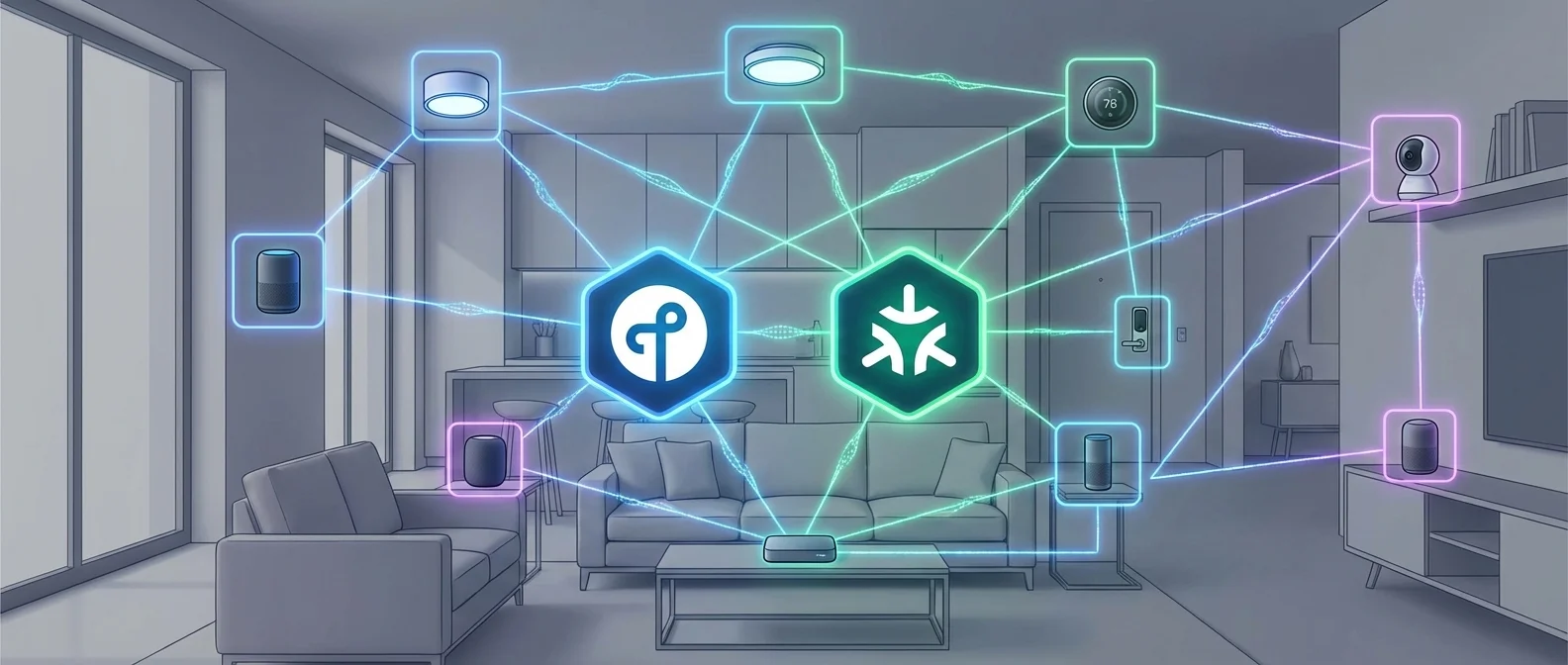
For over a decade, the smart home was synonymous with chaos: Zigbee, Z-Wave, WiFi, Bluetooth, proprietary protocols — every manufacturer with its own ecosystem, every device with its own hub, every app with its own limitations. The consumer was caught in the middle, trying to figure out which light bulb works with which bridge, and whether the thermostat “talks” to Alexa or only to Google Home. The Matter and Thread protocols promise to end this chaos — and three years after their launch, the evidence suggests they are actually succeeding.
📖 Read more: 5G Gaming: Can It Replace WiFi?
The Fragmentation Problem
Let’s start from the beginning. In 2019, anyone who wanted to build a reliable smart home faced a series of questions: Zigbee or Z-Wave for the sensors? WiFi or Bluetooth for the lights? Which hub supports what? Philips Hue used Zigbee but through a proprietary bridge, IKEA Tradfri had its own gateway, Apple’s HomeKit was a closed ecosystem, and Google and Amazon were fighting each other for voice control dominance. Every manufacturer had to decide whether to support Alexa, Google Assistant, Siri, or all three — which meant triple the development cost and multiple apps on the user’s phone.
The situation was particularly problematic for the average consumer. Even the most tech-savvy users struggled to maintain a decentralized network of dozens of IoT devices, while for the non-technical user, the smart home remained a luxury full of frustrations. It was clear that the market needed a unified standard — a common “vocabulary” that would allow any device to communicate with any ecosystem without bridges, without adapters, without proprietary clouds.
In December 2019, something unprecedented happened: Amazon, Apple, Google, and Samsung SmartThings announced together with the Zigbee Alliance (now the Connectivity Standards Alliance) that they would collaborate to create a common, open protocol. This project, initially codenamed “Project CHIP” (Connected Home over IP), would eventually become known as Matter.
What Is Matter?
Matter is a technical communication standard for IoT and smart home devices, developed by the Connectivity Standards Alliance (CSA). Unlike previous protocols, Matter is built entirely on the Internet Protocol (IPv6), operates locally on your network without cloud dependency, and is simultaneously supported by every major ecosystem: Google Home, Apple HomeKit, Amazon Alexa, Samsung SmartThings, and IKEA. The core idea behind Matter is that any device bearing the Matter logo should work automatically on any compatible platform — no adapters, no bridge, no configuration.
Technically, Matter is not a data transport protocol — it is an application-layer protocol. This means it defines what devices say to each other (e.g., “turn on the light,” “set the temperature to 22°C,” “lock the door”), but not how the data is physically transmitted. For transport, it uses existing protocols: WiFi and Ethernet for mains-powered devices or high-bandwidth applications, and Thread for low-power battery-operated devices. This combination — Matter as the “language,” WiFi and Thread as the “roads” — is perhaps the most elegant architecture the IoT space has ever seen.
A critical feature of Matter is local-first operation. Unlike many cloud-dependent solutions of the past, a Matter device executes commands through the local network — your light turns on even if the internet goes down. The controller (e.g., Google Nest Hub, Apple TV, Echo) acts as a local “brain” that coordinates the devices. The cloud is used only for remote access, firmware updates, and voice assistants — never for core functionality. This architecture means faster response times (sub-second instead of 1-3 seconds via cloud) and greater reliability.
Finally, the Matter SDK is open-source, released under the Apache License. This means any manufacturer — from major brands to startups — can integrate Matter into their products without licensing fees. The market responded: by the end of 2025, over 150 device types have been certified as Matter-compatible.
📖 Read more: Direct-to-Cell: Satellite Internet on Your Regular Phone
What Is Thread?
If Matter is the “language” that devices speak, Thread is one of the “roads” through which messages travel. It is an IPv6-based, low-power mesh networking protocol designed specifically for IoT. It was founded in July 2014 by the Thread Group — a consortium that includes ARM, Google/Nest, Samsung, Silicon Labs, Qualcomm, and NXP.
Technically, Thread uses 6LoWPAN (IPv6 over Low-Power Wireless Personal Area Networks) over IEEE 802.15.4, the same 2.4 GHz radio spectrum that Zigbee uses. The key difference? Every Thread device has its own IPv6 address — it is a “citizen” of the internet protocol stack, something Zigbee does not offer. This means a Thread device can communicate directly via IP without a protocol translator, making the Thread + Matter combination exceptionally efficient.
Thread’s mesh architecture is self-healing: if a device drops off the network, the remaining nodes automatically route data through an alternative path. There is no single point of failure — if a light bulb burns out, the sensors behind it continue to function through another node. Meanwhile, AES encryption ensures that every data packet is secure.
A central element of the Thread ecosystem is border routers: devices that bridge the Thread mesh to the home’s WiFi/Ethernet network and, by extension, to the internet. In practical terms, most modern smart home hubs already function as Thread border routers: the Google Nest Hub (2nd gen) and Nest Hub Max, the Apple HomePod Mini and Apple TV 4K (2nd and 3rd gen), the Amazon Echo 4th gen and Echo Show 10, and the Samsung SmartThings Hub v3. If you already have one of these in your home, you already have a Thread border router — without needing to buy anything extra.
Google also developed OpenThread, an open-source implementation of the protocol (under a BSD license), giving manufacturers the ability to integrate Thread into their products for free. This openness, combined with Matter’s open SDK, creates a fully free technology stack — a rarity in the IoT space, where proprietary protocols dominated for decades.
Matter + Thread: How They Work Together
The relationship between Matter and Thread confuses many people, but it is actually simple. Think of Matter as the language devices speak (what they say), and Thread, WiFi, or Ethernet as the channels through which they speak (how what they say gets delivered).
📖 Read more: Satellite Internet for Greek Islands: Complete Guide 2026
When we talk about “Matter over Thread,” we mean a device that uses the Matter protocol at the application layer and transmits data through a Thread mesh network. This combination is ideal for small, low-power devices: temperature sensors, motion sensors, switches, door locks. These devices don’t need high bandwidth — they need reliability, low latency, and long battery life, exactly what Thread offers.
Conversely, a Matter device can choose WiFi as its transport. This makes sense for devices that are already plugged into mains power and need high bandwidth: security cameras (with Matter 1.5), smart TVs, media players. WiFi is not ideal for battery-powered sensors — the power consumption is far too high — but it is perfect for devices that are plugged in anyway. There is also the option of Ethernet connectivity, useful mainly for hubs and bridges.
This flexibility means a Matter-equipped home can seamlessly combine Thread sensors, WiFi cameras, and Ethernet hubs — all speaking the same Matter “language” over different “channels” depending on their needs. The Thread border router in the living room bridges the Thread sensors to the local IP network, and the controller (e.g., Google Home, Apple Home) sees everything as a unified system. For the user, the process is invisible — you scan a QR code, the device is added.
Protocol Comparison: Thread vs Zigbee vs Z-Wave vs WiFi
To understand why the Matter + Thread combination is considered so important, it’s worth seeing how Thread compares to the protocols that dominated the smart home until recently. Zigbee, standardized in 2003, also uses IEEE 802.15.4 at 2.4 GHz with mesh networking, but it is not IP-native — it requires a bridge to translate data into IP packets. This limitation means higher latency and dependence on proprietary hubs. Z-Wave, developed in 1999 in Denmark by Zensys (now owned by Silicon Labs), uses sub-1 GHz spectrum (868 MHz in Europe, 908 MHz in the US), avoiding the 2.4 GHz congestion, but with a lower data rate (100 kbit/s) and a proprietary protocol.
📊 Smart Home Protocol Comparison
| Feature | Thread | Zigbee | Z-Wave | WiFi |
|---|---|---|---|---|
| Network type | Mesh (self-healing) | Mesh | Mesh | Star (hub-based) |
| Frequency | 2.4 GHz | 2.4 GHz | 868/908 MHz | 2.4/5/6 GHz |
| IP-native | ✅ IPv6 | ❌ Requires bridge | ❌ Requires bridge | ✅ IPv4/IPv6 |
| Power consumption | Very low | Low | Low | High |
| Range | 10-30m (mesh: hundreds) | 10-100m | 100m (LR: 1.6 km) | 50-100m |
| Data rate | 250 kbit/s | 250 kbit/s | 100 kbit/s | Gbps |
| Security | AES encryption | AES-128 | S2 Framework | WPA3 |
| Matter support | ✅ Native | ⚠️ Via bridge | ⚠️ Via bridge | ✅ Native |
| Open standard | ✅ OpenThread (BSD) | ✅ CSA | ❌ Proprietary (Silicon Labs) | ✅ IEEE 802.11 |
| Hub required | Border router | Dedicated hub | Dedicated hub | Router only |
Thread’s key advantage over Zigbee and Z-Wave is not speed or range — in those respects, they are similar. The advantage is that Thread + Matter operate natively over IP, eliminating the need for proprietary hubs and protocol translators. A Thread sensor speaks IPv6 directly — no Hue Bridge or SmartThings Hub needed as an intermediary. The border router (which likely already exists in your home as a Google or Apple device) is sufficient.
Z-Wave, despite its advantages in range (especially with Z-Wave LR reaching 1.6 km) and avoidance of 2.4 GHz congestion, remains a proprietary protocol. The Z-Wave 800 series significantly improved security with the S2 security framework and battery life, but the limit of 232 devices per network (4,000 with Z-Wave LR) and dependence on Silicon Labs raise long-term concerns. On the other hand, Zigbee is now managed by the same CSA that develops Matter, which means the bridge between legacy Zigbee devices and Matter will become increasingly seamless — over 4,000 Zigbee products are already on the market.
📖 Read more: Dual SIM: How to Use Two Numbers on One Phone
Matter Versions: From 1.0 to 1.5
Matter’s evolution over the past three years has been impressively rapid. Version 1.0, released on October 4, 2022, supported the basic categories: lights, plugs, switches, locks, thermostats, HVAC systems, blinds, sensors, and TVs. It was an ambitious but solid foundation — the “it actually works” moment the industry needed.
Version 1.1 (May 2023) was primarily a maintenance release, focusing on bug fixes and stability improvements. The real leap came with version 1.2 (October 2023), which added 9 new device types: refrigerators, dishwashers, robot vacuums, air purifiers, fans, air quality sensors, and smoke alarms. Suddenly, Matter was not just for lights and plugs — it covered the entire household.
Version 1.3 (May 2024) introduced water and energy management, as well as kitchen appliances: ovens, microwaves, cooktops, dryers, and casting functionality. Version 1.4 (November 2024) was even more ambitious, adding batteries, solar panels, routers, water heaters, heat pumps, EV chargers, and Thread improvements. Sub-version 1.4.1 (May 2025) brought NFC onboarding — scan the device with your phone without even needing a QR code — and multi-device setup for simultaneous pairing. Version 1.4.2 (August 2025) introduced security enhancements and made Thread 1.4 a requirement for border routers, with support for over 150 device types.
The biggest development came with version 1.5 (November 2025): camera support. This was the most requested feature from both consumers and manufacturers — security cameras are among the most popular smart home devices, but until now they were excluded from Matter due to the complexity of video streaming. Version 1.5 also added soil moisture sensors, improved energy management, and closures (gates, doors, blinds). The latest stable release is v1.5.0.1, released on December 2, 2025.
💡 Matter 1.5 — The Game Changer
Camera support in Matter 1.5 is a game-changer. For the first time, you can use Matter security cameras across Google Home, Apple Home, or Alexa without vendor lock-in. Combined with over 150 supported device types, Matter now covers virtually every aspect of the smart home.
Conclusion: Why Matter + Thread Is the Future
Let’s be clear: Matter and Thread are not perfect yet. Adoption took time, some early experiences were slow or buggy, and certain legacy devices will never get Matter support. But the trend is unmistakable: every major manufacturer — from IKEA to Apple, from Samsung to Amazon — is actively investing in Matter. Google, Apple, and Amazon have embedded Thread border routers in dozens of their products, making the Thread mesh network something that “just exists” in most homes.
For anyone building or upgrading a smart home today, the practical advice is clear: prioritize devices with Matter certification. This doesn’t mean you should throw away your old Zigbee or Z-Wave devices — bridges exist and will continue to exist. But every new purchase is worth making Matter-compatible. If you already have a Google Nest Hub, Apple TV 4K, or Amazon Echo 4th gen, you already have a Thread border router — you don’t need anything extra to get started.
The vision behind Matter — “it just works,” regardless of manufacturer, regardless of ecosystem — is now closer to reality than ever. After years of fragmentation, the smart home is finally getting a common language. And that language is called Matter.