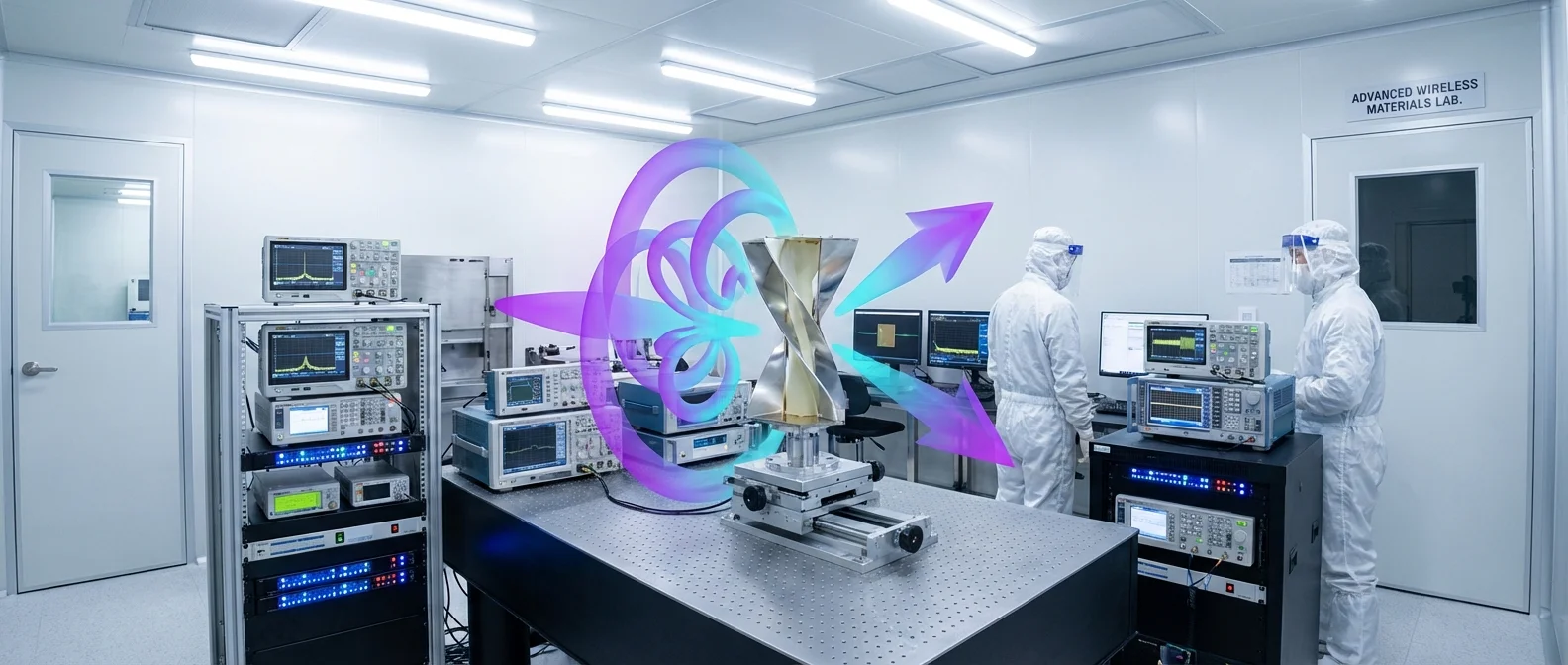
Antennas are at the core of every wireless communication — from your smartphone to orbiting satellites. Yet the push toward 6G and sub-THz frequencies demand radically new approaches. Topological antennas, rooted in condensed matter physics and metamaterials, promise signals that are immune to interference, sharp bends, and material defects — a genuine revolution in wireless technology.
📖 Read more: Terahertz Technology: The Foundation of 6G
What Are Topological Antennas
The concept originates from topological insulators — materials discovered in condensed matter physics where electrons flow freely along surfaces but not through the bulk. Applying this principle to electromagnetic waves yields antennas where signals propagate along interfaces with topological protection.
In practice, this means electromagnetic waves are immune to back-scattering, material impurities, and even sharp bends in the waveguide. The signal inherently “knows” how to follow its path without losses, regardless of obstacles.
The mathematical foundation comes from topology — the branch of mathematics that studies properties preserved under continuous deformations. In the context of antennas, this translates to electromagnetic states that cannot be “broken” by random perturbations — a kind of built-in shield embedded in the physical structure of the material itself.
Why This Matters for 6G
6G will operate at sub-THz frequencies (100 GHz – 1 THz), where signals attenuate dramatically due to obstacles and atmospheric absorption. Topological antennas offer:
- Interference resilience — topological protection against scattering
- Wider bandwidth — fewer narrowband constraints
- Precise directivity — stable beams even in complex environments
- Reduced losses — ideal for mmWave and sub-THz transmission
Metamaterials and Metasurfaces
At the foundation of this technology lie metamaterials — artificially engineered materials with properties not found in nature. They can exhibit a negative refractive index and manipulate the phase and polarization of light at sub-wavelength scales.
Metasurfaces are their two-dimensional counterpart — ultra-thin layers that provide complete control over electromagnetic waves. They are already deployed in Reconfigurable Intelligent Surfaces (RIS) for 5G coverage enhancement, but their topological variants take performance to an entirely new level.
The critical innovation is the combination of metasurfaces with topological structures. While a conventional metasurface may lose its properties if there is a manufacturing defect, the topological version retains functionality even with missing elements or imperfections. This opens the door to antennas that operate reliably under extreme conditions — from Arctic cold to desert heat.
"Topological metasurfaces give us the ability to design antennas that are fundamentally resilient to manufacturing imperfections — something impossible with conventional materials."
Evolution: From Classic Antennas to Topological
The trajectory of antenna technology over recent decades:
Classic antennas → Phased Arrays → Massive MIMO (5G: 64T64R) → Holographic MIMO → Topological antennas
In beamforming — the process of steering the signal beam — evolution has been equally impressive. Early systems used analog beamforming, followed by digital, and today hybrid dominates. The next generation will rely on AI-driven adaptive beamforming, where artificial intelligence algorithms adjust the beam in real time.
5G introduced Massive MIMO with 64 transmitters and 64 receivers (64T64R), evolving to 128T128R. Samsung Research is working on holographic beamforming for 6G, with ultra-dense antenna arrays at sub-wavelength spacing — elements placed closer together than the wavelength itself. This creates a nearly continuous radiation field rather than discrete antenna elements. The topological approach adds a layer of physics-based protection that cannot be achieved through software alone.
Antenna Type Comparison
| Feature | Traditional | Metamaterial | Topological |
|---|---|---|---|
| Defect tolerance | Low | Moderate | High |
| Bandwidth | Limited | Wide | Very wide |
| Loss at bends | High | Moderate | Near zero |
| Directivity | Good | Very good | Excellent |
| Production cost | Low | Moderate | High (currently) |
| Technology readiness | Mass production | Pilot use | Research / Prototypes |
Key Research Milestones
Research has accelerated in recent years:
MIT / Harvard (2019-2024): Experiments with topological photonic crystals proved undisturbed light propagation through defective materials. Their work laid the foundation for mmWave antenna applications.
University of Pennsylvania: Development of topological insulator antennas specifically designed for robust 5G/6G communications. Prototypes demonstrated a 40% loss reduction in complex geometries.
Samsung Research: Holographic beamforming with metasurfaces for 6G, targeting Tbps data rates. The company combines AI-driven beamforming with topological elements.
NTT DOCOMO: Orbital Angular Momentum (OAM) multiplexing experiments enabling multiple independent channels on the same frequency — a technique that benefits enormously from topological protection. OAM gives the electromagnetic wave a “vortex shape,” and each different mode can carry separate data streams.
Applications and Sectors
6G Sub-THz Communications
Antennas for base stations and mobile devices at 100 GHz – 1 THz. Topological protection under extremely challenging transmission conditions.
Satellite Antennas
Phased arrays with topological features for LEO satellites. Resilience to thermal and mechanical stress in space environments.
Automotive Industry
Autonomous driving radar with exceptional precision. Topological antennas for interference-free V2X communications.
Medical Imaging
Antennas for microwave imaging and therapeutic applications. Precise energy focusing without unwanted scattering.
Challenges and Timeline
Despite impressive capabilities, significant challenges remain:
Manufacturing cost: Topological metamaterials require high-precision nanofabrication. Currently, per-unit cost remains prohibitive for mass production — estimated at $500–$2,000 per prototype antenna. As lithography and 3D printing technologies advance, these costs are expected to decrease substantially within the next decade.
Chipset integration: Existing chipsets (Qualcomm, MediaTek) were not designed for topological antennas. A new RF front-end architecture is required, potentially involving co-designed chips that natively support topological waveguide interfaces rather than conventional coaxial or stripline connections.
Thermal management: Ultra-dense structures at sub-THz frequencies create significant thermal challenges. The closely packed topological elements generate concentrated heat that must be dissipated efficiently, especially in compact mobile devices where space for cooling is extremely limited.
Timeline: Prototypes for specialized applications (satellites, military) are expected by 2028. Commercial use in telecommunications likely after 2030, in parallel with 6G deployment. The 3GPP standardization body has not yet formally addressed topological antenna specifications, but early discussion papers from Release 20 study items acknowledge the potential of topologically-protected waveguides for future air interfaces.
The Greek Perspective
Greece stands to benefit significantly from topological antennas. The island geography creates unique wireless communication challenges \u2014 island-to-island connectivity at mmWave frequencies is extremely sensitive to atmospheric conditions and maritime scattering. With over 200 inhabited islands spread across the Aegean and Ionian seas, the need for robust, interference-resistant antenna technology is particularly acute for the Greek telecom infrastructure.
At the same time, dense urban environments like Athens, with narrow streets and multi-story buildings, make ideal testing grounds for scatter-resistant antennas. Greek universities, including the National and Kapodistrian University of Athens (NKUA) and Aristotle University of Thessaloniki (AUTH), are already conducting research on metamaterials and photonic materials — the transition to topological antenna applications is a natural next step.
Of particular interest is the application in tourist areas, where seasonal user surges demand antennas that adapt dynamically. With topological phased arrays, a base station on an island could reliably serve thousands of tourists without signal degradation, even in the presence of sea reflections and high humidity that typically cause scattering at mmWave bands.
What Comes Next
The convergence of topological physics, metamaterials, and AI-driven beamforming is paving the way for antennas that will be:
- Self-adapting — real-time characteristic adjustment via AI
- Self-healing — topological protection compensates for physical degradation
- Multi-band — a single antenna covering multiple mmWave and sub-THz bands
The technology is still in the research stage, but laboratory results are so encouraging that every major telecommunications company is already investing in it.