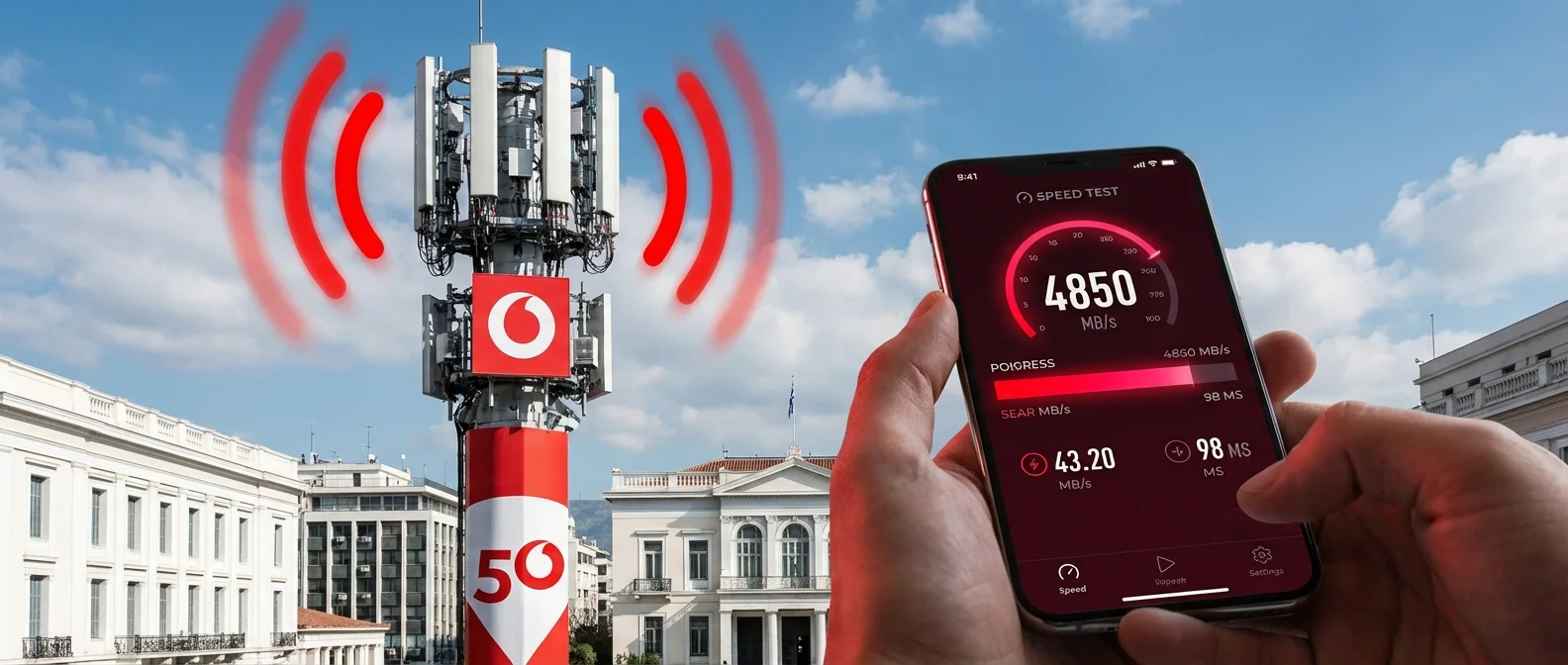
Vodafone Greece enters 2026 with ambitious 5G plans, backed by a €1 billion investment program running through 2029. As the country's second-largest mobile carrier, Vodafone is pursuing a balanced strategy: simultaneous 5G and FTTH fiber deployment, targeting holistic telecom solutions. Let's examine what it offers, where coverage exists, and whether it's worth choosing as your primary provider.
📖 Read more: Gigabit Internet Greece: When & Where 2026
Vodafone Greece: Who They Are
Vodafone Greece — officially Vodafone-Panafon — was founded in 1992 and is a subsidiary of Vodafone Group Plc, one of the world's largest telecom groups. Headquartered in Chalandri, Athens, with CEO Achileas Kanaris, the company offers mobile telephony, fixed internet, FTTH fiber, IPTV (Vodafone TV), and enterprise solutions.
In the December 2020 5G spectrum auction, Vodafone was the highest bidder, spending €130 million. It secured:
Vodafone 5G Coverage 2026
Vodafone's 5G coverage is expanding steadily, though it still trails COSMOTE. By early 2026, the network covers approximately 80% of the population across more than 45 cities. Coverage is particularly strong in:
Attica Region
Extensive coverage in Athens, Piraeus, northern and southern suburbs. Chalandri (Vodafone HQ) serves as a showcase area with full 5G.
Thessaloniki
City center, eastern Thessaloniki, Kalamaria, Pylaia. Gradual expansion to western suburbs.
Major Urban Centers
Patras, Heraklion, Larissa, Volos, Ioannina, Chania, Rhodes — 5G in central areas with average speeds of 150-350 Mbps.
Tourist Destinations
Santorini, Mykonos, Corfu, Rhodes — Vodafone targets tourist areas for premium experience during summer season.
Plans & Pricing 2026
Vodafone, like all Greek carriers, charges nothing extra for 5G access. Basic mobile plans automatically include 5G access, as long as your device is compatible. Main plan categories:
📊 Vodafone Mobile Plans 2026
| Plan | Data | Minutes | Price/month |
|---|---|---|---|
| Vodafone Red 1 | 5 GB | Unlimited | ~€15 |
| Vodafone Red 2 | 15 GB | Unlimited | ~€25 |
| Vodafone Red 3 | 30 GB | Unlimited | ~€35 |
| Vodafone Red 4 | 60 GB | Unlimited | ~€45 |
| Vodafone Unlimited | Unlimited | Unlimited | ~€55 |
⚠️ Pricing Note
Prices are indicative based on 24-month contracts. They may vary depending on promotions, bundling with fixed internet or TV, and seasonal offers. Visit vodafone.gr for current pricing.
Real-World Speeds
In real-world conditions — city center during normal hours — Vodafone 5G delivers speeds that satisfy most needs:
- Download: Average 200-300 Mbps, peak ~700 Mbps in ideal conditions
- Upload: Average 30-60 Mbps
- Latency: 18-30ms (5G NSA), expected below 12ms with 5G SA
- Streaming: 4K HDR streaming without buffering, even in crowded spots
Compared to COSMOTE, Vodafone falls behind in peak speeds (700 vs 1000+ Mbps) but offers fairly competitive averages. The real-world difference in daily use is minimal — 200 Mbps is more than enough for any smartphone task.
€1 Billion Investment & Future Plans
Vodafone Greece announced a €1 billion investment plan through 2029, focused on three pillars:
5G Standalone
Transition to full 5G SA architecture, independent from 4G core. Commercial availability expected within 2026.
FTTH Fiber
Over 300,000 FTTH lines already installed, targeting 500,000+ commercially available. Speeds up to 1 Gbps on fixed line.
Convergence & TV
Vodafone TV with 150,000+ subscribers, integrating Disney+, HBO Max. Converged packages combining fixed + mobile + TV.
Vodafone vs COSMOTE: Is It Worth It?
The honest answer: it depends on your priorities. If you consider absolute speed and wider coverage in rural areas critical, COSMOTE remains undeniably ahead. However, if you value convergent packages (fixed + mobile + TV), competitive pricing, and a brand with strong international presence — Vodafone is an excellent choice, especially in major urban centers.
Conclusion
Vodafone Greece demonstrates serious commitment to 5G evolution with €1 billion in investments, a gradual transition to 5G SA, and simultaneous FTTH development. Coverage of 80% across 45+ cities, average speeds of 200-300 Mbps, and competitive packages make it an attractive choice, especially for urban users who also use fixed-line services. The gap with COSMOTE is shrinking — and the next 2-3 years will determine whether Vodafone can truly close it.