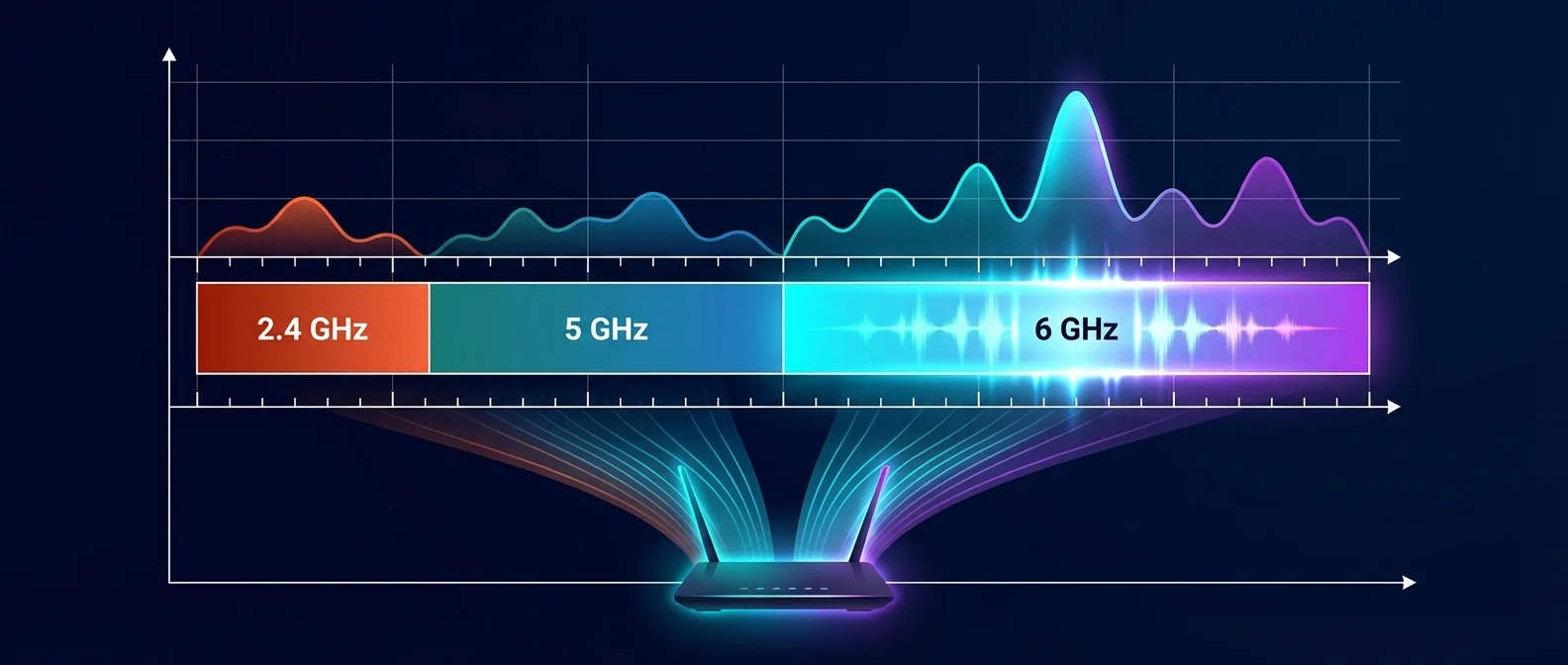
For decades, WiFi has lived in two "neighborhoods": 2.4 GHz and 5 GHz. The first was packed — Bluetooth devices, microwave ovens, baby monitors, dozens of neighboring networks all fighting for space — while the second, though quieter, dealt with radar restrictions (DFS) and gradually increasing congestion. Now, an entirely new spectrum band is opening up: 6 GHz. With WiFi 6E and WiFi 7, this “virgin” frequency range promises less interference, wider channels, lower latency, and speeds approaching 10 Gbps — and it's rapidly becoming a reality worldwide.
📖 Read more: Mesh vs Repeater vs Access Point: Which One Is Right?
📡 What Is the 6 GHz Band?
The 6 GHz band refers to the radio spectrum between 5,925 and 7,125 MHz — an entirely new slice of spectrum allocated for WiFi use. This amounts to up to 1,200 MHz of additional spectrum, nearly triple what WiFi previously had available in the entire 5 GHz range. It represents the largest spectrum expansion in WiFi history.
"WiFi 6E" isn't an entirely new technology — it uses the same 802.11ax (WiFi 6) standard but extended to the 6 GHz band. The “E” stands for “Extended.” This means the same core technologies — OFDMA, MU-MIMO (both uplink and downlink), Target Wake Time (TWT), BSS Coloring, 1024-QAM — now operate in a band with zero legacy from older devices. In theoretical terms, 802.11ax reaches 9,608 Mbit/s — quadrupling subcarrier capacity compared to 802.11ac.
Why is the 6 GHz band so significant? Think of it this way: 2.4 GHz is like a two-lane road jammed with traffic, 5 GHz is a wider avenue that's starting to fill up too, and 6 GHz is a brand-new highway with no cars on it — clean, fast, and exclusively for modern vehicles.
🔓 Regulation: Who Opened the Spectrum?
The story begins in the United States. On April 23, 2020, the FCC approved the use of the entire 5,925–7,125 MHz band (1,200 MHz) for unlicensed WiFi use. It was the first time such a massive chunk of spectrum had been made available for unlicensed services, and the industry responded with tremendous enthusiasm. The FCC defined three categories of devices:
- Standard Power (SP): EIRP 36 dBm, indoor and outdoor use, with Automated Frequency Coordination (AFC) — meaning the device verifies it won't interfere with existing services before transmitting
- Low-Power Indoor (LPI): EIRP 30 dBm, indoor use only, no AFC required
- Very Low-Power (VLP): EIRP 14 dBm, indoor and outdoor at very low power, ideal for portable devices
Europe followed a few months later. ECC Decision (20)01 of November 20, 2020 approved the use of only the lower portion of the band: 5,945–6,425 MHz, approximately 480 MHz of new spectrum. Unlike the US, Europe does not allow Standard Power outdoor use — only LPI (indoor) and VLP (indoor and outdoor). This means that in Greece and the rest of the EU, the 6 GHz band is primarily for indoor use, at least for now.
At the European level, the 480 MHz translates to: 24 channels at 20 MHz, 12 at 40 MHz, 6 at 80 MHz, and 3 at 160 MHz — with absolutely no DFS (Dynamic Frequency Selection) required, unlike many 5 GHz channels that demand radar avoidance. In the US, with the full 1,200 MHz, there are 59 LPI channels and support for bonded channels up to 320 MHz (with WiFi 7).
The United Kingdom activated the band in July 2020 (lower 6 GHz, LPI + VLP). Germany followed in 2021, and Australia in March 2022, later expanding to 6,585 MHz from October 2025. India, a massive market, only opened the lower 6 GHz in January 2026. The global trend is clear: the 6 GHz band is gradually opening everywhere, with the US leading in total spectrum availability.
⚡ What Changes in Practice?
The 6 GHz band doesn't just offer “more WiFi” — it fundamentally transforms the user experience. Here are the five key practical benefits:
Zero Interference
The 6 GHz band is “pristine.” No 802.11a/b/g/n/ac devices operate there — only WiFi 6E and WiFi 7 devices. This means zero legacy interference, zero Bluetooth crosstalk, zero microwave oven disruptions.
Wider Channels
In Europe: 160 MHz channels with no restrictions. In the US: up to 320 MHz with WiFi 7. Wider channels = more data per transmission = higher real-world throughput.
Lower Latency
Approximately 75% latency reduction compared to WiFi 5 (802.11ac). Critical for cloud gaming, video calls, VR/AR applications, and real-time high-resolution streaming.
No DFS Required
Unlike many 5 GHz channels (UNII-2/2C), the 6 GHz band doesn't require Dynamic Frequency Selection. This means instant connection with no radar avoidance delay — zero seconds of wait time.
More Channels
24 non-overlapping channels (20 MHz) in Europe — compared to just 3 in 2.4 GHz and ~25 in 5 GHz. In densely populated apartment buildings, this makes an enormous difference.
Greater Capacity
With OFDMA and MU-MIMO, multiple devices are served simultaneously. In a home with 30+ IoT devices, the 6 GHz band doesn't get “choked” the way 2.4 GHz does.
In practice, anyone living in a dense apartment building with dozens of neighboring networks will notice the difference immediately. On 2.4 GHz, you might “see” 30-40 networks around you, all competing for 3 channels. On 6 GHz, the airwaves are clean — at least until the neighbors upgrade too.
📖 Read more: WiFi 7 vs WiFi 6E: Real-World Differences
📊 2.4 GHz vs 5 GHz vs 6 GHz: The Full Comparison
To understand why 6 GHz represents such a significant upgrade, let's compare the three bands side by side. Each band has its strengths and weaknesses — 6 GHz doesn't replace the others but complements them.
📊 WiFi Band Comparison
| Feature | 2.4 GHz | 5 GHz | 6 GHz |
|---|---|---|---|
| Available spectrum (EU) | ~80 MHz | ~580 MHz | ~480 MHz |
| Non-overlapping channels (20 MHz) | 3 | ~25 | 24 |
| Max channel width | 40 MHz | 160 MHz (DFS) | 160 MHz (no DFS) |
| DFS (radar avoidance) | Not required | Required (UNII-2/2C) | Not required |
| Legacy devices | Very many | Many (802.11a/n/ac) | None |
| Interference | Extremely high | Moderate | Minimal to none |
| Range | Longest (~50m) | Medium (~35m) | Shorter (~25m) |
| Wall penetration | Good | Moderate | Reduced |
| Max theoretical speed | ~600 Mbps | ~3,500 Mbps | ~9,600 Mbps |
| Best for | IoT, range | General use | Gaming, 4K/8K, VR |
The most important takeaway: 6 GHz has shorter range and worse wall penetration compared to 2.4 GHz. This is basic physics — the higher the frequency, the shorter the wavelength, and the harder it is to penetrate obstacles. That's precisely why tri-band mesh systems (2.4 + 5 + 6 GHz) aren't a luxury but a necessity: each band serves a different purpose.
In a typical apartment in any major city, 2.4 GHz will handle IoT devices (sensors, smart bulbs, smart plugs), 5 GHz will cover general use (browsing, streaming), and 6 GHz will power the most demanding applications: 4K streaming to multiple screens, cloud gaming, high-quality video calls, and large file transfers.
📶 WiFi 6E & WiFi 7: Which Devices Use 6 GHz?
The 6 GHz band is no longer theoretical — it's a reality in hundreds of products. Here's what's available as of February 2026.
Routers & Mesh Systems
WiFi 6E routers have been widely available since 2022. Popular models include the ASUS ROG Rapture GT-AXE16000, Netgear Orbi RBKE963, TP-Link Deco XE75, Linksys Atlas Max 6E, and the eero Pro 6E system. Prices range from around €150 for basic 6E routers to €500+ for high-end tri-band mesh systems. WiFi 7 routers (802.11be) have now hit the market too: TP-Link Archer BE900, ASUS ROG Rapture GT-BE98, Netgear RS700 — priced from €300 to €700.
Smartphones
Nearly every flagship smartphone launched after mid-2022 supports WiFi 6E: Samsung Galaxy S23/S24/S25 series, iPhone 15 Pro/16 series, Google Pixel 7 Pro and later, OnePlus 12 and later. The latest flagships (Samsung Galaxy S25 Ultra, iPhone 16 Pro) already support WiFi 7.
Laptops & Tablets
Intel chipsets from the Alder Lake (12th gen) series onwards support WiFi 6E via Intel AX411/AX211, and Meteor Lake (14th gen) supports WiFi 7 via Intel BE200. Apple MacBook Pro/Air M2 and later support 6E, while M4 models support WiFi 7. For tablets, iPad Pro M2+ and Samsung Galaxy Tab S9 are 6E-ready.
"WiFi 7 (802.11be) takes the 6 GHz band to the next level: 320 MHz channels, 4096-QAM instead of 1024-QAM, Multi-Link Operation (MLO) for simultaneous use of multiple bands, and a theoretical maximum speed of 23,059 Mbit/s. If WiFi 6E was the introduction to 6 GHz, WiFi 7 is its full realization."
— IEEE 802.11be Standard, 2025An important point: only WiFi 6E (802.11ax) and WiFi 7 (802.11be) devices can use the 6 GHz band. There's no backward compatibility — and that's precisely the biggest advantage. Clean spectrum, reserved exclusively for modern devices. If your smartphone, laptop, and router all support WiFi 6E or newer, you're already communicating on 6 GHz.
🔮 What's Next: Upper 6 GHz & WiFi 8
The 6 GHz story doesn't end here. In Europe, the usable band is currently limited to the “lower 6 GHz” (5,945–6,425 MHz, 480 MHz). The remaining spectrum — 6,425–7,125 MHz, another ~700 MHz — is still under study. CEPT is considering expansion, but the process is slow due to competing uses of the spectrum (primarily microwave point-to-point services). The decision is expected at WRC-27 (World Radiocommunication Conference 2027).
If Europe eventually approves the upper 6 GHz, the 480 MHz would grow to ~1,200 MHz — matching the US situation. That would mean unrestricted 320 MHz channels, theoretical speeds exceeding 20 Gbps with WiFi 7, and even more non-overlapping channels.
Meanwhile, IEEE is already working on WiFi 8 (802.11bn), with expected standardization around 2028-2029. Among the features being discussed: coordinated multi-AP operation (multiple access points working as one), even higher QAM modulation, potential use of new spectrum bands, and improved energy efficiency. The 6 GHz band will remain the core of every future WiFi standard.
Australia provides an interesting case study: after initially approving only the lower 6 GHz in March 2022, it expanded the band to 6,585 MHz in October 2025 — a potential precursor to a broader European move. India, which only activated 6 GHz in January 2026, is also expected to expand the band in the future.
✅ Conclusion: Is the Upgrade Worth It?
The short answer: yes, if you're buying new equipment. The 6 GHz band is no longer experimental technology — it's an established standard with hundreds of routers, smartphones, and laptops on the market. The experience on 6 GHz is noticeably better, especially in densely populated areas and homes with many simultaneous devices.
You don't need to replace everything at once. A modern tri-band mesh system (2.4 + 5 + 6 GHz) will serve both your older and newer devices. WiFi 6E router prices have dropped significantly — you can find reliable models from €120-150 — while WiFi 7 routers start at around €300.
💡 Practical Tips for Upgrading to 6 GHz
- Check your devices first: If your smartphone, laptop, and tablet don't support 6E, the router alone won't help
- Go tri-band: A 2.4 + 5 + 6 GHz router ensures compatibility with all your devices
- Apartment buildings: 6 GHz offers dramatic improvement due to zero congestion from neighbors
- WiFi 7 is worth it if: You want maximum speed, MLO, and 320 MHz channels (US) or future European expansion
- Don't abandon 2.4 GHz: It's still essential for IoT devices, range, and older hardware
- Mesh systems > standalone routers: In homes over 80 m², a mesh system makes better use of 6 GHz due to its shorter range
The 6 GHz band isn't just an “upgrade” — it's a new chapter in wireless communication. For the first time in decades, WiFi has enough spectrum for every home, every office, and every public space to genuinely deliver fast, stable, interference-free wireless connectivity. The “virgin” band is here — and it truly changes everything.