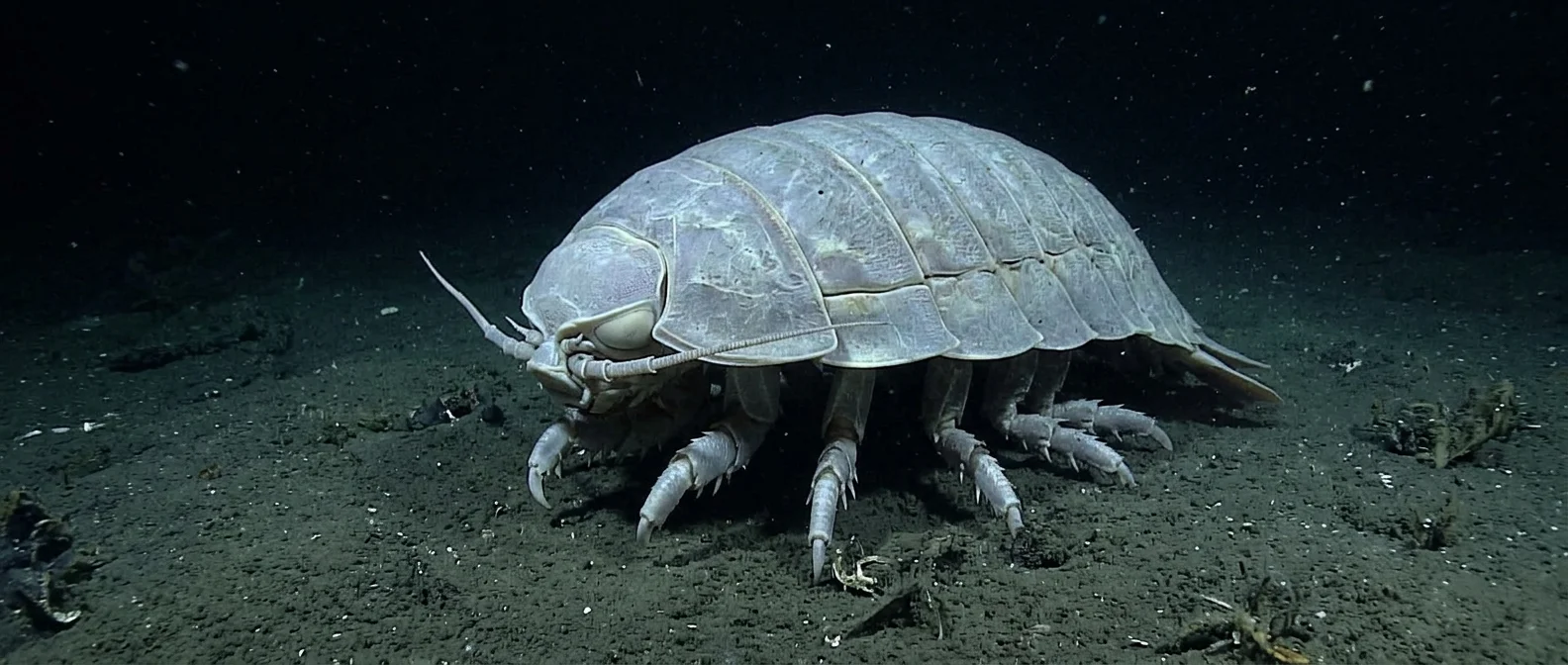
At 2,600 feet below the Gulf of Mexico's surface, a baited trap dangles in absolute darkness. Hours later, when researchers haul it to the surface, they find a creature that looks like it escaped from a science fiction movie: a cream-yellow arthropod stretching 10 inches long, sporting 14 legs, an exoskeleton resembling medieval knight armor, and eyes that gleam like mirrored spheres. This is a giant isopod — and it just turned out to be an entirely new species. From the depths off Mexico's Yucatan Peninsula to Vietnam's Spratly Islands, these prehistoric-looking marine creatures continue to astonish science — and go viral on the internet.
Natural History Archive: What Are Giant Isopods
Giant isopods of the genus Bathynomus are the largest isopod crustaceans on the planet. They belong to the same group as terrestrial pill bugs or woodlice we find under garden stones — but on a completely different scale. While their terrestrial cousins measure mere millimeters, these marine giants reach nearly 20 inches in length — roughly 2,500% larger. Today we know about 20 living Bathynomus species, though new ones are discovered every few years.
The first giant isopod description came in 1879 from French zoologist Alphonse Milne-Edwards, who named Bathynomus giganteus. The discovery was significant because it proved life existed in the ocean's great depths — something many scientists of that era questioned. Since then, these creatures have never stopped surprising us.
Anatomy of an Armored Giant
Giant isopods possess a calcareous chitin exoskeleton that functions like natural armor. Their body divides into three main sections: the head (cephalon), thorax (pereon) with seven pairs of legs, and abdomen (pleon) ending in the pleotelson — a tail-shield equipped with characteristic spines. The number of these spines serves as a taxonomic key: the newly discovered B. yucatanensis bears 11 spines, while B. maxeyorum has only 7.
Compound Eyes
Massive mirror-like compound eyes with approximately 4,000 lenses, adapted to the near-zero light of the deep sea. They reflect light like silver spheres.
14 Grasping Legs
Seven pairs of thoracic legs (pereopods) — the first two function as food-grasping claws, the remaining five as walking legs on the seafloor.
Chitin Armor
Calcareous chitin exoskeleton so hard that few predators can crack it. When threatened, they roll into a ball like a massive pill bug.
Radar Antennae
Two pairs of antennae — the outer ones extremely long — detect chemical food signals across vast distances in the abyss darkness.
An impressive feature is their ability to curl into a perfect sphere, exactly like their terrestrial cousins. This defensive mechanism, known as volvation, transforms their exoskeletal armor into a nearly impenetrable ball — particularly effective against smaller marine predators.

Life in the Abyss: Habitat and Behavior
Giant isopods inhabit the benthic zone of oceans, typically at depths between 650 and 8,200 feet, though most are found at 1,600-2,600 feet. They prefer clay or muddy seafloors, where temperatures barely reach 39°F and pressures of dozens of atmospheres would be lethal to most terrestrial animals. In the Gulf of Mexico, South China Sea, waters around Australia, and the Indian Ocean, these creatures reign as the top scavengers of the abyss.
Record-Breaking Fasting
Giant isopods can survive over 5 years without food in captivity. Their metabolism is extremely slow — an adaptation to the sparse food sources of the deep seafloor. When they finally find food (dead whales, fish, or squid), they eat so much they can't walk.
As opportunistic scavengers and predators, they feed primarily on dead marine animals that sink from upper layers. Whale carcasses, known as whale falls, become true feasts: dozens of isopods may gather around a single corpse. However, they're not exclusively scavengers — they can capture slow-moving animals like sponges, anemones, and worms.
New Species: From Yucatan to Darth Vader
Though giant isopods were discovered nearly 150 years ago, their taxonomy remains an active research field. In August 2022, a team of Taiwanese, Japanese, and Australian researchers published in the Journal of Natural History the description of a brand-new species: Bathynomus yucatanensis.
The specimen was captured in a baited trap in 2017 in the Gulf of Mexico at 2,000-2,600 feet depth. Initially thought to be a B. giganteus variant, detailed morphological examination revealed a series of unique characteristics: more slender body proportions, longer antennae, and a distinctive cream-yellow exoskeleton color — clearly different from its gray relatives. Molecular genetic analysis of COI and 16S rRNA genes confirmed it was a separate species, closely related but distinct from B. giganteus.
With this new addition, known Bathynomus species in the Gulf of Mexico increased to three: B. giganteus (1879), B. maxeyorum (2016), and B. yucatanensis (2022). The same study clarified that specimens from the South China Sea previously identified as B. kensleyi were actually B. jamesi — the largest known species, which can reach an impressive 20 inches in length and 5.7 pounds in weight.

Bathynomus vaderi: The Darth Vader of the Deep
In January 2025, the scientific community revealed another impressive new species: Bathynomus vaderi, named after Star Wars' Darth Vader. The resemblance of its head to the iconic helmet of the galaxy's most famous Sith Lord wasn't coincidental — researchers found the similarity striking enough to honor the connection nomenclaturally.
Spratly Islands
Discovered in waters near Vietnam's Spratly Islands in the South China Sea. First Bathynomus species formally described from Vietnamese waters.
Supergiant
Belongs to the supergiant category — 12.8 inches long and over 2.2 pounds. Larger than most known giant isopods.
B. vaderi was published in ZooKeys journal by a research team led by Peter Ng of the Lee Kong Chian Natural History Museum at the National University of Singapore, in collaboration with Conni M. Sidabalok from Indonesia and Nguyen Thanh Son from Vietnam National University. The discovery story is unique: in March 2022, staff from Hanoi University purchased four giant isopod specimens from a fish market in Quy Nhon city. Two of these were sent to Singapore for identification — and proved to match no known species.
From Bycatch to Luxury Dish
In Vietnam, giant isopods are called bọ biển (sea bugs). Until 2017, fishermen sold them as cheap bycatch. Today, they've become an expensive delicacy — some consider them tastier than lobster. They're sold live in markets in Hanoi, Ho Chi Minh City, and Da Nang, while restaurants post cooking recipes on social media.
300-Million-Year Evolutionary Legacy
Isopods as a group appeared approximately 300 million years ago, during the Carboniferous Period — long before dinosaurs. Their gigantism in the deep sea, known as deep-sea gigantism, remains one of marine biology's most intriguing phenomena. Multiple theories attempt to explain it: high pressure may favor larger cells, cold temperature slows metabolism allowing longer lifespans, and few competitors may permit natural selection favoring size.