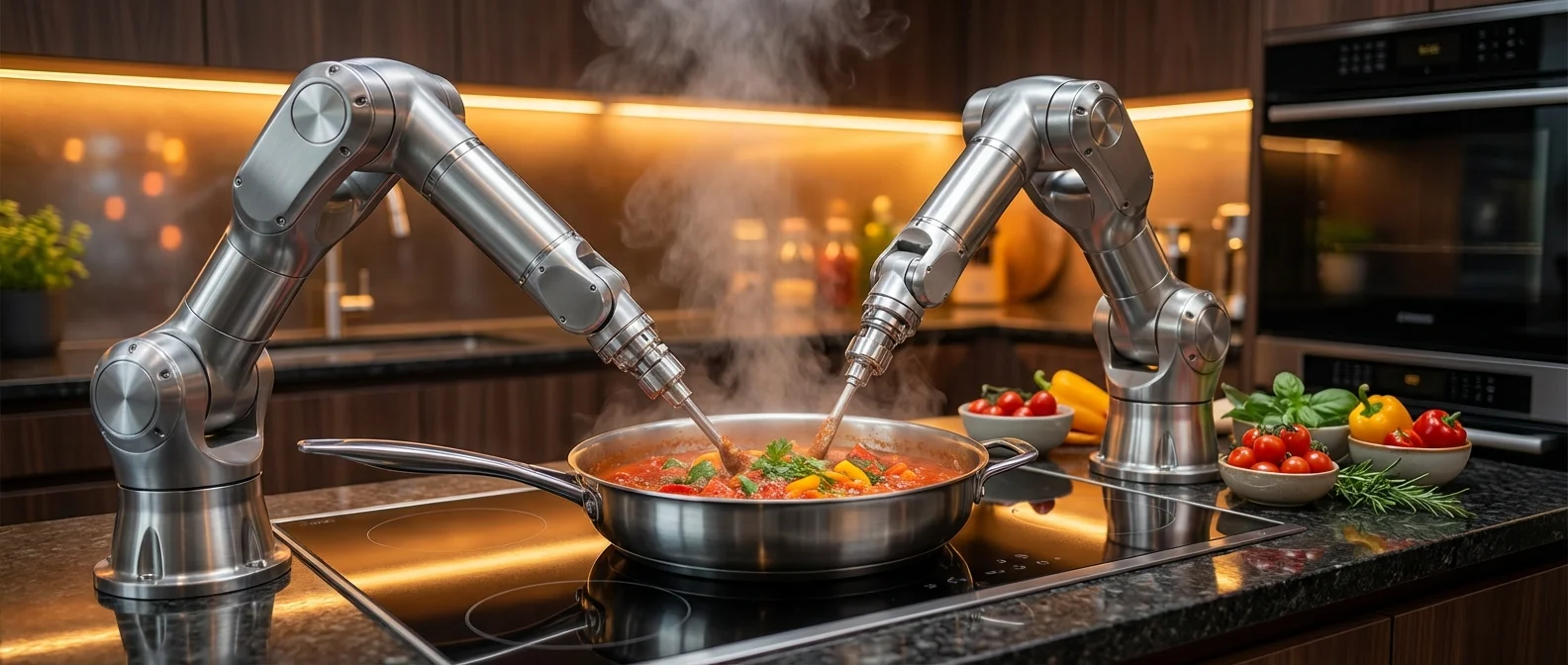
Imagine coming home after a long day to find a pair of robotic arms has already prepared a gourmet risotto following a Michelin-starred chef's recipe — with exactly the same movements, temperatures, and timing. This is no longer science fiction. In 2026, kitchen robots have reached a turning point: from Moley Robotics' $248,000 robotic arms to the Flippy 2.0 units churning out thousands of pizzas a month, cooking automation is fundamentally reshaping how we eat.
📖 Read more: Home Security Robots: AI Guards That Never Sleep
What Exactly Is a Kitchen Robot?
The term “kitchen robot” covers a wide spectrum of devices — from multicookers like the Thermomix that mix, heat, and weigh automatically, to fully autonomous robotic arms that replicate the moves of professional chefs. In between lie commercial frying robots (e.g., Flippy), restaurant serving bots, and AI-powered platforms that generate custom recipes on demand.
- Fully Robotic Kitchens: Robotic arms that cook autonomously (Moley Robotics) — they reproduce exact chef movements via motion capture
- Commercial Frying Robots: Rail-mounted robots for fast food kitchens (Flippy 2.0, Chippy) — frying, grilling, and prepping around the clock
- Smart Multicookers: IoT kitchen devices with guided cooking (Thermomix TM7, Cookidoo) — they heat, mix, and weigh automatically
- Serving Robots: Autonomous dish-delivery robots in restaurants — already deployed at thousands of locations worldwide
- AI Recipe Generation: Algorithms that create new recipes based on available ingredients, dietary needs, and personal preferences
Moley Robotics: The World's First Robotic Kitchen
Moley Robotic Kitchen — R-Kitchen
Founded in 2015 in London by Russian-British mathematician Mark Oleynik, Moley Robotics developed what is described as “the world's first robotic kitchen.” The system consists of two robotic arms with five-fingered hands equipped with tactile sensors, built in collaboration with Universal Robots and German robotics firm SCHUNK.
The hands went through 11 development cycles and 100,000 test cycles. They can grip and interact with nearly any kitchen tool — blenders, whisks, soup ladles, even the stove knobs.
The technology works through motion capture: an integrated 3D camera and a wired glove record every movement of a human chef, translate them into digital instructions using gesture recognition algorithms, and then the robotic kitchen reproduces the entire sequence to cook an identical dish from scratch.
The first recipe the kitchen “learned” was a crab bisque created by award-winning chef Tim Anderson, winner of MasterChef UK 2011. The recipe library now holds over 5,000 dishes, with renowned chefs like James Taylor, Andrew Clarke, and the Berezutskiy brothers continuously adding new recipes.
Hygiene & Safety
The Moley Kitchen features built-in UV disinfection for both the worktop and the air in the cooking zone, minimizing contamination risk. Minimal human contact during food preparation.
The kitchen comes in two versions: R-kitchen (fully robotic) and X-kitchen (an IoT platform with a smart fridge and storage, upgradeable to the robotic model). A commercial version exists for restaurants, catering, and hotels. The R-kitchen price? Roughly £248,000 (~€290,000) — clearly targeting luxury homes or commercial operations.
📖 Read more: Hotel Robots: The Silent Revolution in Room Service
Flippy 2.0: The Fast Food Frying Robot
Miso Robotics — Flippy ROAR & Flippy 2.0
Miso Robotics (a CaliGroup subsidiary, founded by John C. Miller) created Flippy, a robotic frying system that transformed fast food operations. The initial deployment was at CaliBurger restaurants, quickly expanding to Dodger Stadium (2018) and White Castle (2020).
Flippy 2.0, recognized by Time as one of the Best Inventions of 2022, was installed at 100+ White Castle locations and piloted at Jack in the Box in San Diego. A special “Chippy” variant was tested at Chipotle for automated tortilla chip production.
The Flippy ROAR (Robot-on-a-Rail) starts at $30,000 — a fraction of the cost of hiring a full-time fry cook. Miller laid out the logic: "The millennials we hire don't tend to stay very long. They come in, we train them, they work for a while, then go drive an Uber."
Beyond Miso Robotics, startup XRobotics makes countertop robots producing 25,000 pizzas per month (TechCrunch, 2025). Chipotle recently developed the robotic Hyphen Makeline, which assembles up to 350 bowls and salads per hour automatically.
Thermomix TM7: The Evolution of Smart Cooking
While not a “robot” in the traditional sense, the Thermomix by Vorwerk represents the longest history of kitchen automation. From the VKM5 in 1961 to the TM7 in 2025, the lineup evolved from a simple mixer into an AI-powered cooking platform.
64 Years of Evolution
VKM5 (1961) → VM 2000 (1971) → TM 3300 (1982) → TM 21 (1996) → TM 31 (2004) → TM5 (2014) → TM6 (2019, sous vide/fermentation) → TM7 (2025). About 75% of production takes place in Cloyes-sur-le-Loir, France.
The Thermomix performs simultaneously: steaming, emulsifying, mixing, precision heating (37°C–120°C), weighing, kneading, chopping, and grinding. The guided cooking feature with a touchscreen walks users through each step. The subscription-based Cookidoo platform offers thousands of online recipes.
The launch price sits around €1,139 — expensive for a kitchen appliance, but a tiny fraction of a robotic kitchen. It's sold through direct sales by “Thermomix consultants” — a model The Guardian described as “resembling multi-level marketing.”
📖 Read more: How Much Does a Humanoid Robot Cost in 2026?
Automated Restaurants Around the World
Robotic restaurants aren't a new concept — the first automats (vending-machine restaurants) operated in the late 19th century. Japan pioneered with conveyor belt sushi at the Mawaru Genroku Sushi in Osaka (1958, Yoshiaki Shiraishi's idea), eliminating the need for waiters entirely.
| Restaurant/System | Location | Technology | Status |
|---|---|---|---|
| Foodom (Country Garden) | Guangzhou, China | Fully robotic | Operating (2020) |
| Spyce Kitchen (MIT) | Boston, USA | Robotic wok | Operating (2018) |
| Kura Sushi | USA (multiple) | Conveyor + tablets + robots | Operating |
| Robo-Chef | Tehran, Iran | First robotic in Middle East | Operating (2017) |
| FuA-Men | Nagoya, Japan | Ramen robot | Operating |
| Serious Dumplings | Boca Raton, USA | Cooking/serving robots | Operating (2025) |
| Karakuri Semblr | Hatfield, UK (Ocado) | 2,700 meal combinations | Operating (2021) |
In China, Country Garden Holdings opened Foodom in Guangzhou in January 2020 — a fully robotic restaurant. At McDonald's across Europe, more than 7,000 touchscreen kiosks replaced cashiers as early as 2011.
Kitchen Robot Price Comparison 2026
| System | Category | Price | Target User |
|---|---|---|---|
| Moley R-Kitchen | Full robotic kitchen | ~€290,000 | Luxury homes / Commercial |
| Flippy 2.0 / ROAR | Commercial frying robot | ~$30,000 | Fast food / Restaurants |
| Hyphen Makeline | Robotic assembly line | Undisclosed | Chipotle / Chain restaurants |
| XRobotics Pizza | Countertop pizza robot | Undisclosed | Pizzerias / Dark kitchens |
| Thermomix TM7 | Smart multicooker | ~€1,400 | Home / Amateur chefs |
| Serving robots | Autonomous delivery | $10,000–$25,000 | Restaurants / Hotels |
AI in the Kitchen: Beyond Automation
Artificial intelligence goes well beyond physical automation. At Columbia University, engineers developed a method for cooking 3D-printed chicken using software-controlled robotic lasers — evaluating cooking depth, color development, moisture retention, and flavor differences.
Kitchen AI Applications in 2026
- Computer Vision: Cameras identify ingredients, check freshness, and monitor cooking levels in real time
- Recipe Generation: LLMs create personalized recipes based on available ingredients, allergies, and nutritional goals
- Gesture Recognition: Moley translates chef movements into digital commands via 3D cameras and wired gloves
- Predictive Maintenance: AI predicts when equipment needs servicing before it breaks down
- Waste Reduction: Algorithms minimize food waste by optimizing portion sizes and ingredient utilization
📖 Read more: How Robots 'See': Cameras, Sensors, and Obstacles
Pros & Cons
The balance between efficiency and the human touch remains the big question. As analysts note, kitchen robots “excel at standardized tasks but struggle with complex or customized dishes.” A technical malfunction can mean a complete shutdown — unthinkable during a restaurant's peak evening service.
Timeline: From Automats to AI Chefs
Greek Cuisine & Robotics
Greek cuisine, with its deep roots in home cooking, fresh ingredients, and “mama's kitchen” traditions, seems inherently at odds with automation. Yet the reality tells a different story:
- Tourist pressure: Island restaurants face massive demand with few skilled workers — serving robots could be a lifesaver
- Ghost kitchens: Delivery-only kitchens are expanding in Athens — an ideal environment for robotic standardization
- Thermomix fever: Greece already has a large Thermomix community, mainly through Facebook groups with thousands of members
- Moussaka by robot: Standardized Greek dishes (gyros, souvlaki, salads) are perfectly suited for robotic preparation
Robots in Greek Hospitality?
In countries like Hungary, serving robots are already taking orders in restaurants (Szombathely, 2025). Greece, welcoming roughly 30 million tourists annually, stands to benefit enormously. The question isn't “if” but “when.”
What's Coming: 2026–2030
The food robotics market is projected to reach $30.8 billion by 2030. But prices need to drop dramatically for mass home adoption. Here's a realistic forecast:
The biggest obstacle is no longer technology — it's culture. Cooking remains a deeply personal, creative act for millions of people. Robots will take over the routine (chopping, frying, cleaning), but human creativity in gastronomy will remain irreplaceable.
In the meantime, if you want a taste of the future, a Thermomix TM7 or a visit to a robotic restaurant is the most accessible starting point. The kitchen of tomorrow won't replace you — it will set you free.