📖 Read more: 5 Weeks of Brain Training Protect for 20 Years
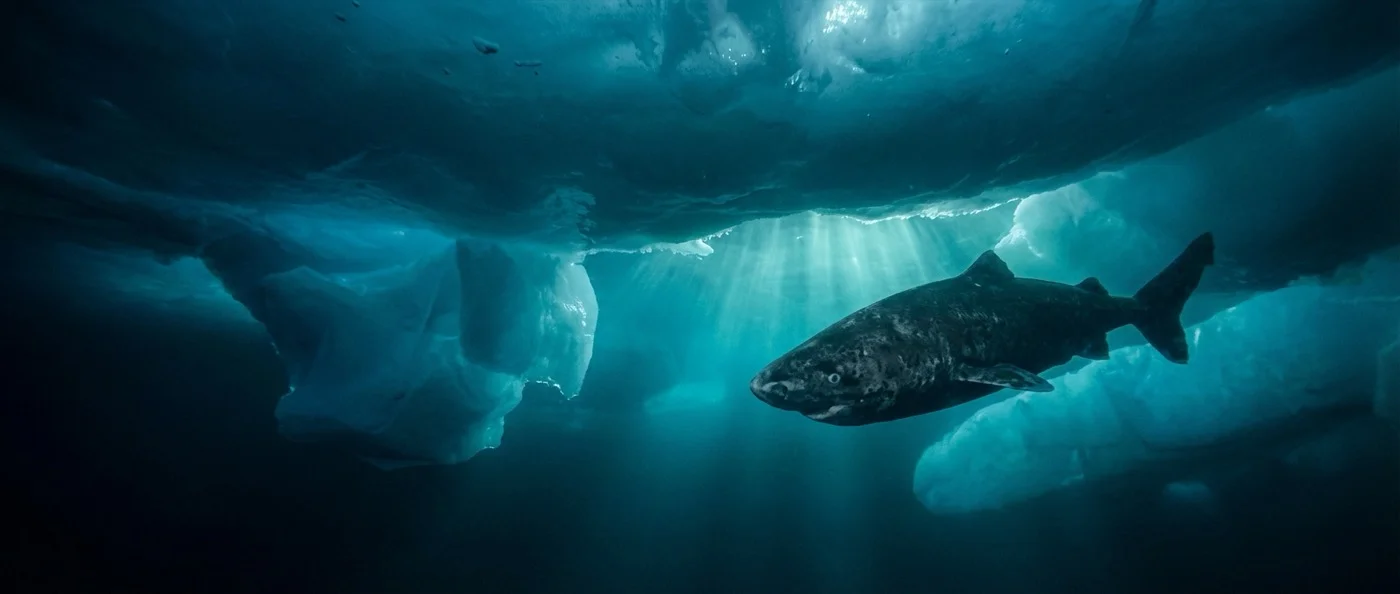
🦈 Meet the Greenland Shark
🎬 Video: The Greenland shark — the longest-living vertebrate on Earth
Somniosus microcephalus (the name literally means “sleepy with a small head”) belongs to the family Somniosidae ("sleeper sharks"). It is one of the largest sharks in the world, reaching lengths of up to 7.3 meters and weighing over 1,000 kg. Genetic data suggest it diverged from ancestral “sleeper sharks” 1–2.34 million years ago during the Pleistocene.
Nearly Blind
The parasitic copepod Ommatokoita elongata attaches to their eyes, causing near-complete blindness. Despite this, they survive by relying on their sense of smell and hearing.
Cold Adaptation
They live in waters of 1-12°C, at depths up to 2,200 meters. High levels of TMAO (trimethylamine N-oxide) in their tissues protect proteins from pressure and cold.
Toxic Meat
Their meat is toxic due to high concentrations of urea and TMAO. In Iceland, it is fermented for months to make the famous “hákarl.”
📖 Read more: Scientists Finally Created Silicon Aromatic Ring After 50 Years
🔬 How Their Age Was Measured
The groundbreaking study by Julius Nielsen and colleagues, published in Science in 2016, used an ingenious method: radiocarbon dating of the eye lens.
The eye lens is unique: its core forms at birth and never changes. By measuring the levels of carbon-14 (¹⁴C) in the lens core, researchers were able to calculate when the shark was born. Specifically, they used the “signal” from nuclear tests of the 1950s as a reference point.
Key Finding
The study by Nielsen et al. (2016), published in Science, examined 28 female Greenland sharks. The largest, measuring 5.02 m, was estimated to be 392 years old (±120 years). This means it could have been born around 1505 — before Columbus even discovered America!
📖 Read more: Ozempic: Impressive Results, Big Questions
❄️ The Secret of Longevity
How does an animal live so long? Scientists are examining multiple factors:
Cold Environment
Freezing waters dramatically slow metabolism. Less metabolism = less oxidative stress = fewer cellular damage = slower aging.
Genetic Adaptations
Their genome (6.45 billion base pairs, published in 2024) contains unique adaptations in DNA repair genes and antioxidant defense.
Slow Pace of Life
At a speed of just 1 km/h and sexual maturity at ~150 years, every biological process occurs in “slow motion.” They grow only 1 cm per year.
TMAO: The Chemical Protector
Trimethylamine N-oxide (TMAO) neutralizes the destabilizing effect of urea on proteins, functioning as a “chemical chaperone” that keeps proteins stable.
«The Greenland shark is the longest-living vertebrate on Earth. What is astonishing is not just how long it lives — it’s that it shows no signs of aging, even at an age of hundreds of years.»
🎬 Video: The Greenland shark — documentary
📖 Read more: Processed Foods: 47% Higher Heart Risk
🧬 Lessons for Human Aging
The study of Greenland sharks offers valuable insights into the biology of aging in general. The mechanisms that allow these animals to live 5 centuries could, theoretically, lead to new treatments against human aging.
Vertebrate Longevity Comparison
⚠️ Threats and Conservation
Despite their remarkable longevity, Greenland sharks face serious threats. Overfishing and climate change are the primary risks. With sexual maturity at 150 years and a slow reproductive rate, their population cannot recover quickly from declines.
The IUCN classifies them as "Vulnerable". Understanding their reproductive habits is critical for their conservation.