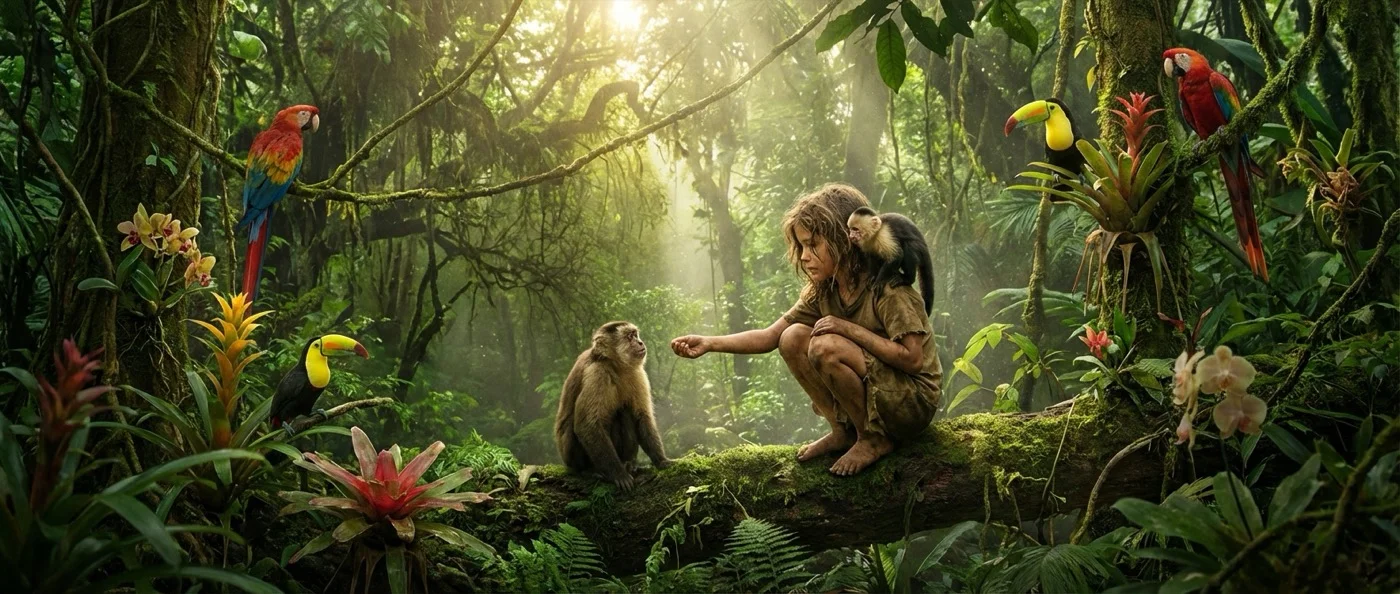
The Girl With No Name
The true story of Marina Chapman — the child who grew up among monkeys in the jungles of Colombia
📖 Read more: Theranos: The Billion-Dollar Company That Didn't Exist
The Jungle as Mother
Somewhere deep in the Colombian jungle, around 1955, a small five-year-old girl stared at the trees around her and recognized nothing. There was no house, no mother, no father. There was only the green silence of the tropical forest, the humidity clinging to her skin like a second nature, and the terrible, incomprehensible loneliness of a child who understood that no one was coming to take her back.
That girl was Marina Chapman — though back then she didn't even have that name. She had nothing. No identification, no language anymore, no trappings of civilization. She was five years old and utterly alone in the world. Her story is, perhaps, the most extreme account of human survival ever recorded — and that's because it's not about someone who conquered nature, but about someone who became part of it.
The story begins in the 1950s, in Colombia, a country torn apart by the civil war known as La Violencia. An era when children vanished regularly, families were scattered, and violence was so pervasive that yet another missing child was nothing more than a number on a list that nobody kept.
The Abduction
Marina remembers very little of life before the jungle. Blurry images like watercolors: a courtyard, a dirt road, people speaking Spanish. She was too young to remember the name of her village. Too young to know her mother's name.
What she does remember are the hands. Hands that grabbed her, that covered her eyes, that carried her into a vehicle. And then — the jungle. Some strangers, most likely members of a child trafficking ring, or perhaps people who had planned to demand a ransom but changed their minds, abandoned her in the middle of nowhere.
Nowhere was the jungle, most likely a section of the Amazon rainforest in southern Colombia. A world without a horizon, almost without sky, nothing but foliage and sounds — the cries of birds, the hum of insects, the murmur of water somewhere far away.
Marina didn't immediately understand what was happening to her. She stayed where they had left her, waiting for someone to come back. No one came back. In those first days, she screamed, she cried, she pounded the trees. But the jungle doesn't answer the cries of children. The jungle just carries on.
The First Days
Hunger came almost immediately. A five-year-old girl knows nothing about the edible plants of the tropical forest, nothing about poisonous berries, nothing about the dangers lurking in every shadow. Marina tried to eat whatever she found — roots, leaves, fruits she didn't recognize.
Before long, she fell ill. One evening, after consuming a quantity of tamarind, her stomach clenched into a knot of fever and pain. The poisoning brought her to her knees. Lying on the ground, unable to move, too weak even to cry, she thought she would die there, in the darkness, alone.
But she didn't die. And the reason was an elderly capuchin monkey — an animal that typically avoids humans. According to Marina's account, the old monkey approached slowly, without fear but without haste. For no apparent reason, he lifted her by the arms — or rather pushed her — and guided her to a water source.
"I can't explain why he helped me. Maybe he sensed I was a baby, like one of theirs. Maybe it was curiosity. Maybe something we can't put a name to."
— Marina Chapman, “The Girl With No Name”
📖 Read more: Flight MH370: Plane Vanished with 239 Passengers
Marina drank water, flushed her stomach, and found the strength to stand again. From that moment on, something between her and the monkeys shifted. She was no longer a foreign intruder in their territory. She was something like a helpless little creature that needed assistance.
The Monkey School
Capuchin monkeys are among the most intelligent animals on the planet. They use tools, recognize social hierarchies, and plan their movements. For a five-year-old girl who had forgotten nearly all human knowledge, they were the only teachers available.
Marina watched them for hours on end. Lessons critical to her survival: which fruits were safe, which trees bore edible nuts, how to find bird eggs in nests. She learned to recognize the signs of danger — the alarm calls that meant snake, or hawk, or something worse.
Gradually, she learned to climb trees. At first she was clumsy, falling several times, scraping her knees and hands. But children adapt quickly — faster than any adult. Within months, she was climbing five-meter trunks with ease, finding footholds in the bark that an adult would never even notice.
The hardest skill was sleeping in the trees. Capuchins sleep high up, on branches that bend but don't break, wrapped around one another for warmth and safety. Marina had to find her own method — a hollow in a large tree, or a thick branch she could cling to.
The Language of Silence
One of the most unsettling things that happened to Marina was the gradual loss of language. It wasn't something dramatic; she didn't wake up one day without words. It was a slow process of erasure, like text written in invisible ink. First the complex words disappeared. Then the phrases. Then the names.
In their place came other sounds. Chirps, whines, shrieks — the language of the capuchins, a language primitive yet effective. It had a limited vocabulary but infinite meaning: danger, food, play, anger, love. Marina didn't speak it perfectly — human vocal cords are different. But she understood. And they understood her.
Body language became the primary form of communication. A tilt of the head, a posture, a glance. Marina developed an ability to read body language that later, in the human world, would prove exceptionally useful — and exceptionally alienating. She could “read” people before they even opened their mouths.
Life Among the Monkeys
Years passed. How many exactly, Marina cannot say with certainty — time in the jungle is not measured by calendars but by seasons of rain and drought. Estimates range between four and five years. Four years without human contact, without a human voice, without human thought.
Her daily routine followed the rhythm of the troop. She woke at first light, followed the monkeys in their search for food, foraged for fruits and roots, groomed fur from their bodies — a social ritual critical to the group's cohesion. She played with the young ones and curled up next to the adults at night.
There were moments of joy — genuine, animal joy. The discovery of a tree laden with ripe fruit, a game of chase among the branches, the warmth of a small monkey nestled in her arms. The jungle was not only danger — it was also home.
But there were also moments of terror. Venomous snakes coiled on branches, jaguars hunting at dusk, rains so violent the trees shook. Marina learned to be afraid without panicking — panic was lethal. She reacted like the monkeys: quietly, quickly, without looking back.
📖 Read more: Tarrare: The Man Who Ate Everything
The Hunters
One day — a day like any other — Marina heard sounds that didn't belong to the jungle. Voices. Human voices. The sound, so familiar and yet so foreign now, filled her with a mix of hope and terror. They were hunters, a group of locals fishing in the river near the troop.
Marina, driven by an instinct she couldn't explain, decided to approach them. She emerged slowly from the trees, nearly naked, filthy, her hair tangled in wild knots, her nails curved like an animal's claws. She didn't know the words to explain who she was. She had no words at all.
The hunters were shocked. A feral child — something rare but recognizable in their culture. They took her with them and transported her to the city of Cúcuta, on the Colombia-Venezuela border.
Historical note
Marina Chapman was not the only “feral child” in recorded history. There are over 100 documented cases of feral children, but her account is one of the very few that resulted in full social reintegration.
The Hell of Civilization
What followed was worse than the jungle. The hunters were not saviors — they were traffickers. They sold Marina to a brothel in Cúcuta. Once a five-year-old, now a nine-year-old girl, barely older, without language, without identity, without anyone in the world. The owner used her as a slave, making her clean, cook, and serve.
The details of this period are dark. Marina speaks of it in broken phrases, distilled into a few sparse pains. She eventually managed to escape — or was driven out; she doesn't remember for certain. She found herself on the streets of Cúcuta, with nothing in her hands, with no destination.
She lived on the streets, eating from the garbage, sleeping in alleyways, slowly relearning language — broken phrases, words stolen from the conversations of passersby. She was a transitional being: no longer wild, not yet domesticated. Something in between, something no one knew how to deal with.
Marucha
If the story had ended here, it would have been just another tragedy among hundreds. But fate — or destiny, or something that has no name — intervened in the form of a woman named Marucha. A neighbor of a mafia family who, for reasons only she knew, decided to save this lost child.
Marucha found her during a period that Marina describes as “slavery” — the mafia family used her as a servant, beating her regularly. Marucha offered a way out. She sent her to Bogotá, the capital of Colombia, to live with one of her daughters.
Marucha's daughter, María, essentially adopted Marina — gave her a room, clothes, food, and above all, a first taste of normal family life. Marina was around fourteen at the time. For the first time in her life, she had a home she could call her own.
"Marucha never explained to me why she helped me. Maybe no explanation was needed. Some people do the right thing without needing a reason."
📖 Read more: The 4 Children Who Survived 40 Days in the Jungle
— Marina Chapman
The Move to England
María's family had ties to Bradford, an industrial city in Yorkshire, England, through the textile industry. In 1977, Marina was sent there as a nanny for the family's children. She was around 27. For the first time in her life, she found herself in a developed country, in a city with clean streets, single-story houses, and winters she couldn't have imagined.
In Bradford, Marina met John Chapman, a scientist who would become her husband. She married him, they had two daughters — Joanna and Vanessa — and she lived a life that, on the surface at least, seemed perfectly normal. A housewife in Yorkshire, a mother, a wife. No one imagined what was hidden behind it all.
But the jungle never fully left. Marina still moved with a distinctive lightness, like someone who never makes a sound. Her reflexes were extraordinarily fast — an inherited gift from her years in the trees. And there was something in her gaze, a vigilance, a readiness that didn't belong in the ordinary world.
The Book and the Truth
For decades, Marina kept her story secret. Barely to the neighbors, barely to friends. No one would have believed that this quiet woman at the end of the street had lived among monkeys. It was a story so extreme it sounded like fiction.
The change came through her daughters. Vanessa Forero, a musician by profession, grew up hearing fragments of this story. She decided the world needed to know. Together with writer Lynne Barrett-Lee, Vanessa helped her mother record everything in a book: “The Girl With No Name.”
The book was published in 2013 and caused a sensation. Several publishers had initially rejected it because they didn't believe it was real. But when it finally came out, Marina appeared on BBC Breakfast, giving interviews in a calm voice, describing scenes that sent shivers down spines. National Geographic filmed a documentary titled “Woman Raised By Monkeys.” Even Kate McKinnon on Saturday Night Live did a satirical impersonation.
The scientific debate
Carlos Conde, a professor in Colombia, conducted tests using photographs — Marina's reaction to images of capuchin monkeys was clearly more emotionally intense than those of ordinary people. Chris French, a professor of psychology at the University of London, raised objections, arguing that Marina might suffer from false memories.
The truth most likely lies somewhere in between. The basic facts — that Marina was abandoned in the jungle, that she lived close to monkeys, that she was sold to a brothel — are not seriously disputed. What is debated is the quality of the interaction: was she truly a “member” of the troop, or simply a child living in the same space? The answer probably doesn't matter. What matters is that she managed to survive.
The Woman and the Jungle
Today, Marina Chapman still lives in Bradford. She is over 70 years old — her exact date of birth is unknown, as no birth certificate was ever found. A being without a beginning, without a biological family, without an origin. Only an ending — an ending that is still being written.
Her daughter Vanessa made a radical decision in 2024: she left her life in Bradford and moved to the jungle. Like a reverse version of her mother's story — the child of civilization choosing nature. Like a circular return.
Marina Chapman reminds us of something our civilization doesn't want to know: that humanity is not a biological given. It is a conquest. You learn to be human — from those around you. If those around you are monkeys, you learn to be a monkey. If those around you are demons, you learn to survive among them. If you're lucky, at some point you find a Marucha.
This woman didn't conquer nature. She wore it like a second skin, and then slowly shed it, like a snake changing its coat. Only some pieces never come off. Some pieces remain under the skin forever.