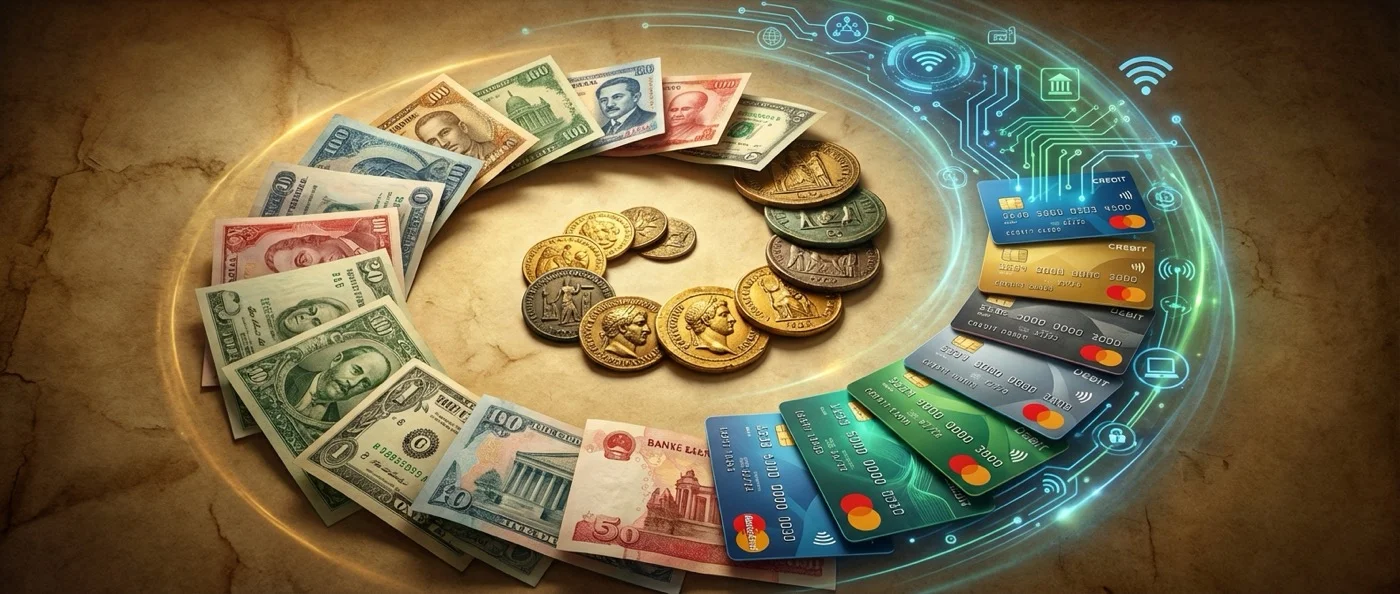
It started as a seashell on a beach. Today it's digits on a screen. You can't eat it, you can't drink it, you can't warm yourself with it — but people kill, die, dominate, and submit for it. Money is perhaps the most successful collective illusion in the history of humanity — and the most fascinating.
📖 Read more: Wow Signal: A Message from Space with No Explanation
🐚 Before Money: The Age of Barter
Before money existed, there was exchange — barter. Imagine: you're a farmer with five sacks of wheat, but you need a pair of shoes. You find the cobbler. But the cobbler doesn't want wheat — he wants meat. The butcher wants wood. The woodcutter wants fabric. This is known as "the double coincidence of wants problem" — and it was the nightmare of the ancient economy.
For millennia, humans solved this problem using "commodity intermediaries": objects that everyone accepted, not because they wanted them, but because they knew someone else would accept them. The most popular?
🐚 Cowrie shells
Used as currency in China, Africa, India, and the Pacific for thousands of years. In China, cowries were so important that the Chinese ideogram for “money” (貝) depicts a shell.
🧂 Salt
The word “salary” comes from the Latin “salarium” — the payment in salt that Roman soldiers received. Salt was precious because it preserved food — vital before refrigeration.
🐄 Cattle
The word “pecunia” (money in Latin) comes from “pecus” (cattle). The word “capital” is possibly linked to “capita” (heads of livestock). Oxen were walking banks.
🍫 Cacao
The Aztecs and Maya used cacao beans as currency. 10 beans = 1 rabbit. 100 beans = 1 slave. Chocolate was literally money.
💡 Did you know?
In Micronesia, on the island of Yap, enormous stone disks (Rai stones) were used as money — some with a diameter of 4 meters and weighing several tons. They were never moved — everyone simply knew who owned each stone. Even if a stone had sunk to the bottom of the sea, the owner remained wealthy because everyone remembered. It was, essentially, blockchain before blockchain.
🪙 600 BC – 300 AD: The Birth of Coinage
Around 600 BC, something revolutionary happened in Lydia, a wealthy kingdom in western Asia Minor (modern-day Turkey). King Alyattes — and later his son, the legendary Croesus — minted the first coins in history: small pieces of electrum (a natural alloy of gold and silver), stamped with the king's seal.
That seal was the real revolution. You no longer needed to weigh every piece of metal — the seal guaranteed the weight and purity. Croesus later introduced separate gold and silver coins, with a fixed exchange rate between them — essentially, the first bimetallic monetary system.
First coins in Lydia
Electrum coins stamped with the king's seal. Standardized weight, guaranteed value. Croesus becomes synonymous with wealth.
Athenian drachma
The “owl” (tetradrachm) becomes the first international currency. It circulates throughout the Mediterranean. Athens funds democracy — literally.
Alexander the Great unifies coinage
A unified monetary system across the entire empire, from Egypt to India. The first “globalization” of money.
Roman denarius
The standard coin of the Roman Empire. Its debasement (reduction of silver content) would become the first great “monetary crisis” — and a template for every future one.
The Roman Empire offers the first historical lesson in monetary collapse. Initially, the denarius contained nearly pure silver. By the 3rd century AD, emperors — facing wars, military expenditures, and impossible taxation — began “clipping” the coins: mixing in more and more copper with each minting. Silver content dropped from 95% to 0.5%. The result? 1,000% inflation in just a few decades. Farmers stopped accepting coins and returned to barter. The economy collapsed. The coin “clipping” wasn't invisible — citizens knew the coins were getting lighter — but there was nothing they could do.
"Coins have no value by nature, but only by convention — that is why they are called 'nomisma,' because their value rests not on nature but on law."
📜 700–1700 AD: The Invention of Paper Money
The wildest idea in the history of money was born in China: instead of carrying heavy metal coins, why not use a piece of paper that represents value? It sounds obvious today. Back then, it was revolutionary.
The first banknotes appeared during the Tang dynasty (~700 AD) as “deposit receipts” — a merchant would deposit his coins in a government treasury and receive a paper certificate. But the full transition to paper currency came during the Song dynasty (960–1279 AD), with “jiaozi” — the first true banknotes in the world.
📊 Metal vs. Paper
Naturally, that “flexibility” proved to be a double-edged sword. The Yuan dynasty (Mongols, 1271–1368) over-printed banknotes to fund wars, causing catastrophic inflation. Marco Polo, who visited China around 1275, described these banknotes in astonishment — in Europe, he had never seen anything like them.
Europe would take centuries to catch up. The first European bank to issue banknotes was Stockholms Banco in Sweden, in 1661. The reason? Swedish copper coins were enormous — some weighed 20 kilograms. Necessity bred invention. But the bank issued more banknotes than it had coins in its vaults — the first European banking crisis. The founder, Johan Palmstruch, was sentenced to death (the sentence was later commuted).
In England, the Bank of England was founded in 1694 — originally as a mechanism to fund the war against Louis XIV's France. It issued “banknotes” — promises to pay in metal coins. That “promise” would become the foundation of every modern banknote. Look at a British banknote: it still reads “I promise to pay the bearer on demand the sum of...” — a promise that's 330 years old.
🥇 1800–1971: The Gold Standard — The Age of Trust
In the 19th century, the major nations adopted the Gold Standard: every currency had a fixed exchange rate to a quantity of gold. Britain led the way — the pound sterling was “good as gold,” literally. You could walk into the Bank of England with a banknote and get gold in return.
The Gold Standard created an era of stability (1870–1914), known as the "First Globalization." Stable exchange rates, free trade, low inflation. But it had a drawback: you couldn't print money beyond your gold reserves. In wartime, that was impossible.
Britain adopts the Gold Standard
The pound sterling is pegged to a fixed quantity of gold. It becomes the world's reserve currency. The British financial century begins.
World War I ends the standard
Countries abandon the Gold Standard to print war money. Inflation, debt, instability.
Weimar Hyperinflation
Germany prints money non-stop. In November 1923, a loaf of bread costs 200 billion marks. Citizens burn banknotes instead of firewood — it was cheaper.
Bretton Woods Agreement
44 countries agree: the dollar is pegged to gold ($35/ounce), all other currencies are pegged to the dollar. The USA becomes “the world's banker.”
Nixon Shock — The end of gold
President Nixon announces that the dollar can no longer be converted into gold. Money becomes “fiat” — worth something only because the government says so.
That moment — August 15, 1971 — is perhaps the most important date in modern economic history. Nixon didn't simply abolish the Gold Standard. He severed the last link between money and something “real.” From that moment on, a $100 bill is worth $100 only because... we all agree it is. The word “fiat” comes from Latin — it means “let it be done.” Fiat money = money by decree.
"Give me control of a nation's currency, and I care not who makes its laws."
🏦 Banks, Loans, and Plastic Money
The history of money isn't just the history of coins — it's primarily the history of credit money. That is, money that doesn't exist yet but is “created” through lending.
Europe's first bankers were the Italian merchant bankers of the Middle Ages — the Medici of Florence, the bankers of Venice and Genoa. The word “bank” comes from the Italian “banco” — the bench on which money changers exchanged coins. When a banker went bankrupt, his bench was publicly smashed — “banco rotto” — from which the word bankruptcy derives.
Fractional reserve banking — the idea that a bank can lend out more than it holds in deposits — began as a shameful secret and ended up as the fundamental principle of every modern banking system. Today, banks keep only a small percentage (typically 3–10%) of deposits as cash — the rest they lend out. If every depositor demanded their money at the same time, the bank would collapse — what we call a “bank run.”
💳 1950: Diners Club
The first credit card. Frank McNamara forgot his wallet at a restaurant — and invented a card to replace cash. 200 members at first.
💳 1958: BankAmericard (Visa)
Bank of America sends 60,000 cards to residents of Fresno, California — unsolicited. The mass credit card is born.
🏧 1967: First ATM
John Shepherd-Barron installs the first ATM in London (Barclays, Enfield). The PIN was 6 digits — reduced to 4 because his wife couldn't remember 6.
The credit card wasn't just a convenience tool. It was a psychological revolution. Studies show that people spend 12–18% more when using a card instead of cash. The pain of watching a banknote leave your hands was replaced by the painless push of a button. For the first time, money became invisible.
💻 1990–Today: Digital Money, Bitcoin, and CBDCs
If the evolutionary line of money was: shell → metal → paper → plastic card, the next step was inevitable: pure digits. Today, roughly 92% of all “money” in the world doesn't physically exist — it's just numbers in databases.
The history of digital money begins earlier than we think. In 1983, cryptographer David Chaum proposed eCash — the first digital “coins” with anonymity. His company, DigiCash, went bankrupt in 1998, but his ideas profoundly influenced what came next.
PayPal — The Beginning
Payments via email. Peter Thiel, Elon Musk, and Max Levchin create a system that would change the logic of commerce. Shopping on eBay instantly becomes easier.
Satoshi Nakamoto publishes the Bitcoin whitepaper
"Bitcoin: A Peer-to-Peer Electronic Cash System." An anonymous individual (or group) publishes 9 pages proposing digital money without banks, without governments, without intermediaries.
Bitcoin's first block
Satoshi “mines” the first block (genesis block). Hidden in the code is a message: a Times headline — “Chancellor on brink of second bailout for banks.”
🍕 The most expensive pizza in history
Laszlo Hanyecz pays 10,000 Bitcoin for 2 Papa John's pizzas. Today, those Bitcoin are worth hundreds of millions of dollars. The date is celebrated as “Bitcoin Pizza Day.”
CBDCs: Central bank digital currencies
Over 130 countries are researching central bank digital currencies. China is already piloting the digital yuan (e-CNY). The future of money doesn't eliminate intermediaries — it digitizes them.
Bitcoin was many things at once: technology, ideology, speculation, hope. Its core innovation was decentralization — no one controls the network, no one can print Bitcoin beyond the 21 million that the code prescribes. For supporters, it was the solution to the eternal problem of monetary manipulation — the government can't “clip” digital coins. For critics, it was a bubble, a tool for crime, an environmental disaster.
⚡ Bitcoin's Energy Consumption
Bitcoin mining consumes more electricity annually than all of Norway. This is due to the “Proof of Work” system — the network's security depends on computational power. Ethereum, after transitioning to “Proof of Stake” (2022), reduced its energy consumption by 99.95%.
🧠 The Psychology of Money: Why Do We Believe?
The deepest truth about money isn't economic — it's psychological. Why do we believe in pieces of paper? Why do we accept digits on a screen as payment for our labor?
Historian Yuval Noah Harari, in “Sapiens,” calls money "the greatest story ever told." It's not an object — it's a shared mythology. A €100 banknote is worth nothing if millions of people don't believe it's worth something. Value doesn't reside in the paper — it resides in trust.
"Money is perhaps the most successful story ever invented by humans, because it's the only story that virtually everyone believes in."
Our relationship with money is deeply irrational. We feel differently about a dollar we earned and a dollar we found on the street — even though their purchasing power is identical. We spend more easily with a card than with cash. We spend small bills more easily than a single large one. These “cognitive biases” aren't individual weaknesses — they're features of the human brain, which evolved to hunt mammoths, not to manage cryptocurrencies.
🔮 Epilogue: From Seashell to Cryptocurrency
The history of money is, in essence, the history of human trust. Every form of money — shell, metal, paper, digit — works only as long as a critical mass of people believes in it. Value doesn't reside in the object. It resides in the relationship between people.
That relationship has always been fragile. Rome clipped its coins. China over-printed banknotes. Weimar printed until money burned. Zimbabwe issued a 100 trillion dollar note. Venezuela, Argentina, Turkey — history repeats itself, because the temptation is always the same: if you can print money, why not print more?
Today, we live in an unprecedented era. Money is no longer a shell, no longer metal, no longer paper — it's numbers running on servers. Central banks digitally control the flow. Algorithms decide who gets a loan. AI evaluates creditworthiness. And somewhere, on a decentralized network, 21 million digital coins run without a government, without a bank, without a gold standard — powered only by mathematics.
The question that remains isn't “what will replace money.” The question is: whom do we trust? A government? A bank? An algorithm? Or a network of strangers that no one controls? The answer will determine what “money” means for the next thousand years.