📖 Read more: Social Media History: From Communication to Exposure
Before photography: a world without images
Consider something simple: before 1826, no human being in history had ever seen an accurate depiction of their own face. Mirrors don't count — they give a reversed image and can't “stop” time. Portrait painters painted, but always with liberties, flattery, interpretations. Louis XIV probably didn't look as majestic as Hyacinthe Rigaud painted him.
The idea that “light can write” (photo = light, graphein = to write) existed centuries earlier. Aristotle observed that light passing through a small hole forms an image. Ibn al-Haytham in the 11th century described in detail the camera obscura — a dark room with a hole, where the outside image was projected upside down on the opposite wall. Artists like Vermeer likely used the camera obscura as a painting aid.
"Photography is truth. Cinema is truth twenty-four times per second."
Niépce, Daguerre, and the race
Joseph Nicéphore Niépce wasn't the classic “inventor in a garage.” He was a wealthy French aristocrat, former officer under Napoleon, amateur inventor. He tiptoed around his workshop at his estate in Le Gras, near Chalon-sur-Saône, testing chemical compounds on metal plates.
«View from the Window at Le Gras»
The oldest surviving photograph. Exposure time: at least 8 hours (some historians say days). The image shows rooftops, chimneys, a tree. Technique: heliography (héliographie) — bitumen varnish on a tin plate.
The Niépce-Daguerre partnership
Niépce partnered with Louis-Jacques-Mandé Daguerre, a theatrical set designer and showman. Daguerre had the ambition, Niépce the expertise. Niépce died in 1833, never seeing the result.
The “birth” of photography
Physicist François Arago announced the daguerreotype at the French Academy of Sciences. Daguerre used iodized silver on a copper plate — exposure time: just 15-30 minutes. The French government purchased the patent and offered the daguerreotype as a “gift to the world.”
Fox Talbot: the alternative
British William Henry Fox Talbot announced his own method — calotype — which used paper instead of metal plates. The great innovation: it produced a negative, from which you could make unlimited copies. Talbot patented it — Daguerre didn't. This made the daguerreotype more popular initially.
💡 Why does no one smile in old photographs?
It wasn't about sadness. With 15-30 minute exposure times, it was impossible to hold a smile that long without moving. That's why they used special head braces to keep the head steady — hidden behind the subject. Besides, photography had the gravitas of a painted portrait: serious, formal.
Photography becomes democratic
The daguerreotype was expensive, fragile, unique (you couldn't copy it). But soon new technologies democratized it.
Wet Plate Collodion
Frederick Scott Archer invented the wet collodion process — a glass plate coated with collodion and silver salts. Faster, cheaper, with a negative. But practically unusable: the photographer had to prepare, expose, and develop the plate while it was still wet — within 10-15 minutes.
Carte de visite
André Adolphe-Eugène Disdéri patented the “carte de visite” — a small photograph the size of a business card. 8 photographs on one plate, dramatically cheaper. Suddenly, even the working class could be photographed. “Photomania” swept across Europe.
The first color photograph
James Clerk Maxwell (the same man who unified electromagnetism) presented at the Royal Institution a tartan ribbon photographed in three colors (red, green, blue) and projected through three lenses. Practically unusable, but the principle was correct.
Dry Plate
Richard Leach Maddox invented glass plates with gelatin instead of collodion. Huge advantage: you could buy them ready-made, expose them, develop them later. The photographer no longer needed a darkroom in the field.
Kodak: «You press the button, we do the rest»
In 1888, George Eastman released the Kodak camera — and photography went from experts to everyone. The camera cost $25 (about $750 today), came preloaded with film for 100 shots, and when finished, you sent the entire camera to the factory. They returned it with your photos printed and new film inside.
The word “Kodak” meant nothing — Eastman invented it because he liked the letter K. “It's short, vigorous, impossible to mispronounce.” The advertising slogan “You press the button, we do the rest” became one of the most successful in history.
📸 Photography: 1826 vs 2024
Photography as testimony
Photography didn't merely record the world — it changed it. For the first time, people could see what was happening far away — and what they saw sometimes shocked them.
⚔️ Crimean War (1855)
Roger Fenton was the first “war correspondent” with a camera. But the government sent him with clear instructions: don't photograph the dead. “Valley of the Shadow of Death” shows cannonballs on a road — no casualties. The first photographic censorship.
🇺🇸 American Civil War (1861-65)
Mathew Brady and his team photographed the battlefields — this time with the dead. The exhibition “The Dead of Antietam” in New York (1862) shocked citizens. The New York Times wrote: “He brought the bodies and stacked them on the sidewalks.”
👧 Lewis Hine & child labor
In the early 1900s, Lewis Hine photographed child workers in factories, coal mines, fields. His photographs — 6-year-olds in textile mills — moved public opinion and led to the first child labor laws in America.
📰 “Migrant Mother” (1936)
Dorothea Lange's photograph of a mother with two children during the Great Depression became the symbol of an entire era. Florence Owens Thompson (the woman in the photo) never received money — she wasn't even asked if she could be photographed.
📖 Read more: The Photographer, the Vulture, and the Child
The film era: golden age and mass culture
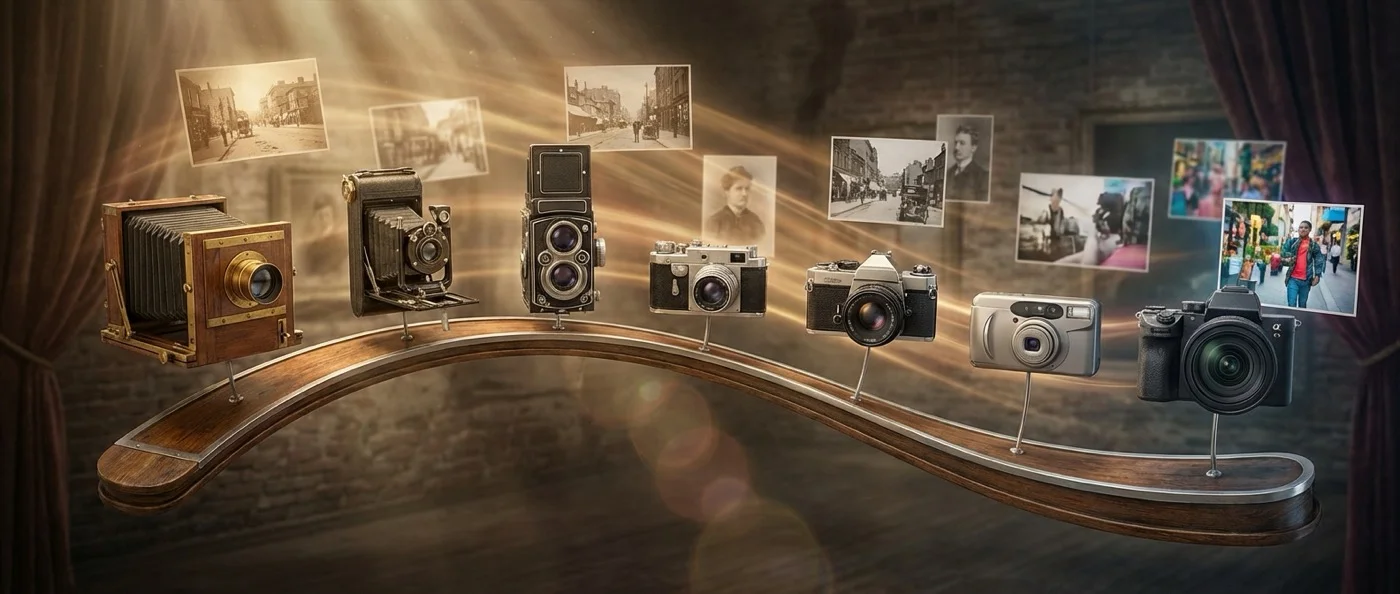
In the 20th century, photography evolved rapidly. 35mm film — originally designed for cinema — transformed cameras into portable, lightweight tools.
Leica I
Leica released the first commercially successful 35mm camera. Small, light, precise. Leica became synonymous with street photography — photographers like Henri Cartier-Bresson carried it everywhere.
Kodachrome
The first commercially successful color film. The colors were so vivid that the word “Kodachrome” became synonymous with rich color. Paul Simon dedicated a song to it: “Mama, don't take my Kodachrome away.” Kodak discontinued production in 2009.
Polaroid: instant photography
Edwin Land presented the Polaroid Model 95. The idea came from his 3-year-old daughter who asked: “Why can't I see the photo now?” The camera developed the photo in 60 seconds. Andy Warhol loved the Polaroid — he took thousands of portraits.
The SLR goes mainstream
Nikon, Pentax, and Canon released SLR (Single-Lens Reflex) cameras that allowed the photographer to see exactly what would be captured through the lens. The Nikon F (1959) became the camera of war correspondents in Vietnam.
"Photography gives you what you can't take: a still moment. The moment passed, but the photograph remains."
The digital revolution
Digital photography didn't arrive suddenly — it came in waves, each more destructive to the “old order.”
The first digital photograph
Kodak engineer Steven Sasson built the first digital camera. It weighed 3.6 kilos, needed 23 seconds to capture a 0.01 megapixel image (10,000 pixels), and stored on cassette tape. Kodak management said: “That's cute, but don't tell anyone.”
Photoshop 1.0
Adobe released Photoshop, created by brothers Thomas and John Knoll. Initial cost: $895. Digital photo editing began — and with it the doubt: “Is this photograph real?”
Nikon D1: the DSLR becomes affordable
At $5,580, the D1 was the first DSLR that photojournalists could actually use. 2.7 megapixels, enough for a newspaper. Darkrooms started closing.
Sharp J-SH04: the camera in your phone
The first commercial camera phone. 0.11 megapixel. Nobody believed it would replace “real” cameras. 24 years later, photographers win World Press Photo awards with iPhones.
The fall of Kodak: the greatest corporate tragedy
Kodak didn't just lose the digital war — it invented it and then ignored it. At its peak (1996), Kodak had 140,000 employees, a $28 billion valuation, and 90% US film market share. In January 2012, it filed for bankruptcy.
What went wrong? Kodak knew digital photography was coming — they themselves had invented the technology! But their profits came from film — with monstrous 70% profit margins. “Why destroy the golden goose?” This is called the innovator's dilemma: the company that dominates a technology can't psychologically embrace the one that will kill it.
🎞️ Numbers of a fall
1999: Kodak sells 1 billion rolls of film per year. Profits $2.5 billion.
2003: Digital surpasses film in sales. Kodak stops manufacturing film cameras.
2005: Kodak holds #1 position in digital cameras in America — but sells at a loss.
2007: Film sales drop 96% in a decade.
2012: Bankruptcy. 47,000 layoffs.
The Instagram era: photography for the masses
On October 6, 2010, Kevin Systrom launched Instagram. 25,000 downloads on day one. 1 million users in 2 months. In April 2012, Facebook bought Instagram for $1 billion — it seemed crazy then, today it's considered the best acquisition in tech history.
Instagram didn't invent mobile photography — but it invented photography as a social act. Filters (Lo-fi, Valencia, X-Pro II) turned every awkward photo into a “vintage masterpiece.” Suddenly, everyone was a photographer — or at least believed so.
📱 Photos per day, by era
AI and the end of “truth”
Artificial intelligence brings a new — perhaps final — crisis to photography. Generative AI tools (Midjourney, DALL-E, Stable Diffusion) can create photographs that look absolutely realistic but depict nothing real.
In March 2023, an AI-generated photo of Pope Francis in a white Balenciaga puffer jacket went viral — millions believed it was real. Boris Eldagsen won a Sony World Photography Award with an AI photo — and refused to accept it, as a “provocation.”
"We lived in an era where photography was proof. Now we're entering an era where photography proves nothing."
Photography was born as an antidote to oblivion — a way to “freeze” time, to hold a moment before it vanishes. Now, in an era where we take 3.8 billion photos a day, perhaps the danger is no longer oblivion — but the deluge. When we photograph everything, perhaps we truly see nothing.