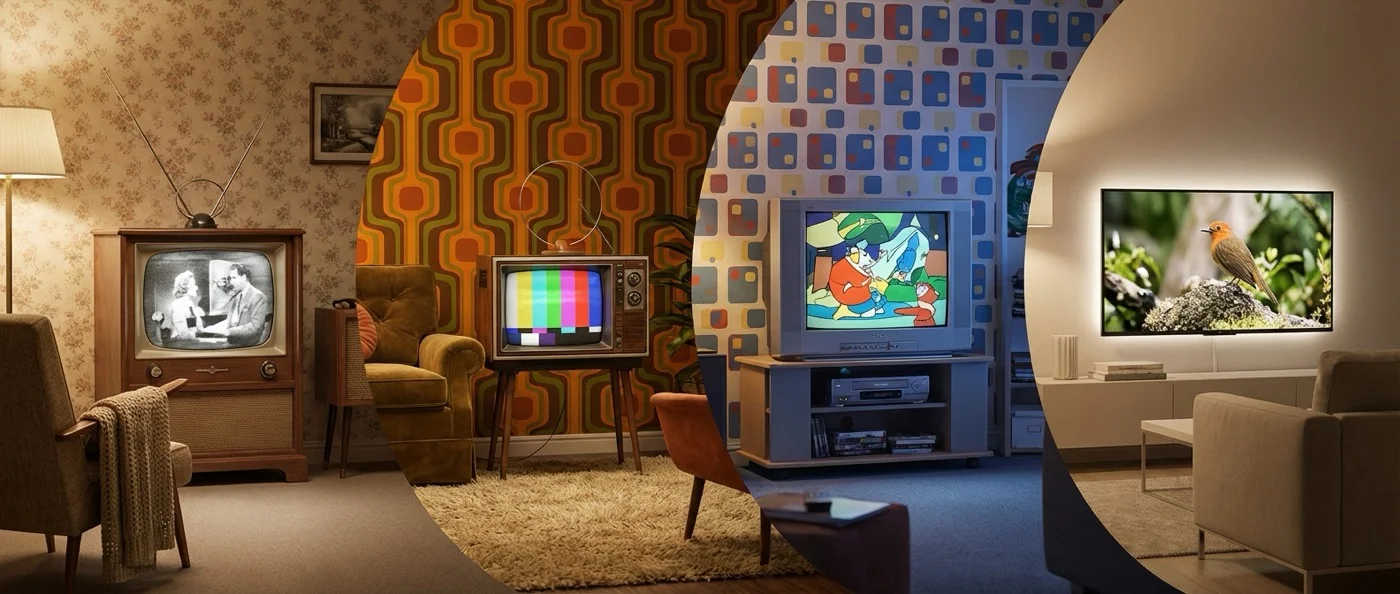
It started as an incomprehensible laboratory experiment — a spinning disk with holes, a piece of selenium, and a faint flicker of light. Today, billions of screens in every corner of the planet broadcast images that shape policies, topple governments, and define how we perceive reality. This is the history of television — a box that doesn't simply show the world, but constructs it.
📖 Read more: The Night Orson Welles Scared America
🔭 1880–1920: The Visionaries — The Era When Images Dreamed of Traveling
The history of television doesn't begin with a screen. It begins with a question that haunted the inventors of the 19th century: can an image be transmitted over distance, like sound through a telephone? The telegraph was already transmitting messages. Alexander Graham Bell had managed to send voice through wire. Photography was capturing moments. But no one had yet sent a moving image.
In 1873, the British electrical engineer Willoughby Smith discovered something unexpected: selenium, a chemical element, reacts to light — its electrical conductivity changes depending on the intensity of illumination. This accidental discovery, known as photoconductivity, became the cornerstone of every future effort to convert light into an electrical signal — in other words, the foundation of every television camera.
Eleven years later, a 23-year-old German student, Paul Gottlieb Nipkow, filed a patent that would prove prophetic. In 1884, Nipkow designed a spinning disk with spirally arranged openings — the famous Nipkow disk. The idea was brilliant in its simplicity: as the disk rotates, each hole “scans” a strip of the image, converting a two-dimensional scene into a sequence of light points — essentially, the first pixels. Nipkow never built a functioning device, but his patent laid the theoretical foundations for three decades of experimentation.
💡 Did you know?
The word "television" was coined in 1900 by the Russian scientist Constantin Perskyi, during a speech at the International Electricity Congress in Paris. The word combines the Greek “tēle” (far) with the Latin “visio” (sight). What was then a theoretical fantasy would become reality in less than thirty years.
In the early years of the 20th century, progress accelerated. In 1907, the development of amplifier tubes by Lee de Forest and Arthur Korn finally made it possible to convert weak optical signals into recognizable images. In 1909, Georges Rignoux and A. Fournier in Paris conducted the first demonstration of instantaneous image transmission: using a matrix of 64 selenium cells, they managed to reproduce letters of the alphabet at 8×8 pixel resolution — an image so crude it could barely distinguish an “A” from a “B,” but enough to prove the concept worked.
In 1911, the Russian Boris Rosing, along with his young student Vladimir Zworykin — a name we'll encounter again — built a system using a cathode ray tube (CRT) at the receiver. The images were “extremely crude,” by Zworykin's own admission, and motion was impossible due to the slow response of the selenium. But the architecture — camera on one end, cathode ray tube on the other — was essentially the skeleton of every television system for the next eighty years.
🔧 Paul Nipkow (1884)
Designed the spinning scanning disk, the first mechanism for converting an image into a linear signal. He never built a working prototype.
⚡ Boris Rosing (1911)
First to use a cathode ray tube as a display. Transmitted blurry geometric shapes. His student, Zworykin, would continue his work.
📡 Willoughby Smith (1873)
Discovered the photoconductivity of selenium — that light can be converted into an electrical signal. The foundation of every camera.
📺 1920–1935: Mechanical Television — When the World Saw for the First Time
If the 1880s were the era of dreams, the 1920s were the era of the first blurry images. And no one chased them more obsessively than a Scottish inventor with nicotine-stained fingers and an obsession that had brought him to the brink of collapse.
John Logie Baird was an untamed spirit. A seller of socks and soap before turning to invention, he had recently recovered from a serious illness in Hastings when he began his experiments. His first prototypes were built from knitting needles, biscuit tins, a dollhouse lens, and a gramophone turntable. From this junk, the first working television was born.
On January 26, 1926, Baird performed his public demonstration of moving images via television before 40 scientists at the Royal Institution in London. The “program” was a ventriloquist's dummy named “Stooky Bill” — its painted features had enough contrast to appear on the system's mere 30 lines of resolution. The image flickered, was smaller than a postage stamp, but it moved. The world had just seen television.
"An inventor, Dr. A. M. Low, has discovered a means of transmitting visual images via wire. If this invention succeeds, it appears we shall soon be able to see people at a distance."
Baird didn't stop there. In 1927, he transmitted a signal via telephone line over a distance of 705 kilometers, from London to Glasgow. In 1928, his company achieved the first transatlantic television transmission — from London to New York — and the first transmission from land to ship. In 1929, Baird collaborated with Bernard Natan of Pathé to establish the first French television company. At the same time, he was involved in the first experimental television service in Germany.
On the other side of the Atlantic, American inventor Charles Francis Jenkins conducted a public demonstration of synchronized silhouettes on June 13, 1925, transmitting the image of a toy windmill over a distance of 8 kilometers. Almost simultaneously, at the Bell Telephone Laboratories, Herbert Ives and Frank Gray performed an impressive demonstration of mechanical television on April 7, 1927 — with a 60×75 centimeter screen, sound, and among the “actors” was the Secretary of Commerce (and future president) Herbert Hoover.
First public demonstration of silhouettes
Baird shows moving silhouettes at Selfridge's in London. Jenkins transmits a windmill silhouette in the USA.
First transmission of a human face
Baird shows a moving face at the Royal Institution. 30 lines of resolution — barely recognizable.
Long-distance signal & Bell Labs
London–Glasgow transmission (705 km). Bell Labs demonstrates television with sound on a large screen.
First television station
Station W2XB (later WRGB) in Schenectady, New York, begins experimental broadcasts — the first television station in the world.
BBC & Baird: first broadcasts
Baird's mechanical television is broadcast via BBC radio transmitter. Regular broadcasts begin five days a week.
Mechanical television was, however, a technological dead end. The Nipkow disk couldn't accommodate enough holes for high resolution, and the spinning mechanical disks were noisy and unreliable. The resolution ranged from 30 to 120 lines — enough to recognize a face, but insufficient for anything ambitious. The solution would come from electronics — and from a clash between a farm-boy genius and an industrial empire.
⚡ 1930–1945: The Electronic Revolution — Farnsworth vs. RCA
One of the most dramatic stories in the annals of technology unfolded in American laboratories during the 1930s — and it wasn't just about electrons and tubes, but primarily about power, money, and stolen dreams.
Philo Farnsworth was a farm boy from Idaho, son of Mormon farmers, who at age 14 had sketched on a school blackboard the basic principles of a fully electronic television system. His teacher, Justin Tolman, later remembered that sketch — and his testimony would prove crucial in a courtroom.
On September 7, 1927, in his laboratory at 202 Green Street in San Francisco, Farnsworth's “image dissector” camera transmitted the first electronic image: a simple straight line. A year later, he refined the system enough to demonstrate it to the press — this is widely considered the first purely electronic television demonstration. In 1929, he transmitted the first live human image: his wife Elma, with her eyes closed — most likely due to the blinding lights.
In the opposing camp, RCA — then the electronics giant — had recruited Vladimir Zworykin, Rosing's former student, who was working at Westinghouse Electric. Zworykin had created his own electronic system, but the 1925 demonstration was disappointing — the image was crude, faint, and static. RCA, which had acquired the patent rights, claimed that Farnsworth's patent was so broad it excluded any other electronic imaging device. They filed a patent interference suit.
⚔️ Farnsworth vs. Zworykin/RCA
In 1935, the patent examiner ruled in favor of Farnsworth. His teacher's testimony — the blackboard, the sketches of the 14-year-old — played a decisive role. Zworykin was unable or unwilling to present a functional model based on his original 1923 patent application. Ultimately, in September 1939, RCA agreed to pay Farnsworth 1 million dollars over ten years, plus licensing fees — the first time in the company's history that it paid royalties to an outside inventor.
Meanwhile, Europe was moving decisively. On November 2, 1936, the BBC launched the world's first regular high-definition television service, with 405 lines, from the studios at Alexandra Palace in north London. At the same time, Nazi Germany used television for propaganda — broadcasting the 1936 Berlin Olympics live at public venues across the country, via the station “Fernsehsender Paul Nipkow.”
"At no critical moment can I find anything useful in my life. Television is a divine gift, but I don't feel I received anything for it."
World War II brought everything to an abrupt halt. On September 1, 1939, the BBC's television service was suddenly interrupted — at 12:35 p.m., after a Mickey Mouse cartoon — due to fears that the broadcasts could serve as a navigation beacon for enemy aircraft heading toward London. In the USA, the War Production Board halted the manufacture of television sets in April 1942. Television was put on ice.
It would restart after the war — but this time it would no longer be an experiment. It would be an industry.
🌟 1945–1960: The Golden Age — Television Enters Every Home
In 1946, the BBC service returned — opening with a live broadcast that began with the words: “Good afternoon, everyone. How are you? Do you remember me? Jasmine Bligh.” It was followed by the same Mickey Mouse cartoon that had been broadcast on the last day before the war. Television didn't just resurrect — it was reborn.
In the USA, the postwar television explosion was perhaps the most impressive technological adoption in history. The numbers speak for themselves:
In just thirteen years — from 1947 to 1960 — television went from a curious living room gadget to an inseparable member of the family. The “magic box” was no longer just a source of entertainment. It was the medium through which an entire generation learned the news, watched the president, followed sports, and discovered the world.
This decade gave birth to the “Golden Age” of American television. Live dramas, variety shows, quiz shows — television discovered its own language. “I Love Lucy” reached 60 million viewers. The quiz show “The $64,000 Question” became a national phenomenon. And Edward R. Murrow's “See It Now,” which defied Senator McCarthy, proved that television wasn't just an entertainment box — it was a weapon of democracy.
📻 Radio vs. Television
Radio took 38 years to reach 50 million listeners. Television achieved it in 13 years. The transition was so violent that countless radio stations closed or converted to television stations within a decade. The era of radio theater ended for good.
Television of this era was still black-and-white, the screens were small, the picture quality crude. But none of that mattered. Families gathered around the “magic box” every evening, neighbors went to the house of whoever had a television to watch together. The rooftop antenna became a symbol of middle-class prosperity, like the car in the garage or the white picket fence in the yard.
At the same time, the Soviet Union was developing its own standard — 625 lines, designed in 1944, first broadcast in Moscow in 1948. This standard would later be adopted as the European CCIR standard. Television had become a global phenomenon — and a political tool of two rival superpowers.
🎨 1960–1975: Color and Power — Television Changes History
Color television didn't arrive suddenly — it came slowly, like color beginning to fill a black-and-white photograph. The first experiments began as early as the 1940s. The first color broadcast in the USA took place on July 8, 1954. But color televisions were expensive, heavy as wardrobes, and rarely broke down where they should have.
The pace of change was gradual. The real shift came only in the mid-1960s, when it was announced that more than half of prime-time programs would now be broadcast in color. The first fully color season came in 1966. And by 1972, sales of color televisions surpassed those of black-and-white sets.
But the 1960-1975 decade won't be remembered only for color. It will be remembered because television became power — an asymmetric factor that could decide elections, end wars, unite or divide entire nations.
📺 Debate Nixon-Kennedy (1960)
70 million viewers watched the young, composed Kennedy against the sweating, unshaven Nixon. Television didn't just cover politics — it defined it. The image won, not the argument.
🕊️ Kennedy Assassination (1963)
For the first time in history, an entire nation experiences collective grief in real time through television screens. 175 million Americans watched the ceremonies.
🌙 Moon Landing (1969)
Six hundred million people around the planet watch live as Neil Armstrong steps onto the Moon. Television unites the world in a shared moment of wonder.
💣 Vietnam War
The “first television war” — or “living room war.” Families watched dead soldiers on the evening news every night. Public opinion turned against the war. Television ends wars.
"Without television, there would have been no Martin Luther King, no civil rights movement, perhaps no Vietnam — certainly no anti-war movement without it."
Television of this era wasn't just a broadcast medium — it was the public sphere. There was no internet, no social media. Just three major networks — NBC, CBS, ABC — shared nearly the entire American audience. This concentration of power was chilling: three private companies decided, every evening, what an entire nation would see. What it would learn. What it would believe.
📡 1975–1990: The Cable Revolution — CNN, MTV, and the Fragmentation of the Audience
The decade begins with a question: can television be sent via satellite? The answer came in June 1962, with the Telstar satellite and the live transmission of signals between Europe and America — an event watched by over 100 million viewers across two continents. But the real change came later, when satellite and cable television “broke” the monopoly of the three major networks.
Cable television started as a practical solution: in rural areas where antennas couldn't pick up a signal, a central cable delivered television channels. Gradually, it transformed into a multi-billion dollar industry. By the late 1980s, the majority of American households were connected to a cable network.
Two channels of this era didn't just change television — they changed culture.
📺 The Channels That Changed Everything
CNN wasn't just another news channel. It was a philosophical shift: the news was no longer broadcast three times a day in half-hour bulletins — it was broadcast continuously. Every moment was a “news bulletin.” This created a new relationship between people and information — a relationship of addiction, a need for constant updates, that would later peak with smartphones. Television taught us to not tolerate silence.
On the technological side, television was becoming more portable. Sony released the first fully transistorized set (TV8-301) in 1960, and by the 1980s, small portable televisions were a common sight. Television receivers were no longer just “living room furniture” — they followed their owners.
💿 1990–2005: The Digital Transition — Flat Screens and Reality TV
The 1990s brought two parallel revolutions. The first was technological: the transition from analog to digital television. The second was cultural: the emergence of reality TV.
Digital television wasn't a matter of vanity — it was a matter of physics. Analog signals wasted enormous swathes of radio frequency spectrum. Digitization allowed the transmission of more channels in the same space, a clear picture without noise, and — most importantly — high definition (HDTV). Japan was a pioneer, with NHK developing the analog MUSE system. But the real game-changer came when America's General Instrument demonstrated the possibility of a fully digital television signal in June 1990.
At the same time, cathode ray tubes — the heavy, deep CRTs — were gradually being replaced. In the early 2000s, the first commercially available flat screens (plasma and LCD) appeared. It became clear that television no longer needed to be a “box” — it could be a picture frame hung on the wall.
🖥️ CRT vs. Flat Screen
But the real cultural bomb of this era wasn't technological — it was about content. Reality shows, with “Survivor” (2000) and “Big Brother” (1999) as reference points, transformed the relationship between viewer and screen. Suddenly, you weren't watching actors — you were watching “real people.” Or rather, people you believed were real, in artificially constructed situations. Television discovered that the cheapest way to keep audiences hooked wasn't a great screenwriter — it was manufactured “authenticity.”
On September 11, 2001, television proved its power once again. Billions of people watched live as planes crashed into the Twin Towers — it was the most-watched live broadcast in history up to that point. Television, still without serious competition from the internet, remained the dominant medium for the moments that mattered.
📱 2005–Today: The Streaming Era — Death and Metamorphosis
Television didn't die. But neither did it survive in the form we knew. It metamorphosed into something entirely different — and that metamorphosis began with a video uploaded to YouTube on April 23, 2005, about elephants at the San Diego Zoo.
The founding of YouTube (2005) didn't immediately replace television, but it relativized it. Suddenly, anyone could “broadcast.” The monopolistic relationship between television networks and audiences was broken — irreparably.
The real disruption, however, came from a DVD-by-mail company. In 2007, Netflix launched its streaming service — transmitting movies and series via the internet. The beginning was humble: a few thousand titles, average quality, slow connection. But the logic was revolutionary: you watch what you want, whenever you want, as many times as you want. You don't need a schedule. You don't need an antenna. You don't even need a television — a laptop will do.
The emergence of Smart TVs — televisions connected to the internet — sealed the metamorphosis. Today's television isn't a receiver of distant signals — it's a gateway to the internet. Netflix, Disney+, YouTube, Amazon Prime, Apple TV+, HBO Max… television no longer dictates a schedule. The viewer decides. Or rather, the algorithm decides for them.
The term “cord-cutting” — disconnecting from traditional cable packages — describes the largest audience migration in television history. In the USA, the number of households with traditional television (cable or satellite) decreases steadily every year. What's growing isn't “television viewers” — it's platform users. The difference isn't semantic. It's existential.
🔀 The Paradox of Streaming
Never in history has so much television content been produced — and never has it been so hard to find something to watch. Over 500 new series are released annually in the USA alone. Overproduction leads to “decision fatigue” — the average viewer spends 7-10 minutes choosing what to watch, before ultimately rewatching something they've already seen.
👁️ Television as Power: A Century of Manipulation and Enlightenment
The title of this article is no accident: “how a box became power.” Television never transmitted “just images.” It transmitted narratives. And whoever controls the narrative controls the world — or at least the way we perceive it.
The most classic example is the Nixon-Kennedy presidential debate in September 1960. Radio listeners believed Nixon won — his arguments were persuasive. Television viewers believed Kennedy won — his image was persuasive. At that moment, television didn't “cover” the elections. It decided them.
Television's power wasn't always negative. It brought the Vietnam War into living rooms — and that created the anti-war movement. It broadcast the civil rights marches — and that strengthened the movement. It showed poverty — and that pressured governments. But the same power could be used in reverse: propaganda, distortion, manufacturing consent.
Today, television is no longer the sole holder of this power. Social media, YouTube, podcasts have decentralized the power of the image. But television's logic — the dominance of image over thought, spectacle over analysis, emotion over reason — didn't disappear. It migrated to new platforms. We still live in the world television created — even if many no longer “watch television.”
"Television is not the truth. Television is a goddamn amusement park. Television is a circus, a carnival, a traveling troupe of acrobats, storytellers, dancers, singers, jugglers, sideshow freaks. We're in the boredom-killing business."
🔮 Epilogue: From the Nipkow Disk to the Algorithm
One hundred and forty years after Paul Nipkow's perforated disk, television has traveled a path that few human inventions can rival. From 30 lines to 8K. From black-and-white silhouettes to photorealistic HDR. From a wooden box in the corner of the living room to a chip tucked in our pocket. And, perhaps most importantly of all: from three channels that decided what we'd watch, to algorithms that decide how we think.
The history of television is the history of a paradox. The technology that promised to show us the world ended up constructing it. The machine created to inform was used equally to manipulate. The medium that united the entire planet before the Moon was used equally to divide it.
Today, “television” is no longer an object. It is a logic — the logic that the image governs, that narrative shapes opinion, that whoever controls what you see controls what you believe. This logic isn't going to disappear. But if you understand how it was born — from Nipkow to the algorithm — at least you can decide: who controls your screen?