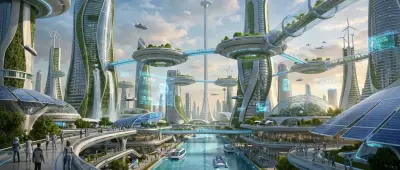
The city of 2090 won't resemble anything we know today. Urban planners, architects, and futurists agree on one thing: technology, climate change, and population growth will completely reshape the way we build and inhabit cities. Let's take a journey into the future and see what awaits us.
🎬 A Visualized Vision of the Future
Artists and designers have already begun sketching this future. The video below shows their vision:
These images are not mere fantasy. They're based on technologies already being developed today — from autonomous electric vehicles to smart buildings with integrated artificial intelligence.
🏗️ The Architecture of a New Era
Forget the flat, dull buildings of the 20th century. The architecture of 2090 will be radically different — biomimetic, self-healing, and fully integrated with nature. Skyscrapers won't just be tall buildings, but vertical ecosystems hosting forests, gardens, and entire communities.
The concept of “biophilic architecture” — design that integrates nature into the built environment — will have reached its peak. Every building will function as a small forest, absorbing CO2, producing oxygen, and providing a refuge for wildlife. Facades will be covered in “living walls” — panels with algae and plants that are self-sustaining and purify the air.
Self-Healing Materials
Cracks in concrete and steel corrosion will be things of the past. Buildings in 2090 will be constructed from “smart” materials that repair themselves. Scientists at Delft University have already developed bio-concrete with embedded bacteria that produce calcite to “fill” cracks. By 2090, this technology will be standard.
Buildings will reshape themselves according to need. Movable walls, expandable spaces, and rooms that adapt to the number of occupants. The concept of a “static” building will have disappeared.
"The cities of the future won't simply be collections of buildings — they'll be living organisms that breathe, adapt, and evolve."
🚗 Transportation: The Sky as the New Road
Roads as we know them will have been transformed. With the evolution of electric vehicles and autonomous driving, the concept of “driving” will have fundamentally changed. But the real revolution will be in the air.
Flying vehicles (flying cars or eVTOL — electric Vertical Take-Off and Landing) are no longer science fiction. Companies like Joby Aviation, Lilium, and Archer Aviation are already testing prototypes. By 2090, these vehicles will be as common as cars are today.
Flying Taxis
Autonomous passenger-carrying drones will connect neighborhoods to city centers in minutes rather than hours. Uber Air and Volocopter are preparing the first networks.
Underground Networks
Surface roads will be exclusively for pedestrians and cyclists. Vehicles will travel through high-speed underground tunnels — similar to Elon Musk's Boring Company concept.
Hyperloop
For long distances, hyperloop capsules will travel at over 1,000 km/h through vacuum tubes. Athens to Thessaloniki in 30 minutes.
Traffic jams will vanish. Autonomous vehicles will talk to each other and the city's infrastructure, finding the fastest routes instantly. Traffic accidents — which currently kill 1.3 million people annually — will have been reduced by 99%.
🤖 AI: The City's “Brain”
Every aspect of life in the city of 2090 will be managed by artificial intelligence. Not in the way Hollywood imagines — with robots rebelling — but through an invisible, pervasive network that makes everything more efficient.
Imagine a city that “thinks.” Street lights that only turn on when someone passes by. Trash bins that automatically notify garbage trucks when they're full. Water supply networks that detect and repair leaks on their own. All of this already exists in experimental form — by 2090, it will be the norm.
The “City Brain” — The Central Intelligence
Every megacity of 2090 will have a central AI system coordinating everything: traffic, energy, security, health, logistics. Alibaba has already deployed its “City Brain” in Chinese cities, reducing congestion by 15% and emergency response times by 50%.
Personal AI Assistants
Your personal AI will know when you need coffee before you feel tired, book restaurants based on your mood, and call taxis before you decide to leave. It will manage our schedules, make reservations, order food, coordinate our travel — and predict what we need before we even think of it. Imagine Siri or Google Assistant, but 1,000 times smarter and fully integrated into your life.
⚡ Energy: The End of Fossil Fuels
The city of 2090 will be 100% carbon neutral — or even carbon negative. Fossil fuels will have been completely abandoned, replaced by a mix of renewable sources that we are only beginning to harness today.
Every building will produce more energy than it consumes. The surplus will power vehicles and networks, and be stored for nights and overcast days. The concept of an “electricity bill” will have disappeared.
🏥 Health: Prevention, Not Cure
Healthcare in 2090 will be radically different. The emphasis will have shifted from treatment to prevention — and technology will make it possible.
Wearable devices — far more advanced than today's Apple Watch — will monitor every aspect of our health in real time. Heart rate, glucose levels, sleep quality, stress levels, even early indicators of cancer. AI will analyze the data and predict health issues before they appear.
Hospitals as we know them will largely disappear. Most medical procedures will be performed at home with the help of robotic systems and telemedicine. Only the most serious surgeries will require a physical visit to a medical center.
🌍 Environment: The Great Reversal
Climate change will have forced cities to adapt dramatically. Temperatures will be higher, sea levels will have risen, and extreme weather events will be more frequent. But humanity will have responded.
Cities of 2090 will have been designed with resilience in mind. Flooding? Buildings will be elevated or floating — like the floating homes of the Netherlands. Heatwaves? “Cool roofs” and vertical forests will reduce temperatures by 5–8°C. Water shortages? Water recycling systems will ensure zero waste.
"The cities that survive to 2090 won't be those that tried to conquer nature, but those that learned to work with it."
👥 Society: New Ways of Living
Social structures will change dramatically. Work as we know it will have been transformed. With robots and AI taking over most repetitive tasks, people will focus on creativity, caregiving, and interpersonal relationships.
The concept of “ownership” will have changed. Why buy a car when you can summon an autonomous taxi at the touch of a button? Why own tools you use once a month when “tool libraries” exist? The sharing economy will dominate.
Neighborhoods will become more self-sufficient. Each district will have its own vertical farms for fresh vegetables, its own co-working spaces, and its own entertainment centers. The need for long daily commutes will have dramatically decreased.
🔮 The Challenges We Must Face
This future hangs on solving massive challenges:
- Inequality: Who will have access to these technologies? Will two-speed cities emerge?
- Privacy: In a city where everything is monitored, what happens to freedom?
- Security: Could a hack on a central AI system paralyze an entire city?
- Human connection: In a world of automation, will we preserve our communities?
The decisions we make today will determine whether the city of 2090 will be a utopia or a dystopia. Technology is simply a tool — how we use it is up to us.
🚀 The Journey Starts Today
The city of 2090 is not just a fantasy. It's a vision based on technologies already in development, trends being observed right now, and needs we know will arise. The children being born today will live in this world.
And perhaps the most exciting part is that much of what we've described already exists in early form. The first flying taxis are being tested in Dubai and New York. Vertical forests are rising in Milan and Shanghai. Nuclear fusion achieved its first net energy gain in 2022. Autonomous vehicles are already operating on test routes.
The future isn't something we wait for. It's something we build — day by day, decision by decision. The city of 2090 starts today.