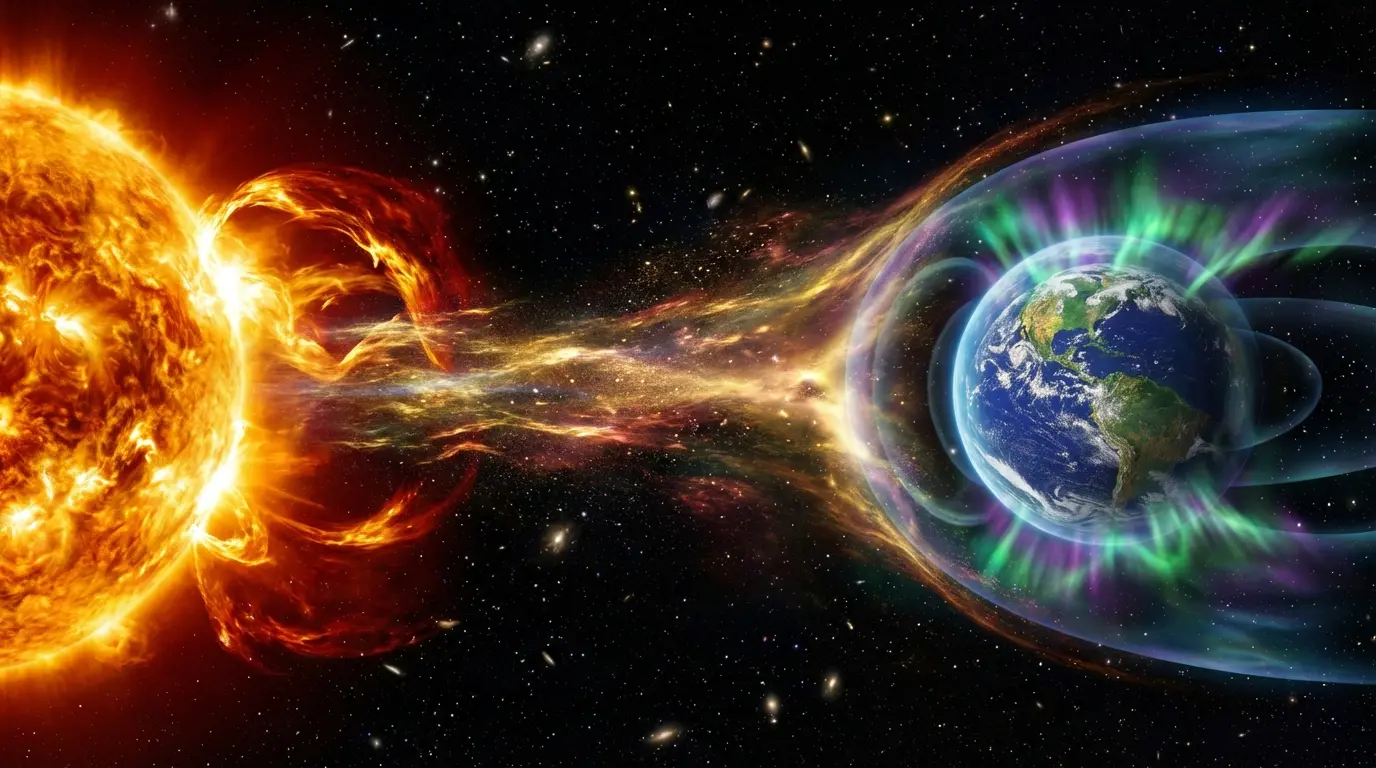
The strongest solar storm in over 20 years is currently hitting our planet, putting scientific teams worldwide on alert. The geomagnetic disturbance rated S4 is causing spectacular phenomena in the sky while simultaneously affecting critical technological systems that modern societies depend on.
⚡ BREAKING: The S4 solar storm is the strongest to hit Earth since 2003. Solar particles traveled from the Sun to Earth in just 25 hours instead of the usual 2–3 days!
What Is a Solar Storm and Why Is It So Important?
A solar storm (or geomagnetic storm) occurs when the Sun ejects massive amounts of charged particles and radiation toward Earth. These explosions, known as Coronal Mass Ejections (CME), can dramatically affect our planet's magnetic field.
This current storm stands out for its arrival speed. While solar particles normally take 2–3 days to traverse the 150 million kilometers between the Sun and Earth, this time they arrived in just 25 hours. This indicates the exceptional intensity of the solar eruption.
The Solar Storm Intensity Scale
Solar storms are categorized on a scale from S1 to S5, depending on the radiation intensity and potential impacts. The current S4 storm is considered “severe” and is one step below the extreme S5 category.
| Category | Classification | Effects |
|---|---|---|
| S1 | Minor | Minor effects on high-orbit satellites |
| S2 | Moderate | Airline passengers at high altitudes exposed to increased radiation |
| S3 | Strong | Disruptions to GPS systems and radio communications |
| S4 | Severe | Significant disruptions to satellites, GPS, HF radio communications |
| S5 | Extreme | Danger to astronauts, complete HF communications blackout |
How Does It Affect Our Daily Lives?
In an era where technology permeates every aspect of our lives, a powerful solar storm can affect many systems we take for granted. The impacts are particularly significant for devices we use daily, such as smartphones and tablets.
Satellites
Communication and observation satellites can suffer damage to their electronic circuits. Increased radiation accelerates wear on their sensitive components.
Aviation
Flights over the poles face communication and navigation issues. Many airlines reroute flights during strong storms.
Telecommunications
High-frequency (HF) radio communications are significantly affected. This can cause problems in maritime and aviation communications.
GPS & Navigation
GPS systems may show reduced accuracy or temporary signal loss. This affects everything from navigation apps to autonomous vehicles.
Power Grids
Geomagnetically induced currents (GIC) can cause overloading of high-voltage transformers, especially at northern latitudes.
Astronauts
The crew of the International Space Station takes protective measures, retreating to shielded areas of the station.
⚠️ IMPORTANT: Although solar storms affect technology, they do not pose a direct health risk to people on Earth's surface. Our atmosphere and magnetic field provide adequate protection.
The Northern Lights: The Storm's Enchanting Side
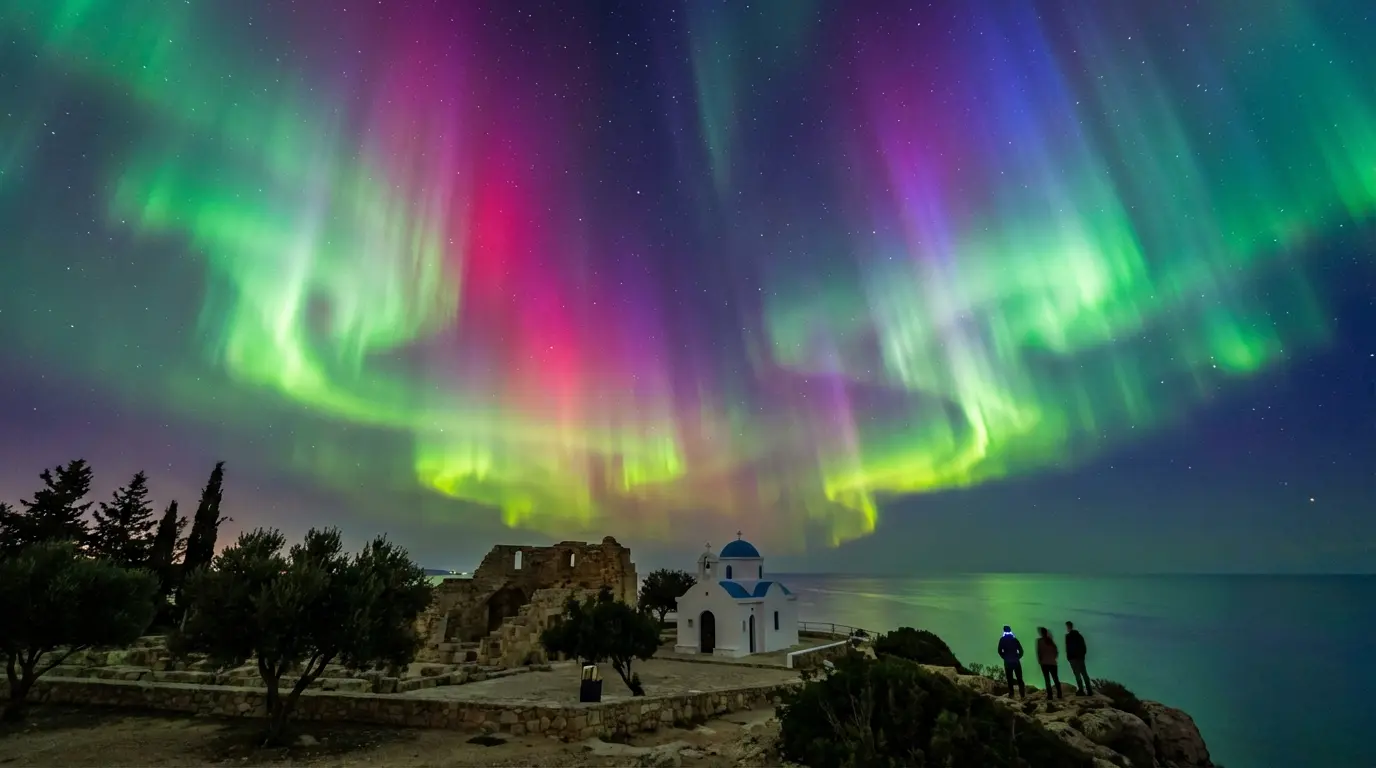
The northern lights became visible at unusually low latitudes
One of the most spectacular consequences of a powerful solar storm is the appearance of the Northern Lights (Aurora Borealis) in areas where they are normally not visible. During this storm, the phenomenon was observed even at lower latitudes, including the Mediterranean.
The aurora is created when charged particles from the Sun interact with atmospheric molecules. The different colors (green, red, blue, purple) depend on the type of atmospheric molecules that are activated and the altitude at which the interaction occurs.
📸 TIP: For those who want to photograph the northern lights, your smartphone camera can capture the colors better than the human eye! Use night mode or long exposure.
Why Do the Lights Reach Southern Regions?
Normally, the northern lights appear in zones near the magnetic poles (65°–72° north). However, during strong geomagnetic storms like this one, the auroral “oval zone” expands dramatically southward.
In cases of S4 and S5 category storms, the phenomenon can become visible even in Mediterranean countries, including Greece and Cyprus. However, at these latitudes, the phenomenon is usually faint and requires dark skies away from urban light pollution to be observed.
Timeline of the Current Storm
A powerful X-class solar flare is recorded on the Sun's surface.
NASA and ESA issue a warning about an incoming geomagnetic storm.
The first charged particles reach Earth — the S4 storm begins.
Northern lights visible at unusually low latitudes. Reports from Greece and Cyprus.
The storm continues with decreasing intensity. Full subsidence expected within 24–48 hours.
International Preparedness and Protocols
The international scientific community has developed extensive protocols for dealing with solar storms. At a recent conference held in Nicosia, an important cooperation protocol was signed between space agencies for the joint monitoring and prediction of such phenomena.
Artificial intelligence now plays a crucial role in predicting solar storms. Machine learning algorithms analyze data from solar observatories in real time, providing warnings with an accuracy that was impossible just a few years ago.
How to Protect Your Devices
Although the chances of damage to consumer devices are small, there are some precautions you can take during powerful solar storms:
- Unplug sensitive devices from the outlet if there is a risk of power surges
- Use a UPS (uninterruptible power supply) for critical equipment
- Back up your important data to ensure nothing is lost
- Don't rely solely on GPS for navigation during a storm
- Check the battery of your laptop so it can operate independently
The Solar Cycle and the Future
The Sun follows an activity cycle of approximately 11 years, known as the solar cycle. We are currently near the maximum of the current cycle (Cycle 25), which explains the increased solar activity.
Scientists predict that activity will remain high until 2026–2027, before it begins to gradually decrease toward a new solar minimum. This means we should expect more similar storms in the coming years.
🔬 SCIENTIFIC NOTE: The strongest recorded solar storm was the “Carrington Event” of 1859, which caused fires at telegraph stations. A similar storm today would cause billions of dollars in damage to global infrastructure.
Impact on Greece
For Greece, the current solar storm is not expected to cause significant problems in daily life. The power grid and telecommunications are operating normally, with only potential minor fluctuations in GPS accuracy.
However, the storm serves as a reminder of the need for preparedness. With the growing dependence on technology, shielding critical infrastructure against space weather events is becoming increasingly important.
Conclusions
The current S4 solar storm is a rare opportunity to observe the power of the Sun and its relationship with Earth. While the impacts on technology are manageable, the phenomenon reminds us how dependent modern society is on technologies that can be affected by space events.
For those who have the opportunity, the northern lights appearing at unusually low latitudes are a unique spectacle worth seeking out. Get away from the city lights, turn your gaze toward the northern horizon, and let nature impress you with its own light show.