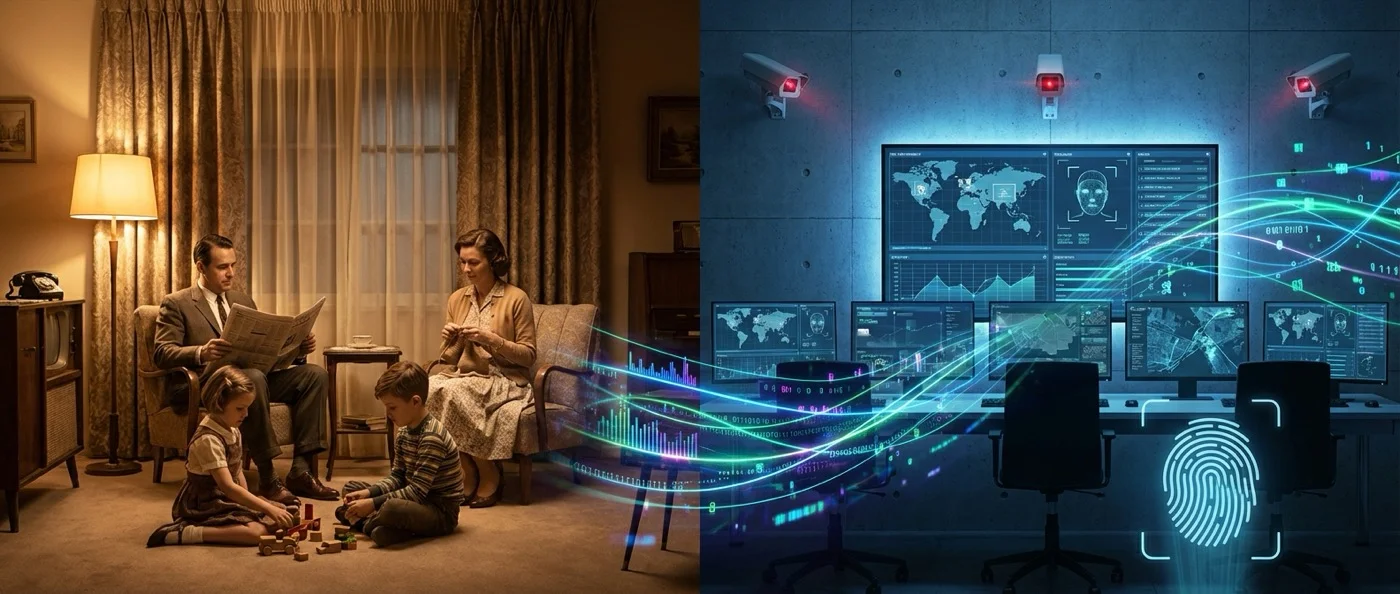
A world without privacy
In ancient Greece, the word “idiotes” (idiotes) had a negative connotation: it referred to someone who dealt only with their own affairs instead of participating in public life. Life was inherently public — in the agora, the gymnasia, the theaters. Aristotle distinguished the “oikos” (private) from the “polis” (public), but even the household was filled with slaves, relatives, and neighbors.
In the Roman Empire, the insulae — multi-story residential buildings — crammed dozens of families into a single building with paper-thin walls. Baths were public, toilets were communal, and conversations could be heard everywhere. There was no ability, let alone desire, to be alone.
Aristotle: oikos vs polis
The first philosophical distinction between the private and public spheres. The oikos was the domain of economy and family, the polis the space of political freedom.
Roman insulae
The first “apartment buildings” in history: 6-8 floors, 200+ residents, zero soundproofing. The noise was so deafening that Juvenal wrote that “only the rich sleep in Rome.”
Medieval communal living
The idea of a “private room” was a luxury even for nobles. Entire families shared a single bed. In monasteries, solitude was considered suspicious — it might indicate “hidden sin.”
"Privacy is an invention, not a discovery. We didn't find it hidden in nature — we created it slowly, piece by piece, century after century."
The first rooms: the birth of the “private”
The history of privacy literally began with walls. In the 16th and 17th centuries, European homes slowly began to acquire partitions, hallways, and — an unprecedented luxury — separate bedrooms. Dutch historian Witold Rybczynski showed that the word “comfort” only acquired its modern meaning in the 18th century.
In 1669, Samuel Pepys — the famous English diarist — wrote his diary in a cryptographic code, a mixture of shorthand and foreign words. He didn't want anyone to read it: he confessed his love affairs, his sins, his finances. It was one of the first times someone felt the need for written privacy.
🚪 The door
One of the most underrated inventions. The locking door, the lock, the chain — each mechanism was a step toward privacy. In 17th-century France, even the king didn't have a truly “private” space.
📮 The envelope
Before the envelope, letters were either open or sealed with wax — but anyone could open them. The modern envelope appeared in the 1830s, creating a form of “physical encryption.” The British government reacted: a scandal erupted in 1844 when it was revealed they were systematically opening letters.
📓 The diary
The practice of keeping a diary spread in the 17th-18th centuries. It was the first form of “private content” — thoughts written only for oneself. The locked diary became a symbol of autonomy, especially for women.
1890: the year privacy was born
Nothing happened by accident. In 1890, two American lawyers — Samuel Warren and Louis Brandeis — published an article in the Harvard Law Review that would change the world: “The Right to Privacy.”
The trigger? The gossip pages, of course. Warren was furious because newspapers published details from his wife's parties. But the real cause ran deeper: technology. The Kodak camera — the first portable camera — had been released just 2 years earlier, in 1888. Suddenly, anyone could photograph you without your consent.
💡 “The right to be let alone”
The definition given by Warren & Brandeis — “the right to be let alone” — remains to this day the most elegant formulation of privacy. Brandeis later became a Supreme Court Justice and continued to defend this right.
Before 1890, privacy wasn't a legal concept anywhere in the world. Afterward, it gradually entered legislation: first as a tort (civil wrong) in the USA, then into constitutions. The 4th Amendment to the U.S. Constitution — "the right of the people to be secure in their persons, houses, papers, and effects" — was now interpreted as protecting privacy, even though the word “privacy” appears nowhere in the text.
The era of wiretapping
The 20th century brought new technologies — and new threats. The telephone turned private conversations into something that could be “wiretapped.” The first known phone wiretap occurred as early as 1895, just 19 years after the invention of the telephone.
Olmstead v. United States
The Supreme Court ruled that wiretapping did not violate the Constitution, because there was no “physical intrusion” into the home. Brandeis vehemently dissented: “Technology will offer the government far more effective means of espionage.”
FBI and J. Edgar Hoover
Hoover turned the FBI into a mass surveillance machine. Files on Martin Luther King Jr., Albert Einstein, John Lennon, thousands of “suspects.” The COINTELPRO program targeted activists, journalists, and even political opponents.
Katz v. United States
Olmstead was overturned. Charles Katz had made a phone call from a phone booth. The FBI recorded him. The Court ruled: privacy protects people, not places. Wherever you “reasonably expect” privacy, you have it.
Watergate
President Nixon planted bugs in the Democratic offices. The revelation led to his resignation, but — more importantly — it made Americans fear for the first time that the government itself could be the “enemy” of their privacy.
📊 Surveillance: then vs now
The Cold War and the culture of suspicion
In the German Democratic Republic (East Germany), the Stasi — the Secret Police — created perhaps the most perfect domestic surveillance system in history. At its peak, the Stasi had 91,015 employees and 189,000 informants — in a country of 16 million. That means 1 in every 63 citizens was an informant.
The Stasi files, if placed side by side, would stretch 111 kilometers. They contained everything: who spoke to whom, what was whispered in bed, how many rolls of toilet paper someone bought, whether children sang the national anthem at school. Author Timothy Garton Ash, when he read his file after the fall of the Wall, discovered that one of the informants was a close friend.
"The Stasi didn't need cameras everywhere. It had something better: people everywhere."
On the other side of the Iron Curtain, the USA was far from innocent. The ECHELON program, a collaboration between the USA, UK, Australia, Canada, and New Zealand (the “Five Eyes”), monitored satellite communications on a global scale. The CIA's MKUltra program conducted mind control experiments on unsuspecting citizens, while Operation CHAOS spied on anti-war activists.
The computer changes everything
Until the 1960s, data was stored on paper — and paper has physical limits. You can't easily search for a name across 111 kilometers of archives. The computer eliminated those limits.
National Data Center (USA)
The proposal for a central database containing information on every American caused panic. It was rejected by Congress, but showed what was coming.
Fair Credit Reporting Act
The first American law to regulate the collection of personal data — for credit companies. For the first time, citizens had the right to see what was written about them.
Privacy Act (USA)
After Watergate, a law was passed regulating how the federal government collects and uses citizens' data. An important step, but it didn't cover the private sector.
French law “Informatique et Libertés”
France passed one of the first comprehensive data protection laws in the world, establishing CNIL — an independent supervisory authority.
German Bundesverfassungsgericht
The Federal Constitutional Court created the concept of “informational self-determination” (informationelle Selbstbestimmung) — that everyone decides who sees their data. This became the foundation of European data protection law.
The Internet: the great rupture
In August 1991, Tim Berners-Lee published the first website. No one imagined that this would spell the death of privacy as we knew it. At first, the Internet was almost anonymous — “on the Internet, nobody knows you're a dog,” as the famous 1993 New Yorker cartoon quipped.
But that didn't last long.
The first cookies
Lou Montulli at Netscape created HTTP cookies so the browser could “remember” users. Initially harmless, cookies were transformed into a tracking tool. Today, every website loads dozens of third-party tracking cookies.
Google: “Don't Be Evil”
Larry Page and Sergey Brin founded Google. At first, the motto was “Don't Be Evil.” Soon, Google discovered that search data was worth gold — for targeted advertising.
Patriot Act
After September 11, the Patriot Act gave American intelligence agencies unprecedented powers: mass metadata collection, “National Security Letters” without court orders, secret courts (FISA courts).
Facebook: “Move Fast and Break Things”
Mark Zuckerberg created Facebook at Harvard. The motto “Move Fast and Break Things” proved prophetic — among the things it “broke” was the privacy of millions of people.
The world after Snowden
On June 5, 2013, Edward Snowden — a 29-year-old former CIA employee and NSA contractor — revealed to the Guardian and Washington Post the biggest espionage scandal in history. The leaked documents revealed that the NSA (National Security Agency) was collecting data en masse from millions of citizens — not suspects, but everyone.
🔍 PRISM
A program that gave the NSA direct access to the servers of Google, Facebook, Microsoft, Yahoo, Apple, and Skype. The NSA could read emails, chats, videos, and photos — in real time.
📞 Metadata
The NSA collects ALL phone call metadata — who called whom, when, how long, from where. Former NSA Director Michael Hayden admitted: “We kill people based on metadata.”
🌐 XKeyscore
A program that allowed NSA analysts to search for ANYTHING — emails, browsing history, chats — of any person on the planet, without a court order.
🏛️ FISA Court
A secret court that approved nearly every surveillance request: 99.97% approval rate. From 1979 to 2012, it rejected only 11 requests out of 33,942.
"Privacy isn't about something you're hiding. It's about something you're protecting."
The reaction was enormous but contradictory. In Europe, it was a scandal — German Chancellor Merkel discovered that the NSA was tapping her phone. In the USA, public opinion was divided: many argued that surveillance was necessary for security. Snowden fled to Moscow, where he remains to this day.
Surveillance capitalism
If state surveillance was the threat of the 20th century, corporate surveillance is the threat of the 21st. Harvard professor Shoshana Zuboff coined the term "surveillance capitalism" to describe an economic model where human data is the raw material.
🏭 How surveillance capitalism works
1. Extraction: Every click, swipe, search, like, location, and photo becomes data.
2. Analysis: AI algorithms process the data to predict your behavior.
3. Sale: Predictions are sold to advertisers as “behavioral futures” — futures contracts on your behavior.
4. Modification: In the final stage, they don't just predict — they modify your behavior (e.g., notifications, nudges, dark patterns).
💰 How much is your data worth?
The numbers seem small — but multiply them by 3 billion users. Meta (Facebook) had revenues of $116 billion in 2022, almost exclusively from advertising. Google, $280 billion. This entire industry is fueled by your data.
Cambridge Analytica: the wake-up call
In 2018, the world was shaken by the Cambridge Analytica scandal. The company — with ties to Steve Bannon — had gained access to the data of 87 million Facebook users through an innocent quiz ("This Is Your Digital Life"). Only 270,000 people took the quiz — but the app collected data from all of their friends as well.
The data was used for psychographic targeting during the 2016 American elections and the Brexit referendum. The idea: if you know someone's psychological traits (openness, conscientiousness, extroversion, agreeableness, neuroticism — the OCEAN model), you can create personalized political messages that push exactly the right buttons.
Zuckerberg appeared before Congress in a marathon 10-hour testimony. The image of him — alone at a huge table, facing a panel of senators — became the defining image of an era. But virtually nothing changed in Meta's practices.
GDPR: Europe strikes back
On May 25, 2018, the GDPR (General Data Protection Regulation) came into effect — the most ambitious data protection legislation in history.
✅ Right of access
Every European citizen can request from any company all the data it holds about them — and the company is obligated to provide it within 30 days.
🗑️ Right to erasure
The “right to be forgotten” — you can request the deletion of your data. Google received over 1.5 million URL deletion requests by 2023.
💶 Fines
Fines can reach up to 4% of global turnover or €20 million — whichever is greater. Amazon was fined €746 million, Meta €1.2 billion, TikTok €345 million.
🔒 Privacy by Design
Privacy must be considered from the design stage — not as an afterthought fix. Companies must collect only the data they genuinely need.
The GDPR isn't perfect. The eternal “Accept cookies” pop-ups are tiresome, enforcement is slow, and many companies find ways to circumvent it. But it changed the global conversation: California passed the CCPA, Brazil the LGPD, India the DPDP Act. Privacy entered the law books.
Facial recognition: the final frontier
Facial recognition technology is perhaps the most alarming development in the history of privacy. Unlike every previous form of surveillance, this one requires no action from the victim — no clicking, no giving an email, no signing anything. It's enough to simply exist.
The company Clearview AI — founded in 2017 — collected over 30 billion photos of faces from social media, blogs, and news sites, without anyone's consent. Its algorithm can identify almost anyone on the planet in seconds. The service is sold to police departments, governments, and even private individuals.
🇨🇳 China: the total surveillance model
China has over 700 million surveillance cameras (one camera for every 2 residents). The Social Credit Score system evaluates citizens based on their behavior: if you jaywalk, if you pay bills late, if you associate with “unreliable” people, you lose points. A low score means: you can't buy plane tickets, you can't travel by train, your children can't attend “good” schools. By 2023, over 30 million “offenders” had been banned from flights.
The resistance: from Tor to encryption
Not everyone passively accepted the death of privacy. A series of tools, movements, and technologies emerged as a response — the “weapons” of digital resistance.
🧅 Tor (2002)
Originally created by the US Naval Research Lab. It routes data through multiple “layers” of encryption (onion routing). Used by journalists, activists, dissidents — but also criminals.
🔐 Signal (2014)
The Signal app, created by Moxie Marlinspike, introduced end-to-end encryption to communication. Not even Signal itself can read the messages. Snowden recommends it. The EU uses it officially.
🦊 DuckDuckGo
The search engine that doesn't track you. From 16 million searches/day (2019) to 100+ million (2021). Small compared to Google, but symbolically significant.
₿ Bitcoin & Cryptocurrencies
Originally designed for financial privacy — transactions without banks. But most blockchains are public. Newer coins (Monero, Zcash) offer true anonymity.
The paradox of our era
We live in the age of the privacy paradox. In surveys, the majority says they are “very” or “somewhat” concerned about their data. But in practice, almost no one changes their behavior.
🤔 What we say vs what we do
Why? Psychologist Daniel Kahneman would explain: privacy is abstract — it doesn't hurt immediately, isn't visible, doesn't have a smell. The convenience of “Login with Google” or “Accept All Cookies” is, by contrast, immediate. The brain always prefers the now.
Psychologist Alessandro Acquisti of Carnegie Mellon conducted an experiment: he asked students if they'd sell their data. Most said no. Then he offered them a $2 pizza coupon. They sold immediately. Privacy is worth less than a pizza.
"If you're not paying for the product, then you are the product."
But even that saying is now outdated. Shoshana Zuboff corrects it: "You're not the product. You're the raw material. The product is the prediction of your behavior."
The battle continues
The history of privacy isn't over. New technologies — AI, Internet of Things, DNA databases, brain-computer interfaces — are opening new fronts. Elon Musk's Neuralink promises brain implants. If our thoughts are digitized, who will protect them?
Privacy was never a “natural state.” It was a social construct, built from walls, envelopes, laws, and encryption. In every era, new technology threatened what the previous generation took for granted. And in every era, people fought — sometimes winning, sometimes losing — to keep a piece of themselves away from the eyes of others.
The question isn't whether we'll lose our privacy. The question is whether we'll care enough to do something about it — or whether we'll keep clicking “Accept All” without a second thought.