📖 Read more: The History of Music Listening: From Vinyl to Streaming
Before streaming: the age of “owning”
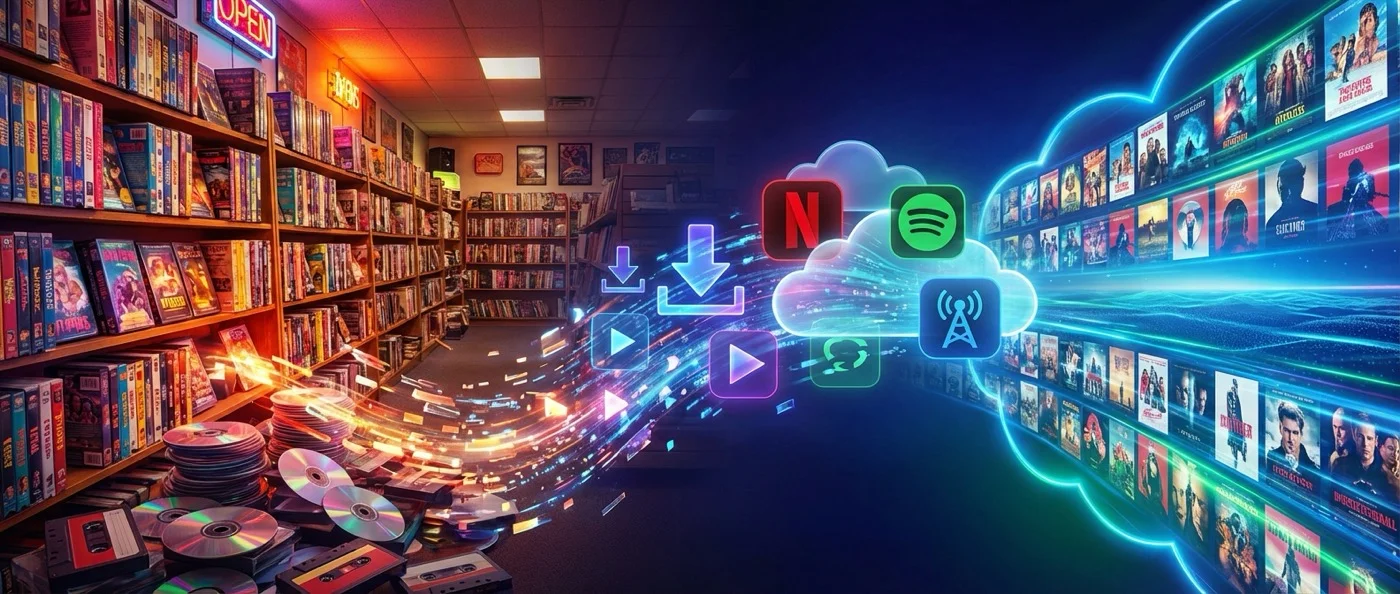
Until the 2000s, entertainment content was a physical object. You went to a record store, browsed, listened to 30 seconds on headphones, bought it, went home, unfolded the lyrics. A movie? Video rental store: "Saturday night, it's rented out, grab the sequel."
The relationship was ritualistic. You knew every song on the album — because you paid for it. You watched a movie 5 times on video — because there was no alternative. Scarcity created value, devotion, love. Today, 100 million songs on Spotify — but how many do we actually listen to?
"First they sold you songs. Then CDs. Then downloads. Now they rent you access to songs. Tomorrow? They'll sell you the moment just before you press play."
The beginning: piracy as a blueprint
Napster: the bombshell
18-year-old Shawn Fanning created peer-to-peer sharing. 80 million users in 2 years. Free music — every song, instantly. The music industry panicked. Metallica sued 335,000 users by name. The RIAA sued a 12-year-old (Brianna LaHara, $2,000 fine). Napster shut down (2001) — but the idea didn't die.
BitTorrent: impossible to stop
Bram Cohen created a protocol with no central server. You can't “shut down” BitTorrent — it's a protocol, not a company. Pirate Bay, KickassTorrents, RARBG: thousands of sites. 2004: 35% of all Internet traffic was BitTorrent.
iTunes Store: the “legal” answer
Steve Jobs: “99 cents per song.” The music industry was opposed — but had no alternative. 1 million songs in 5 days. Apple didn't “save” music — it bought it. But you still “downloaded” — you still “owned” (theoretically, with DRM).
📖 Read more: The Complete History of the Internet: From ARPANET to Today
Music streaming: Spotify changes everything
Daniel Ek (Swedish, 23 years old) realized that piracy couldn't be beaten with lawsuits — it could be beaten with convenience. If legal access is easier than piracy, people will pay.
🎵 Spotify (October 2008)
Freemium model: free with ads, €10/month without. 100+ million songs. AI playlists (Discover Weekly, Release Radar). 626 million users (2024), 246 million premium. Dominates music streaming.
💰 The economics
Spotify pays $0.003–0.005/stream. An artist needs 250,000 streams/month to earn $1,000. 90% of streams go to the top 1% of artists. Taylor Swift: $80+ million/year from streaming. Independent musician? Average: $636/year.
🎧 Playlist culture
Spotify doesn't sell songs — it sells playlists. "Today's Top Hits": 35 million followers. If you get on a Spotify playlist, you become a hit. If you don't, you don't exist. The “curators” (algorithmic + human) replaced DJs. Power shifted from labels to platforms.
📖 Read more: The History of Television: How a Box Became Power
Video streaming: the fall of Blockbuster
📼 The most expensive “No” in history
Year 2000: Reed Hastings (Netflix, then DVD-by-mail) proposed an acquisition to Blockbuster — $50 million. Blockbuster's CEO laughed. Literally. Blockbuster 2004: 9,000 stores, 84,000 employees, $6 billion in revenue. Blockbuster 2010: bankruptcy. Netflix 2024: $34 billion in revenue, 283 million subscribers.
Netflix: DVD by mail
Reed Hastings & Marc Randolph. Legend has it: Hastings paid a $40 late fee at Blockbuster (for Apollo 13) — and got angry. Reality: probably a myth. But the idea was real: DVDs by mail, no late fees, no store.
Netflix streaming: the turning point
Initially 1,000 titles. Poor quality, buffering, limited content. Nobody believed it would replace DVD/Blu-ray. But convenience beat quality — it always does.
House of Cards: Netflix becomes a studio
Netflix didn't just want to show content — it wanted to create it. House of Cards: $100 million for 2 seasons, before a single frame was shot. Based on data: Netflix's algorithm knew that fans of Political Drama + David Fincher + Kevin Spacey = hit. Art becomes algorithm.
Streaming Wars
Disney+ (November 2019): 10 million subscribers in 24 hours. HBO Max, Apple TV+, Peacock, Paramount+. Every studio wants its own platform. Result: consumers need 5–7 subscriptions ($60–100/month) to watch everything — meaning more than the cable it was supposed to replace.
📊 Entertainment cost by era
Gaming Streaming: The Last Digital Frontier
Music is streamed. Movies are streamed. Games? In the 2020s, they're starting — but with difficulty.
📖 Read more: The History of Trust: From People to Systems
🎮 Google Stadia (2019-2023)
Google promised: AAA games without a console, just a browser. Reality: input lag, poor library, abandoned. Google shut it down in January 2023. Cloud gaming needs near-zero latency — and that doesn't exist (yet).
🟢 Xbox Game Pass
"The Netflix of games": $17/month, 100+ games, Day 1 releases. 34+ million subscribers. A success? Yes — but it didn't replace purchasing, it supplemented it. Games aren't like movies: a single-player RPG = 60-100 hours. 3-4 games/month is plenty.
📡 Twitch & YouTube Gaming
Streaming doesn't just mean “you play” — it means “you watch others play.” Twitch: 31 million daily viewers. Top streamers: $5–10 million/year. Entertainment becomes a spectacle of spectacles.
Binge culture: the age of “just one more episode”
Netflix invented (or exploited) binge watching — an entire season at once. “Are you still watching?” — the most ironic question: the algorithm knows you won't stop.
🧠 The psychology of binge
Cliffhanger → dopamine → autoplay → one more. Study (Journal of Clinical Sleep Medicine, 2017): binge watchers have 98% higher chances of poor sleep quality. Average binge: 3.2 hours/session. Netflix designs FOR this — Reed Hastings: “Our biggest competitor is sleep.”
📖 Read more: Chernobyl: The Night of the Worst Nuclear Disaster
What we lost: ownership of digital content
With streaming, you don't “own” anything. If the platform shuts down — you lose access. If it removes a movie — it vanishes. If it raises the price — you pay or leave.
📀 Ownership vs Rental
In 2009, Amazon remotely deleted copies of Orwell's "1984″ from users' Kindles — without warning. The irony needs no comment.
The future: AI, live, interactive
The next generation of streaming won't just be “watching something” — it will be creation in real time. Netflix's “Bandersnatch” (2018) was a forerunner: interactive storytelling, you decide. AI-generated content: imagine a movie created just for you, based on your preferences. Spotify AI DJ already exists. YouTube dream tracks. Sora (OpenAI) generates video from text.
Culture began as a shared experience — 10,000 Athenians watching Sophocles at the theater. It moved to individual ownership — records, videos, books. Now it's shifting to individual streams — everyone watches/listens to something different. We gained access, we lost community. Streaming gave us everything — except something shared to bond over.