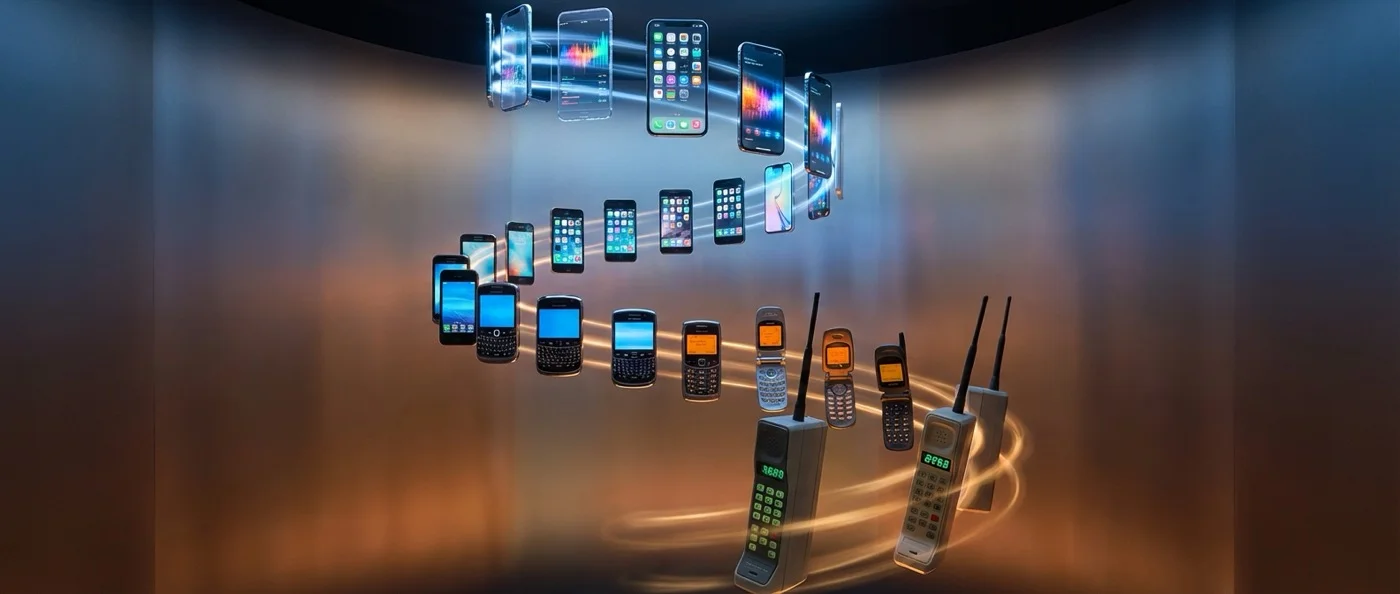
On April 3, 1973, a man stood on the sidewalk of 6th Avenue in Manhattan, holding an object that resembled a brick. It weighed 1.1 kilograms, had 20 minutes of battery life, and took 10 hours to charge. He called his rival at Bell Labs and told him: "I'm calling you from a mobile phone — a real mobile phone." The man was Martin Cooper, an engineer at Motorola. And he had just changed the world.
📖 Read more: Theranos: The Billion-Dollar Company That Didn't Exist
📞 Before the Mobile Phone: Radiophones and Dreams
The idea of a “wireless telephone” wasn't born in the 1970s — it was born almost immediately after the invention of the telephone (1876). As early as the 1920s, police and armed forces were using radiophones in vehicles — massive transceivers that took up the entire trunk.
In 1946, AT&T introduced the Mobile Telephone Service (MTS) in the US — but it wasn't what we think of today. It was radiotelephony: you spoke to an operator, who manually connected the call. Only 3 channels were available per city, meaning only 3 simultaneous calls. The waiting list for an MTS connection in New York? 10 years.
💡 Did you know?
The Soviet Union claims that Leonid Kupriyanovich built a portable radiotelephone weighing 500 grams as early as 1957. The difference? It wasn't cellular — it used a single fixed frequency, so only one call could be made per area.
The true ancestor of the mobile phone wasn't just technological — it was theoretical. In 1947, engineers Douglas Ring and Rae Young at Bell Labs proposed the idea of a cellular network: instead of one large transmitter covering an entire city, small transmitters in “cells,” each with its own frequency, could serve thousands of simultaneous calls. The idea was 30 years ahead of its time.
📱 1983–1991: The 1G Era — The “Bricks”
Ten years after Cooper's legendary call, Motorola released the first commercially available mobile phone: the DynaTAC 8000X. The date: March 13, 1984. The price: $3,995 — equivalent to about $12,000 today. Weight: 794 grams. Battery: 30 minutes of talk time. Charging time: 10 hours.
📊 DynaTAC 8000X (1984) vs. iPhone 16 (2024)
Who bought a mobile phone in the '80s? Stockbrokers, top executives, doctors — and, of course, drug lords. Mobile phones were so rare and expensive that they became symbols of social power. Gordon Gekko in “Wall Street” (1987) held a DynaTAC. Pablo Escobar bought them by the hundreds. The first cellular networks (1G) were analog — voice was transmitted as radio waves, without encryption. Anyone with a radio scanner could “listen in” on your calls.
Scandinavia, unexpectedly, led the way. The NMT (Nordic Mobile Telephone) networks of Sweden, Norway, Denmark, and Finland were the most advanced in the world. Finland — sparsely populated, with vast distances — had a practical reason: landlines couldn't reach everywhere. Necessity gave birth to Nokia.
📲 1991–2001: The 2G Era — Nokia, SMS, and Democratization
The transition to 2G (GSM) was the real revolution. Digital signal instead of analog — encryption, better quality, and most importantly: data. The first SMS (Short Message Service) was sent on December 3, 1992 — engineer Neil Papworth sent “Merry Christmas” to a colleague at Vodafone. No one imagined that those 160 characters would become the primary form of communication for an entire generation.
First SMS in the world
"Merry Christmas" — 15 characters that changed the way we communicate. Initially, only between networks — not between users.
📖 Read more: The History of Speed: Why Everything Must Happen Now
IBM Simon — First “smartphone”
Touchscreen, calendar, email, fax, notes. It cost $1,100. Only 50,000 units sold. The world wasn't ready.
Nokia 6110 — Snake!
The game Snake became a global phenomenon. Nokia proved that a mobile phone could also be entertainment — not just a tool.
Nokia 3210 — The people's phone
No external antenna, T9 predictive text, internal antenna. 160 million units sold. The era when “everyone started having a mobile phone.”
First camera phone
The Sharp J-SH04 in Japan integrated a 0.11-megapixel camera. The era when “every pocket is a camera” began.
The period 1997–2007 was the Golden Age of Nokia. The Finnish company — which started as a paper mill in 1865 — dominated the market with a share exceeding 40% worldwide. Its phones were legendary for their functionality, battery life (weeks of endurance), and — of course — for being indestructible. The Nokia 3310 (2000) sold 126 million units and became a meme of cultural immortality.
"Connecting People."
In Japan, the evolution went even further. By the late '90s, Japanese mobile phones (known as “keitai”) could pay bills, watch television, send emoji (invented in Japan in 1999), and even function as transit tickets. Japan was already living in 2020 — but the rest of the market didn't follow because these phones only worked on the Japanese network. They were called “Galápagos phones” — they evolved on their own, in isolation.
⌨️ 2001–2007: BlackBerry, Email in Your Pocket
Before Steve Jobs took the stage, there was a small Canadian company that was the first to understand that a phone could be a work tool. Research In Motion (RIM) released the BlackBerry — with a full QWERTY keyboard, real-time email, and military-grade security. The result? All of Wall Street, Congress, the White House — even Barack Obama — were inseparable from their BlackBerry.
The obsession was such that the term "CrackBerry" was coined — that's how addictive it was. Corporate executives never stopped checking email again. The line between “work hours” and “free time” began to blur — something that smartphones would later perfect.
📧 BlackBerry (2003)
Real-time push email. QWERTY keyboard. Encryption. The “email addiction” started here — before social media perfected it.
🎵 Motorola RAZR (2004)
A phone was enough on its own. But the RAZR wanted something more: design. 14mm thin, metallic. 130+ million units sold. Fashion entered technology.
📖 Read more: Dashrath Manjhi: Carved a Mountain Alone for 22 Years
🍎 January 9, 2007: The Day Everything Changed
There are few dates in the history of technology that separate “before” from “after.” January 9, 2007 is one of them. Steve Jobs took the stage at the Macworld Conference in San Francisco and said:
"Today, Apple is going to reinvent the phone... An iPod, a phone, an internet device. These are not three separate things. This is one device. And we are calling it iPhone."
The iPhone wasn't the first smartphone — that title belongs to the IBM Simon (1994) or, if you prefer, to many Windows Mobile and Palm devices. But Jobs understood something no one else had: that the interaction was more important than the features. One button. One touchscreen. No stylus, no keyboard. Your fingers were the interface.
The industry's reaction? Laughter. Microsoft CEO Steve Ballmer laughed and declared: "$500? No keyboard? It won't sell." BlackBerry CEO Jim Balsillie: “It's not a threat.” Nokia didn't even bother to comment.
Within five years, BlackBerry would lose 95% of its value. Nokia would be sold to Microsoft. And Motorola would become part of Google (and later Lenovo). Jobs hadn't created a new phone — he had created a new category of objects.
First-generation iPhone launches
Days-long lines outside Apple stores. 270,000 units sold in the first 30 hours. It had no 3G, no video camera, no copy-paste — nobody cared.
First Android — HTC Dream (G1)
Google responds. Android — free, open source, across multiple manufacturers. The Apple vs. Android rivalry begins. Today, Android = 72% worldwide.
App Store opens
500 apps at launch. Today over 2 million. It created an entire industry — “there's an app for that” wasn't a slogan, it was a prophecy.
Instagram, Uber, WhatsApp explode
Apps that wouldn't exist without a smartphone. Photography, transportation, communication — everything was reinvented for this new screen.
🔗 2012–Today: The Age of Dependency
Let's be honest: the mobile phone is no longer a “phone.” It's a wallet, camera, map, calendar, alarm clock, flashlight, radio, television, bank, work tool, entertainment device, social tool, and — increasingly — an addiction machine.
The numbers are staggering: the average user checks their phone 144 times a day. They spend 4.37 hours daily on the screen. 71% check their phone within the first 10 minutes after waking up. 44% feel anxious without their phone — a condition psychologists call "nomophobia" (no-mobile-phone phobia).
📖 Read more: Moai Statues: Who Built Them on Easter Island?
📸 A camera that killed industries
Kodak, Nikon compacts, travel cameras — all disappeared. Today, 1.72 trillion photos are taken annually — 90% with a mobile phone.
🗺️ A map that reshaped cities
Google Maps didn't just replace maps — it replaced knowledge. Today, we can't remember how to get anywhere without GPS.
💰 A bank in your pocket
Mobile payments, contactless, Apple Pay, Google Wallet. In China, 86% of payments are made via WeChat Pay or Alipay. Cash barely exists.
🧠 An addiction machine
Notifications, likes, infinite scroll — designed by former casino engineers. Tristan Harris (ex-Google) called them “slot machines in our pockets.”
📱 Mobile Generations — The Evolution in Numbers
💀 The Casualties: What the Mobile Phone Killed
Every technological revolution leaves casualties behind. The smartphone killed so many that they're worth listing:
- Wristwatches — the watch industry (outside luxury) collapsed. Why look at a watch when you check your phone 144 times a day?
- Compact cameras — Kodak went bankrupt in 2012. The very company that invented digital photography (1975) refused to change.
- GPS devices — Garmin, TomTom — from multi-billion to niche.
- MP3 players — even the iPod that gave birth to Apple's resurgence was killed by the iPhone.
- Alarm clocks, flashlights, radios, pocket calculators — entire product categories vanished.
- Phone booths — in the UK, from 92,000 (2002) to 21,000 (2022).
- Road atlases — Rand McNally, which dominated cartography for 150 years, nearly disappeared.
⚠️ The Fall of Nokia
In 2007, Nokia held 49.4% of the global mobile phone market. In 2013, it sold its mobile division to Microsoft for $7.2 billion. CEO Stephen Elop said in an infamous speech: "Our platform is burning." Nokia wasn't defeated technologically — it was defeated strategically. It failed to understand that mobile phones had become computers.
🔮 Epilogue: From Brick to Extension of the Self
Fifty years after that call in Manhattan, the mobile phone is no longer an object we “have.” It's an object we are. Our digital identity — photos, messages, bank accounts, memories, relationships — lives inside this rectangular piece of glass and aluminum.
Marshall McLuhan once said: “First we shape our tools, and then our tools shape us.” The mobile phone changed the way we think (Google before we remember), the way we love (Tinder, WhatsApp goodnight messages), the way we navigate (we can't remember streets), the way we pay (tap), the way we work (Slack, email, Zoom — always reachable).
The question is no longer “what can a phone do.” The question is: what can we no longer do without one? And the answer, terrifyingly, is: almost nothing.