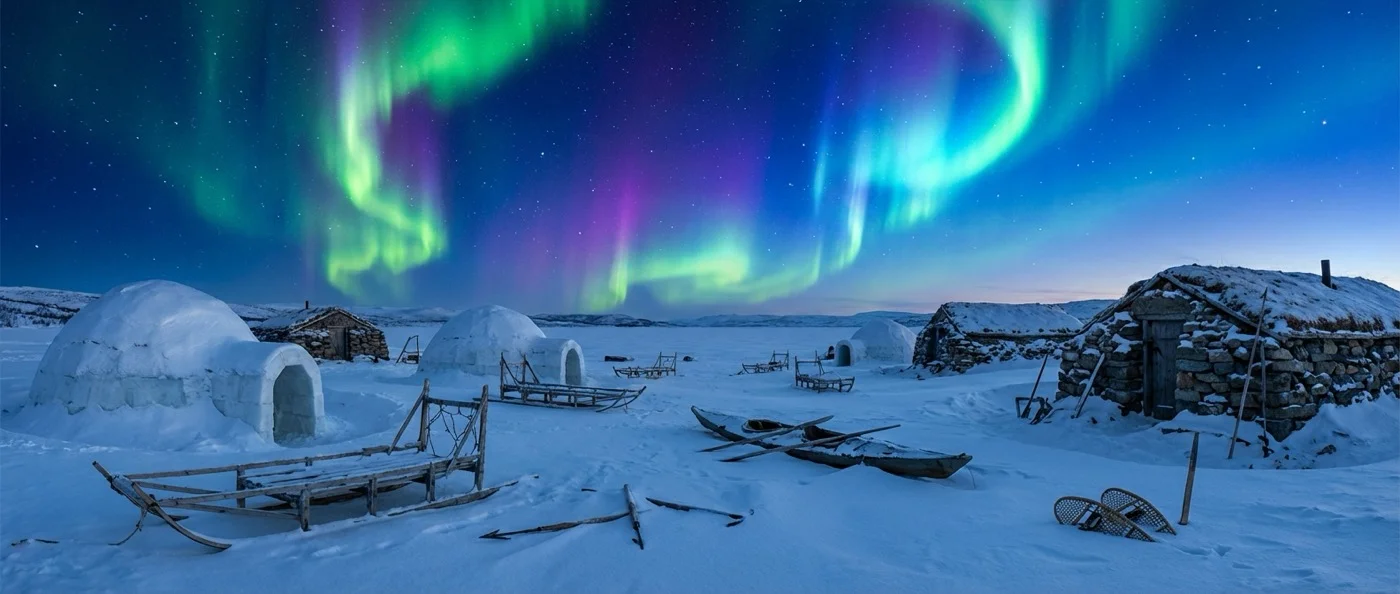
There is something deeply unsettling about the idea of a place that suddenly empties. An abandoned house can be explained — a family moved away, an owner died. But an entire village? Dozens of people vanishing as if swallowed by the earth, leaving everything behind — food on the fire, clothes on sewing needles, dogs still tied up?
📖 Read more: The 3 Lighthouse Keepers Who Vanished Mysteriously
This story begins in the frozen expanses of the Canadian North, at Angikuni Lake, in November 1930. A fur trapper arrives at an Inuit village he knew well — and finds only silence. The story will travel from there to the shores of North Carolina, to the colony of Roanoke, where 115 settlers vanished leaving behind only a single word carved into wood.
Are these stories true? Or are they urban legends fed by our most primal fear — that an entire village can simply cease to exist?
In November 1930, Joe Labelle was a Canadian fur trapper living in the wilds of Nunavut, in the deep Canadian North. That season he had just obtained his first trapping license — he was relatively new to the profession, but he knew the area well. Angikuni Lake, roughly 100 kilometers west of Hudson Bay, was a location he had visited before.
On the shores of the lake stood a small Inuit village — a settlement of approximately 25 people living in six caribou-skin tents. Labelle knew them. He had traded with them in the past. As he approached the settlement on that freezing afternoon, he expected to see familiar faces, to smell the fire burning beneath the cooking pots, to hear the dogs barking.
Instead, he found silence.
What Labelle found that afternoon would become one of the most chilling mysteries of the Canadian North. The six tents were in place — but no one was inside. More disturbing: food hung above hearths that had been extinguished for days. Half-finished caribou-skin shirts were still turned on sewing needles, as if someone had stood up in the middle of their work and never returned.
Nothing had been packed. No sign of an organized departure. It was as though 25 people had evaporated in seconds.
And then there were the dogs. Seven sled dogs were found tied to nearby trees — dead from starvation. If their owners had left voluntarily, why didn't they take the dogs? In the Arctic tundra, sled dogs were vital for transportation — no rational person would abandon them.
But the most chilling discovery lay a short distance from the settlement. A grave had been opened — yet the stones that sealed it were undisturbed, placed carefully to the side, as if someone had removed the body with reverence and precision. Under normal circumstances, such a grave would never be opened — in Inuit culture, burial was considered sacred.
Labelle, terrified, traveled to the nearest telegraph station and notified the Royal Canadian Mounted Police (RCMP). The report immediately mobilized an investigation team. Officers traveled to the frozen Angikuni Lake to investigate.
According to early reports, the officers confirmed Labelle's findings. The settlement was indeed abandoned. There were no signs of violence — no blood, no signs of struggle, no signs of any natural disaster. The inhabitants appeared to have simply stood up and left.
The story was first published in the Danville Bee newspaper on November 27, 1930, written by journalist Emmett Kelleher. From there it spread to dozens of newspapers across North America. Each republication added new details — mysterious lights in the sky, more missing inhabitants, strange marks in the snow.
However, reality turned out to be far less dramatic. In January 1931, Sergeant Nelson of the RCMP filed his official report. His words were dry and matter-of-fact: “There is no foundation for this story whatsoever.”
The RCMP determined that Labelle's story contained significant inaccuracies. There was no permanent village of 25 people on the shores of Angikuni Lake during that period. The Inuit of the region were nomadic hunters — they moved regularly following caribou herds. An empty campsite didn't mean a disappearance; it simply meant the group had moved on, as they did every few weeks.
The RCMP concluded that the story was at best an exaggeration, at worst a complete fabrication. Labelle had most likely found a temporary campsite that had been abandoned naturally, and his imagination — or his desire for publicity — did the rest.
But the truth couldn't travel as far as the myth. The story had already gone viral — by 1930 standards.
Despite the RCMP's debunking, the Angikuni story not only didn't die — it grew. In 1959, American author Frank Edwards included it in his book Stranger than Science, giving it new life. Edwards added details that didn't exist in the original report — mysterious lights in the sky, UFO sightings, numbers far larger than the originals.
From there, the story entered popular culture. Dean Koontz used it as inspiration for his novel Phantoms (1983), in which an entire village in Colorado mysteriously empties. Whitley Strieber, known for his books about alien abductions, referenced Angikuni in Majestic. Gradually, Angikuni Lake acquired a mythical quality — a place where reality ceased to apply.
📖 Read more: The Disappearance of Amelia Earhart in the Pacific
Each generation added its own elements. In the 1970s, the story was linked to UFOs. In the 1990s, to paranormal phenomena. In the 2010s, to creepypasta on the internet. The truth — an empty nomadic campsite in the Arctic tundra — was too boring to compete with the imagination.
If the Angikuni story proved to be largely a myth, there is one case of a vanished community that remains a genuine mystery to this day: the colony of Roanoke.
In July 1587, a group of approximately 115 English settlers — men, women, and children — landed on Roanoke Island, off the coast of present-day North Carolina. Their governor, John White, established them there and shortly afterward sailed back to England to bring new supplies. His granddaughter, Virginia Dare, had just been born on the island — the first English child born in the New World.
White was unable to return for three full years. The Anglo-Spanish War and the Spanish Armada kept him away. When he finally returned in August 1590 — on the exact date of his granddaughter's third birthday — he found the settlement abandoned.
Before leaving, White had agreed with the colonists: if they moved, they would carve their destination on a tree. If they were in danger, they would add a cross. There was no cross — only the word “CROATOAN,” which pointed to the nearby island of Croatoan (present-day Hatteras). White was convinced the colonists had peacefully relocated there.
Unfortunately, White never got the chance to check. A storm combined with a broken anchor forced his ship to return to England. He never set foot in the New World again. And the 115 colonists — the “Lost Colony” — were never found.
Theories have multiplied over four centuries. The most likely: the colonists were assimilated into local Native American tribes. Explorer John Lawson, who visited Hatteras Island in 1701, found the local Hatteras people claiming that some of their ancestors were white — some had gray eyes. Today, the Lumbee tribe of North Carolina is recognized as descendants of the Croatoan Indians and — possibly — of the lost colonists.
Other theories include an attack by Chief Wahunsenacah of the Powhatan, based on reports from the Jamestown settlers (1607). Historian William Strachey wrote that Wahunsenacah massacred the colonists who had been living peacefully near Chesapeake Bay, leaving only seven survivors — four men, two boys, and one woman.
The most recent scientific study (1998) revealed that the period 1587–1589 was the worst drought in 800 years in the region. This would explain why the colonists were forced to relocate — they couldn't feed themselves.
The world is full of abandoned villages. Epidemics, wars, natural disasters, economic collapse — the reasons are always mundane. In Greece, dozens of mountain villages empty out every decade as young people migrate to the cities. In Japan, thousands of villages are slowly dying due to demographic crisis. In Russia, entire ghost towns bear witness to the Soviet collapse.
But those villages don't fascinate us. The ones that captivate us are the villages that empty without explanation — or at least without an explanation that satisfies our imagination.
The psychology behind this fascination runs deep. Community is the primary unit of human security. From the moment we formed our first tribes, the group protects us. The idea that an entire group can “vanish” strikes at something deeply primal — the fear that the safety of the collective is an illusion. That what can happen to one person can happen to an entire community. Simultaneously.
There is something else, too: the word “CROATOAN” at Roanoke, the food on the fire at Angikuni. These details are not accidental in the narrative. They are the elements that transform an event into a myth — the small, human traces left behind as a riddle. Like a message in a bottle: someone was here, someone tried to speak, but the silence swallowed them.
Angikuni Lake remains a myth — a beautiful, chilling myth, but a myth nonetheless. The RCMP debunked it, the story was never confirmed, and the number of “vanished” grew with every retelling. A nomadic campsite that had simply moved on was transformed into “a village swallowed by the wind.”
Roanoke, on the other hand, remains a genuine mystery — though mounting evidence suggests the colonists simply assimilated into local populations, living lives far more peaceful than our imaginations would have us believe.
Perhaps this is the real truth behind "vanished villages": people rarely disappear. They relocate, they assimilate, they change. But the myth of total disappearance fascinates us more — because it touches something we don't want to admit: that entire communities can be extinguished, silently, like a candle in the wind.
At Angikuni Lake today, there is nothing. No monument, no sign, no tourists. Only the Arctic wind whistling over the ice. At Roanoke, a national historic site welcomes hundreds of curious visitors every summer. A play titled “The Lost Colony,” first staged in 1937, is still performed.
The two stories — one false, the other true — share something in common: the silence. That deep, undisturbed silence that remains when people leave. And that, in the end, is more terrifying than any explanation.