📖 Read more: Why We Stopped Downloading and Started Streaming Everything
Trust in antiquity: face to face
For 200,000 years, trust was personal. Robin Dunbar (anthropologist, Oxford) calculated that the human brain can maintain stable relationships with ~150 people. Beyond that, you don't truly “know” someone — you can't trust them based on experience.
In hunter-gatherer societies, trust was absolute within the group — and non-existent outside it. The “stranger” was an enemy by definition. The Greek word xenos means both “stranger” and “guest” — because the stranger is a potential enemy who must be tamed through hospitality.
"Trust is like air. You don't think about it as long as it exists. You only start thinking about it when it's gone."
Religion: the first “trust platform”
Yuval Noah Harari (Sapiens) argues that religion was the first trust technology “at scale.” Why? Because two complete strangers, who perhaps spoke different languages, could cooperate if they shared the same god.
⛪ The church as a “certificate”
Medieval traveler? Go to church. If the stranger was Christian, you could trust them (theoretically). Religion provided a “common code” — morality, rules, punishment (hell) — that functioned like a rating system before ratings existed.
🤝 The oath
The “oath” was the first "digital signature": binding, with God as witness. Breaking an oath wasn't just immoral — it was blasphemy. That's why courts still swear on the Bible — a remnant of an era when trust was based on divine punishment.
Commerce: trust as an economy
Mesopotamian seals
The first "signatures": cylindrical seals on clay, unique per merchant. They certified: “this jar/sack/ship belongs to me.” Trust in commerce requires identity.
Currency: “trust me, I'm the king”
The Lydians (modern-day Turkey) minted the first coins. What is a coin? A piece of metal — but with the king's seal. The seal says: “I guarantee this has value.”
Jewish & Arab trade routes
The Geniza documents (Cairo) reveal: Jewish merchants across the Mediterranean-Indian routes maintained trust networks without courts — only reputation. If someone cheated, the community excluded them. “Reputation” as an enforcement mechanism — 1,000 years before eBay introduced star ratings.
Bank of England: trust becomes an institution
Paper money = “promise to pay.” It literally reads: “I promise to pay the bearer on demand the sum of…” A piece of paper is worth 20 pounds only if you trust that the bank will pay. Trust shifted from individuals to institutions.
The era of institutions: bureaucracy = trust
The 19th-20th century created a massive "trust operating system": states, courts, police, universities, certifications, insurance, credit cards. Every institution says: "trust me instead of checking everyone individually."
📜 Contract / Law
The idea: if someone cheats you, the state punishes them. You don't need to “know” the seller — it's enough to trust that the law will protect you. Problem: justice is slow. In Greece, a civil case can take 5-10 years.
🏦 Credit score (1956)
FICO score: a number (300-850) that tells a stranger whether they can trust you. Based on: payment history, debt, account age. Criticism: opaque, racist (Brookings study: Black Americans with an average score 40+ points lower).
📰 The “4th estate”
Journalism as a “check on power.” Watergate (1974): two reporters (Washington Post) brought down a president. Trust in media 1976: 72%. Today (Gallup 2024): 32%. What changed? Cable news, partisan channels, social media, the “fake news” narrative.
📖 Read more: The Complete History of the Internet: From ARPANET to Today
The trust crisis: what went wrong?
Iraq: “Weapons of Mass Destruction”
The US/UK invaded based on “intelligence” about WMD — which DID NOT exist. Trust in governments/intelligence agencies collapsed. Colin Powell (an incredibly respected general) presented “evidence” at the UN — it was fake. If you can't trust him, who can you trust?
Financial crisis
Banks sold “toxic” mortgage loans in packages (CDS/CDOs) — rating agencies (S&P, Moody's) rated them AAA. They collapsed. Lehman Brothers went bankrupt. Governments bailed out the banks — $700 billion bailout. Penalties? Almost none. Trust in the financial system? Zero.
Snowden: the government is spying on you
The NSA was monitoring everything — emails, calls, metadata — of American citizens. Legally (technically). The trust shift: “the government protects my rights” → “the government is my surveillant.”
Pandemic & vaccine mistrust
COVID-19: science said “get vaccinated.” 30-40% worldwide refused or hesitated. Reasons: politicization, internet misinformation, historical trauma (Tuskegee experiment, 1932-1972: African Americans deliberately left untreated). Mistrust isn't always “irrational” — sometimes it's based on real betrayals.
📉 Trust in institutions (US, Gallup)
Digital trust: stars instead of handshakes
Technology didn't solve the problem — it transformed it. You don't trust people or institutions — you trust algorithms.
⭐ Reviews & Ratings
eBay (1997) introduced a rating system — the first “digital reputation.” Amazon, TripAdvisor, Yelp: you trust strangers because 4,000 other strangers rated them positively. Problem: 30-40% fake reviews (FTC estimate). Amazon sued 10,000+ fake reviewers — but the industry is worth $152 billion/year (in commercial decisions).
🚗 Uber/Airbnb: trust through a platform
You get into a stranger's car (Uber) or sleep in a stranger's home (Airbnb). 15 years ago, unthinkable. Now, everyday. Why? The algorithm “guarantees” it: background checks, ratings, GPS tracking, digital receipts. But trust doesn't go to the driver — it goes to Uber.
₿ Blockchain: “trustless trust”
Satoshi Nakamoto (2008): Bitcoin. The idea: trust without intermediaries. No state, no bank — the code “guarantees” it. The reality: FTX collapsed (2022, $8 billion lost), scams, rug pulls. The “trustless” technology requires enormous trust in the code — and in the people behind it.
China Social Credit: trust as an algorithm
🇨🇳 Social Credit System
China (pilot from 2014, widespread from 2020): algorithmic citizen scoring. Pay on time? +score. Run a red light? -score. Deemed “untrustworthy”? You can't travel (23 million flight denials in one year). This isn't fiction — it's already here. Trust becomes mandatory — and measurable.
AI: do you trust a machine?
ChatGPT (2022): 100 million users in 2 months. You ask AI for medical advice, legal guidance, psychological help. You trust a machine with no body, no accountability, no consequences. If the AI gives you bad advice — who's responsible? The company? The developer? The algorithm? No one?
Self-driving cars (Waymo, Tesla): you trust a machine to drive. Algorithmic medicine: AI diagnoses cancer better than radiologists. But if it's wrong? The doctor loses their license. The AI? Gets updated.
"Trust is built drop by drop and lost by the bucket."
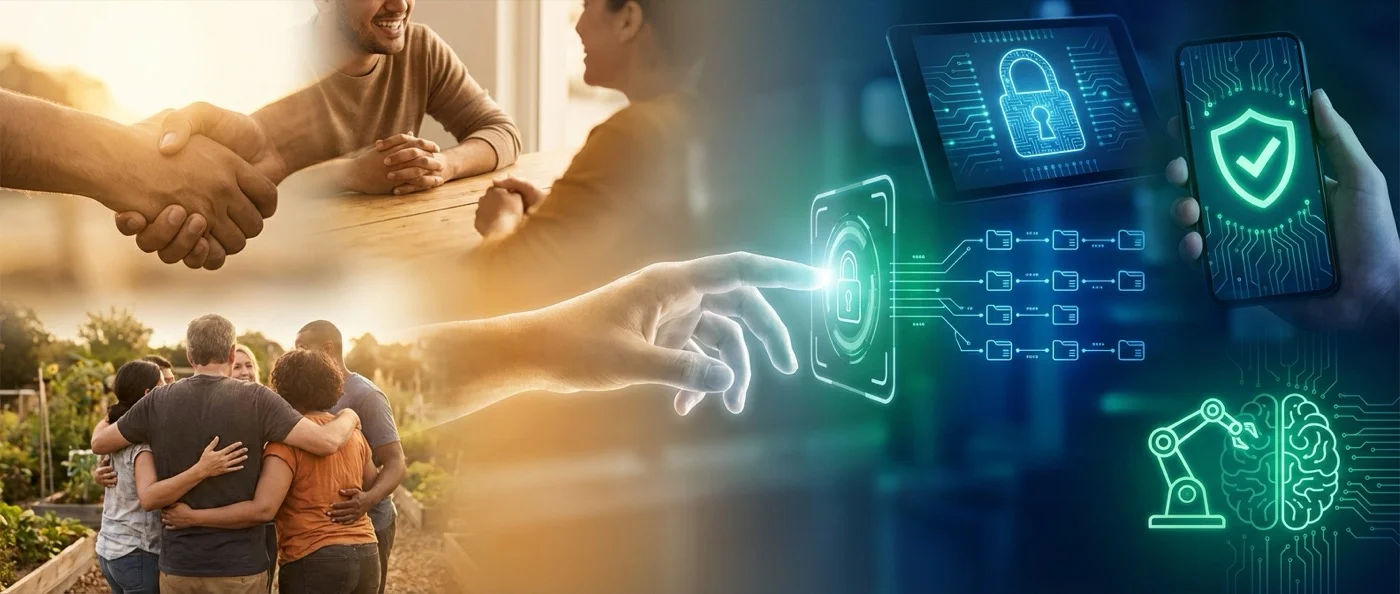
The history of trust reveals a steady trajectory: from people → religion → institutions → algorithms. Each step distances us from the original mechanism: eyes, voice, handshake. We gain scale — we lose depth. The question isn't whether we'll trust machines. We already do. The question is: who will trust us — and whether it will be deserved.