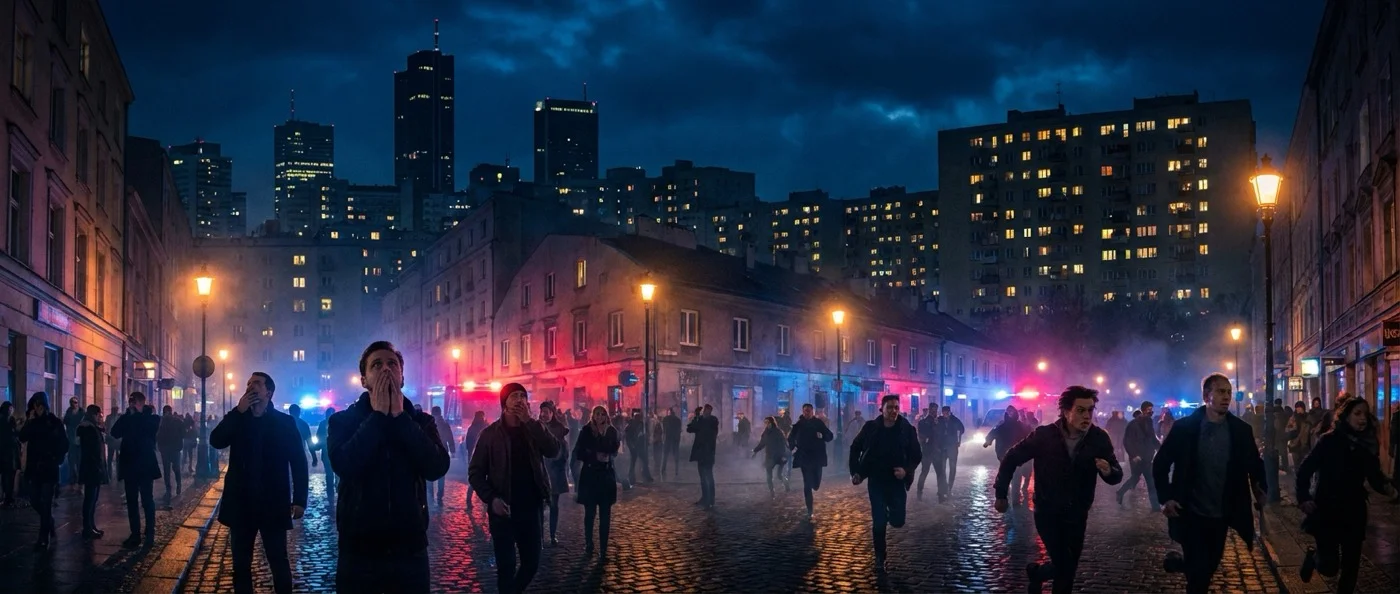
Listen to the article 'The Night an Entire City Stayed Awake for No Reason' as a podcast
~13 min listening
0:00 0:00
The Night Nobody Slept
From the insomnia that kills to the teenager who stayed awake for 11 days — What happens when sleep won't come
Prologue
The Last Night
There is something worse than pain, fire, or even death: the inability to sleep. Sleep isn't a luxury — it's the most fundamental function of the brain. Without it, the mind deteriorates, the body collapses, and reality dissolves.
This article isn't about one particular night in one particular city. It's about something far more terrifying: true stories of people who could never sleep again — and died because of it. Stories of volunteers who refused sleep just to see what would happen. And the frightening truth that the modern world is gradually building a society that refuses to sleep.
Let's start with the teenager who decided to stay awake for 11 days — for a school project.
This article isn't about one particular night in one particular city. It's about something far more terrifying: true stories of people who could never sleep again — and died because of it. Stories of volunteers who refused sleep just to see what would happen. And the frightening truth that the modern world is gradually building a society that refuses to sleep.
Let's start with the teenager who decided to stay awake for 11 days — for a school project.
— i —
❧ ❧ ❧
Chapter One
264 Hours Without Sleep
In December 1963, in San Diego, California, 17-year-old Randy Gardner decided to do something no one had dared before: stay awake as long as possible, for a project at his school's science fair. Two friends, Bruce McAllister and Joe Marciano, would monitor him.
But it didn't just end up at the school fair. William Dement, a sleep researcher at Stanford, heard about the experiment and flew to San Diego to observe it. What he saw was shocking.
For the first two days, Randy was relatively fine — tired, but functional. On the third day, his mood changed: he became irritable and couldn't concentrate. On the fourth, hallucinations began — he thought a street sign was a person. By the sixth day, his speech was slow and incoherent. By the ninth, he couldn't finish a sentence.
But it didn't just end up at the school fair. William Dement, a sleep researcher at Stanford, heard about the experiment and flew to San Diego to observe it. What he saw was shocking.
For the first two days, Randy was relatively fine — tired, but functional. On the third day, his mood changed: he became irritable and couldn't concentrate. On the fourth, hallucinations began — he thought a street sign was a person. By the sixth day, his speech was slow and incoherent. By the ninth, he couldn't finish a sentence.
⏰ The record: Randy Gardner stayed awake for 264 hours and 25 minutes — 11 days. Afterward, he slept for 14 hours and 40 minutes and woke up spontaneously, seemingly recovered. But decades later, Gardner himself stated that he suffered from severe insomnia for the rest of his life.
— 1 —
❧ ❧ ❧
Chapter Two
The Disease Without a Cure
While Randy Gardner chose not to sleep, there are people who have no such choice. Fatal Familial Insomnia (FFI) is a hereditary prion disease that literally kills people by robbing them of sleep.
The disease was discovered in 1986, based on the case of an Italian man known only as Silvano. In a rare moment of lucidity, Silvano asked for his decline to be documented and donated his brain to science, hoping that a cure would someday be found. The disease progresses through four stages:
Stage 1 (4 months): Sleep becomes increasingly difficult. Panic attacks, paranoia, phobias. Stage 2 (5 months): Hallucinations and panic become relentless. Stage 3 (3 months): Complete inability to sleep. Rapid weight loss. Stage 4 (6 months): Dementia. The person becomes unresponsive, mute, and dies.
The disease was discovered in 1986, based on the case of an Italian man known only as Silvano. In a rare moment of lucidity, Silvano asked for his decline to be documented and donated his brain to science, hoping that a cure would someday be found. The disease progresses through four stages:
Stage 1 (4 months): Sleep becomes increasingly difficult. Panic attacks, paranoia, phobias. Stage 2 (5 months): Hallucinations and panic become relentless. Stage 3 (3 months): Complete inability to sleep. Rapid weight loss. Stage 4 (6 months): Dementia. The person becomes unresponsive, mute, and dies.
"The patient is trapped in a state just before sleep — an eternal hypnagogia. He doesn't sleep, he doesn't wake. He's somewhere in between, forever."
— Description of FFI Stage 4, New England Journal of Medicine, 1986
— 2 —
❧ ❧ ❧
Chapter Three
The Families Who Fear Sleep
To this day, only about 70 families worldwide are known to carry the FFI gene: 8 German, 5 Italian, 4 American, 2 French, 2 Australian, 2 British, 1 Japanese, 1 Austrian, and 16 families in the Basque Country. Only 37 sporadic cases (without family history) have ever been recorded.
The mutation is located on the PRNP gene, on chromosome 20. It causes the accumulation of misfolded prion proteins in the thalamus — the part of the brain that regulates sleep. The thalamus gradually degenerates, and with it, the person's ability to sleep. Survival ranges from 7 months to 6 years, with an average of 18 months. There is no cure. Sleeping pills don't work — in fact, they may worsen the symptoms.
In 2001, a 52-year-old American with FFI tried everything: vitamins, meditation, stimulants, sedatives, complete sensory deprivation. He managed to extend his life nearly a year beyond the average. He wrote a book, drove hundreds of miles. Eventually, the disease won.
The mutation is located on the PRNP gene, on chromosome 20. It causes the accumulation of misfolded prion proteins in the thalamus — the part of the brain that regulates sleep. The thalamus gradually degenerates, and with it, the person's ability to sleep. Survival ranges from 7 months to 6 years, with an average of 18 months. There is no cure. Sleeping pills don't work — in fact, they may worsen the symptoms.
In 2001, a 52-year-old American with FFI tried everything: vitamins, meditation, stimulants, sedatives, complete sensory deprivation. He managed to extend his life nearly a year beyond the average. He wrote a book, drove hundreds of miles. Eventually, the disease won.
🧬 The carrier's anguish: FFI can be detected through genetic testing before symptoms appear. But if you learn you carry the gene, you know that someday — perhaps at 40, perhaps at 60 — sleep will begin to disappear. Sonia Vallabh, a researcher at the Broad Institute, learned she carried the gene after her mother died from FFI. Together with her husband Eric Minikel, they left their careers and devoted themselves to researching a cure.
— 3 —
❧ ❧ ❧
Chapter Four
What Happens to the Brain Without Sleep
Science understands quite well what happens when a person doesn't sleep. And it's not pretty.
24 hours: Reduced concentration, irritability, increased stress — equivalent to 0.10% blood alcohol content (above the legal limit). 48 hours: The brain begins experiencing “microsleeps” — 5-30 second sleep episodes the person doesn't even notice. Judgment becomes impaired. 72 hours: Severe cognitive dysfunction, hallucinations, paranoia. 96+ hours: “Sleep deprivation psychosis” — the brain begins to lose contact with reality.
Experiments on rodents showed that total sleep deprivation leads to death within 2-4 weeks. The rats developed skin lesions, lost their thermoregulation, and died of sepsis — as if their immune system had completely collapsed.
During sleep, the brain doesn't “rest” — it works intensively: clearing toxins through the glymphatic system, consolidating memories, repairing neurons. Without sleep, these processes stop and the brain literally begins to destroy itself.
24 hours: Reduced concentration, irritability, increased stress — equivalent to 0.10% blood alcohol content (above the legal limit). 48 hours: The brain begins experiencing “microsleeps” — 5-30 second sleep episodes the person doesn't even notice. Judgment becomes impaired. 72 hours: Severe cognitive dysfunction, hallucinations, paranoia. 96+ hours: “Sleep deprivation psychosis” — the brain begins to lose contact with reality.
Experiments on rodents showed that total sleep deprivation leads to death within 2-4 weeks. The rats developed skin lesions, lost their thermoregulation, and died of sepsis — as if their immune system had completely collapsed.
During sleep, the brain doesn't “rest” — it works intensively: clearing toxins through the glymphatic system, consolidating memories, repairing neurons. Without sleep, these processes stop and the brain literally begins to destroy itself.
— 4 —
❧ ❧ ❧
Chapter Five
The Nights Nobody Slept
While FFI is an individual tragedy, there have been moments in history when entire communities went sleepless — not from disease, but from fear.
In July and August of 1789, during the “Great Fear” (La Grande Peur) that followed the French Revolution, entire French towns and villages went sleepless for nights on end. Rumors of bandits and military raids spread like wildfire. Farmers formed self-defense groups, keeping watch at crossroads with pitchforks and axes. Night after night, insomnia fed panic, and panic fed insomnia.
During the London Blitz (1940–1941), millions of Londoners spent nights in shelters, tube stations, and basements, without real sleep. The continuous bombing lasted 57 consecutive nights. Psychologists of the era recorded a paradox: after the first few weeks, many developed a “numbness” — an inability to feel fear, but also an inability to sleep properly, even after the war.
And then there's the mysterious case of “The Hum” — a low-frequency sound that keeps residents awake in cities around the world. In Taos, New Mexico; Bristol, England; Windsor, Ontario — residents report a constant, low hum that's heard mainly at night. Not everyone can hear it. It can't always be located. And it keeps people awake for years.
In July and August of 1789, during the “Great Fear” (La Grande Peur) that followed the French Revolution, entire French towns and villages went sleepless for nights on end. Rumors of bandits and military raids spread like wildfire. Farmers formed self-defense groups, keeping watch at crossroads with pitchforks and axes. Night after night, insomnia fed panic, and panic fed insomnia.
During the London Blitz (1940–1941), millions of Londoners spent nights in shelters, tube stations, and basements, without real sleep. The continuous bombing lasted 57 consecutive nights. Psychologists of the era recorded a paradox: after the first few weeks, many developed a “numbness” — an inability to feel fear, but also an inability to sleep properly, even after the war.
And then there's the mysterious case of “The Hum” — a low-frequency sound that keeps residents awake in cities around the world. In Taos, New Mexico; Bristol, England; Windsor, Ontario — residents report a constant, low hum that's heard mainly at night. Not everyone can hear it. It can't always be located. And it keeps people awake for years.
— 5 —
❧ ❧ ❧
Chapter Six
Insomnia as Torture
Sleep deprivation isn't just an accident or a disease — it has been deliberately used as a method of torture, from ancient times to the present day.
The Soviet KGB employed sleep deprivation in “continuous interrogations” — interrogating prisoners in 24-hour shifts, never allowing them to sleep. Menachem Begin, the former Prime Minister of Israel, endured such treatment as a prisoner and described it: "In the mind of the tortured, a fog descends. The will to resist vanishes. He says whatever the interrogators want."
The CIA classified sleep deprivation as an “enhanced interrogation technique” — a euphemism for torture. The Geneva Convention doesn't explicitly name sleep deprivation, but the UN has designated it as a form of ill-treatment. Despite this, it's still being used.
The Soviet KGB employed sleep deprivation in “continuous interrogations” — interrogating prisoners in 24-hour shifts, never allowing them to sleep. Menachem Begin, the former Prime Minister of Israel, endured such treatment as a prisoner and described it: "In the mind of the tortured, a fog descends. The will to resist vanishes. He says whatever the interrogators want."
The CIA classified sleep deprivation as an “enhanced interrogation technique” — a euphemism for torture. The Geneva Convention doesn't explicitly name sleep deprivation, but the UN has designated it as a form of ill-treatment. Despite this, it's still being used.
"Nobody can withstand sleep deprivation. The brain begins to self-destruct. You don't need violence — you just need patience and a few cold air fans."
— State security psychologist report, declassified document
— 6 —
❧ ❧ ❧
Chapter Seven
The Modern Insomnia Epidemic
We don't need prions or torturers to keep us awake. We do it to ourselves, every night, voluntarily.
According to the World Health Organization, insomnia constitutes a “modern epidemic.” One-third of adults in Western countries sleep less than 7 hours a night — below the 7–9 hours the adult brain requires. Japan, with an average of 6 hours and 22 minutes, holds the lowest average sleep time worldwide.
Neuroscientist Matthew Walker, author of “Why We Sleep,” warns: "We are the first generation in history to sleep less than every previous one. And the consequences — cancer, Alzheimer's, obesity, depression, cardiovascular disease — are already becoming visible."
The artificial glow of screens (blue light) suppresses melatonin. Constant scrolling activates the dopamine cycle. Notifications invade the night. Gradually, entire societies are becoming what FFI does on an individual level — staying awake, against their will.
According to the World Health Organization, insomnia constitutes a “modern epidemic.” One-third of adults in Western countries sleep less than 7 hours a night — below the 7–9 hours the adult brain requires. Japan, with an average of 6 hours and 22 minutes, holds the lowest average sleep time worldwide.
Neuroscientist Matthew Walker, author of “Why We Sleep,” warns: "We are the first generation in history to sleep less than every previous one. And the consequences — cancer, Alzheimer's, obesity, depression, cardiovascular disease — are already becoming visible."
The artificial glow of screens (blue light) suppresses melatonin. Constant scrolling activates the dopamine cycle. Notifications invade the night. Gradually, entire societies are becoming what FFI does on an individual level — staying awake, against their will.
— 7 —
❧ ❧ ❧
Epilogue
The Right to Darkness
Sleep is not a waste of time, no matter how much modern culture tries to convince us otherwise. It is the most important function our brain performs. Without it, everything collapses — slowly at first, and then all at once.
In 1964, Randy Gardner wanted to prove that humans could defeat sleep. Instead, he proved that sleep always wins — even if it takes years to get its revenge. Silvano in Bologna died slowly, trapped in an eternal dawn that never led to darkness. The residents of Taos still hear the hum.
The night when an entire city stays awake isn't some future scenario. It's already happening. Every night, millions of people stare at ceilings or screens, unable to close their eyes. The difference is that now they don't tremble from fear — they tremble from FOMO.
Turn off your screens. Switch off the lights. Sleep is not a weakness. It's the only power that can keep you alive.
In 1964, Randy Gardner wanted to prove that humans could defeat sleep. Instead, he proved that sleep always wins — even if it takes years to get its revenge. Silvano in Bologna died slowly, trapped in an eternal dawn that never led to darkness. The residents of Taos still hear the hum.
The night when an entire city stays awake isn't some future scenario. It's already happening. Every night, millions of people stare at ceilings or screens, unable to close their eyes. The difference is that now they don't tremble from fear — they tremble from FOMO.
Turn off your screens. Switch off the lights. Sleep is not a weakness. It's the only power that can keep you alive.
— the end —
· · · · ·
📖 Read more: The Epidemic That Made People Laugh Until They Collapsed